
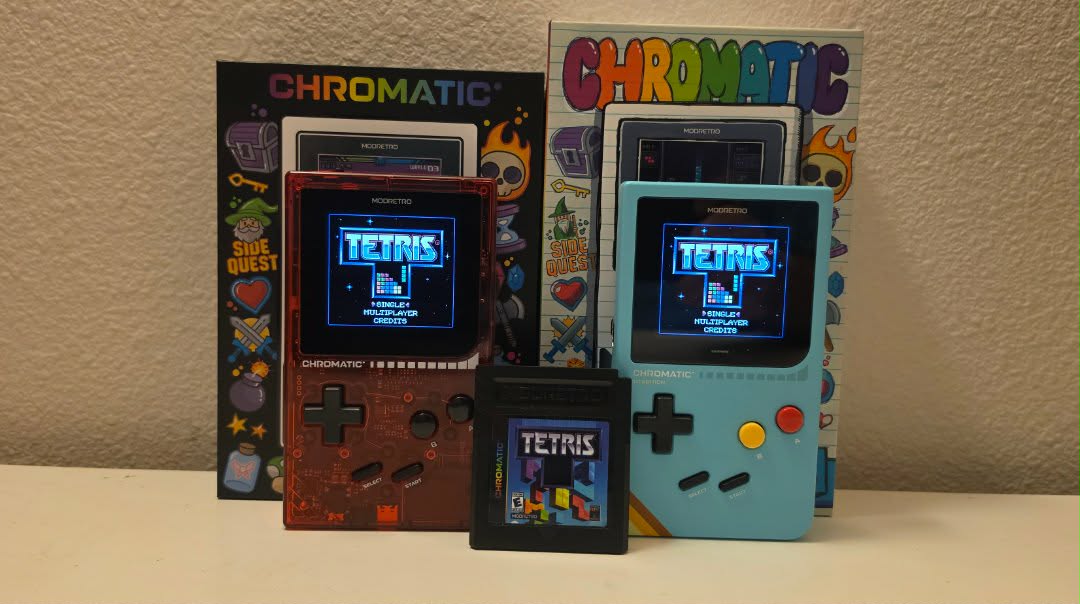
The original ModRetro Chromatic (2025 Model) isn’t just another cheap cash grab on 90s nostalgia. ModRetro created it as a forged in silicon love letter to retro purists who take 8-bit handheld gaming to heart. Instead of slapping laggy software emulation onto an off the shelf, crappy handheld, ModRetro built this metal-clad beast as the true, uncompromising heir to Nintendo’s legendary Game Boy and Game Boy Color legacy.
Crack open the casing, and you won’t find a generic mobile processor choked with Linux bloat or Android platform. At its core, the Chromatic runs on a custom-engineered FPGA (Field-Programmable Gate Array) that mimics vintage 8-bit Nintendo silicon down to the exact clock cycle.
That translates to zero translation layers, zero input lag, and zero OS menu fluff. Instead, you get 100% native execution on raw hardware logic. ModRetro even reinforced the cartridge bay with heavy-duty gold-plated pins, ensuring your vintage game collection can endure decades of continuous slams into the slot, though your games may take a beating.
The industrial design of this 2025 flagship is nothing short of incredible, featuring a ultra dense thixomolded magnesium alloy shell that feels both premium and perfectly mirrors the timeless vertical Game Boy Color profile. On the front, high grade PBT plastic buttons rest over custom conductive rubber pads, delivering a wonderfully tactile, springy snap every single time you roll the D-pad or mash the A and B buttons.

Rounding out the package is an ideal blend of retro authenticity and modern utility. Across the top and sides, you’ll find a fully operational physical IR link sensor and a classic link cable port for true head-to-head showdowns. On the bottom sits a versatile USB-C port. The USB-C port serves as a way of providing power as well as the ability to stream lag-free direct video feeds straight to your Mac or PC. Also along the side you will find a loop for a charm or lanyard and on the bottom sits a clean, noise-free 3.5mm audio jack.

If it ran in 1998, it runs here flawless and region free. Out of the box, the Chromatic plays original Game Boy (DMG) and Game Boy Color (GBC) cartridges natively. Whether you’re sliding in an American copy of Tetris, a rare Japanese import, or a European release, you can play them all without touching a software patch or dumping a ROM.
Beyond vintage media, the Chromatic serves as the flagship platform for ModRetro’s own lineup of brand new Chromatic cartridges. Developed in tandem with modern retro creators and indie studios, these physical releases aren’t just bare chips, they ship complete with authentic cardboard boxes, plastic shells, and glossy printed manuals that recapture that magical late 90s unboxing experience.
MicroSD slots, sideloading menus, and digital downloads are nowhere to be found here. The platform is completely devoted to physical media. The hardware interacts directly with on cart save chips, EEPROMs, and batteries, guaranteeing your decades old Pokémon saves boot up as effortlessly as they did on day one, provided you still have a good battery.

Firing up the 2025 Chromatic is pure magic in an era bloated by boot logos and firmware updates. You snap in a cart, flip the top power switch, and you’re instantly playing in seconds. No loading screens, no user accounts, no Wi-Fi prompts, just instant, frictionless fun the moment power hits the circuit.
Because everything is calculated on the FPGA silicon level, input latency is imperceptible. You aren’t fighting an emulator’s input buffer; your button presses execute in sub millisecond real time. Tight platforming jumps and split second puzzle moves feel sharp, direct, and incredibly satisfying.

When it’s time to settle a rival match, multiplayer works the classic way: with wires. Unfurl an actual, physical link cable, hook it up to a friend’s Chromatic or original Game Boy Color, and you’re trading creatures or going head-to-head without a single dropped packet, Bluetooth headache, or sync failure.
One thing I do want to mention is that ModRetro and devs behind the games ModRetro puts out, do release updated versions of the handhelds firmware and games do get updates as well.
For the firmware and game updates for carts, these can be done using a computer and ModRetros proprietary application. Though this is a great thing being offered, none is required to just play and enjoy this handheld and the games made for it.

The centerpiece of the entire unit is its custom 2.56-inch IPS backlit LCD display. Rather than using a dense smartphone panel that blurs or stretches classic sprites, ModRetro built a screen with a true native 160×144 resolution. It maps pixels to original Game Boy software at an exact 1:1 ratio, preserving the intended geometry and pixel structure of vintage pixel graphics of the era.
Protected by a sheet of scratch-resistant Gorilla Glass (or ultra-luxurious Sapphire Crystal on the 1st editions), the display punches out rich colors and crisp backlighting while keeping the iconic 8-bit pixel grid completely intact. The natural layout organically mimics vintage LCD gaps, giving you a warm, authentic image without relying on artificial software CRT filters.
Performance is also rock solid. This is because the FPGA core runs in perfect sync with original CPU and GPU timing. Heavy sprite loads, fast horizontal scrolling, and rapid screen transitions render smoothly with zero screen tearing or stutter. It’s rather impressive when actually being played and compared to original hardware.

Chiptune aficionados are in for a treat with the Chromatic. Powered by a punchy, custom ultra loud internal speaker, the handheld blasts rich, almost room filling sound without distorting or turning tinny at max volume.
Because the FPGA hardware recreates original Game Boy audio channels down to the wave generators and noise circuits, iconic soundtracks play back with absolute precision. Low-end bass hits with a satisfying thump, while crisp 8-bit sound effects punch through cleanly without the harsh, piercing static common on software emulators.
For late-night sessions or that long commute, the bottom 3.5mm headphone jack provides a whisper-quiet noise floor. Plug in your favorite headphones and enjoy pristine, buzz-free stereo sound without any annoying background hiss or ground loop static.
The 2026 Model Revision & Pricing Differences
While the original 2025 flagship launched as a premium, metal-clad collector’s item priced at $199.99 (reaching up to $299 for the Sapphire Glass variant), ModRetro expanded the family with the 2026 Chromatic Transparent Edition.

This revised model swaps the dense magnesium alloy body for a high-grade transparent ABS plastic shell, delivering a translucent aesthetic in classic late-90s colors like Smoke, Purple, Red, and Green.
The most notable difference comes down to the price gap. By switching to transparent ABS plastic, ModRetro lowered the entry point to a far more accessible $149.99 for the 2026 release. This is a full $50 to $150 drop compared to the 2025 metal original.
Despite the reduced price and lighter build, the 2026 model makes zero compromises under the hood. It packs the exact same cycle-accurate FPGA core, identical pixel-matched 160×144 LCD screen, and tactile PBT buttons as the high-end 2025 original, offering a lighter, nostalgic option perfect for everyday carry.

The 2025 ModRetro Chromatic stands as a masterwork in dedicated retro hardware, proving that native silicon beats software emulation every single day of the week. By focusing on the FPGA chip route and a bombproof (not tested) magnesium alloy shell, it really is the ultimate way to play Game Boy and Game Boy Color cartridges.
The introduction of the $149.99 transparent 2026 edition makes the entire Chromatic platform even more compelling. Whether you prefer the heavy, tank-like metal finish of the $199 original or the lighter, translucent retro charm of the 2026 edition, both models offer an uncompromised 8-bit journey.
If you’re ready to pull a box of childhood cartridges out of storage or dive into collecting brand new physical indie releases on native hardware, the Chromatic line stands tall as the definitive homage to handheld gaming history!

In addition to writing articles, Ryan Byers also creates content for his YouTube channel called "Obscure Games and Consoles", collects video games, and dabbles in video game development.