
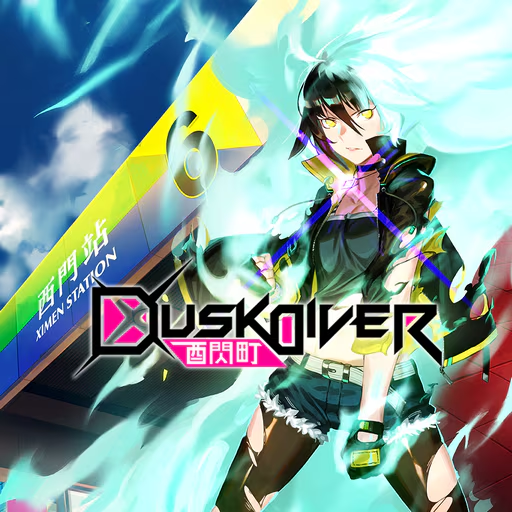
The narrative of Dusk Diver centers on Yang Yumo, an ordinary high school student whose life takes a drastic turn during a casual afternoon hanging out in Taipei’s bustling Ximending shopping district. An interdimensional rift opens up, pulling Yumo and her friend into Youshanding. Youshanding is a mirror dimension utopia inhabited by phantoms and dangerous entities known as Chaos Beasts.
To fix her unstable condition and protect her hometown, Yumo is forced into a labor contract at a local convenience store that secretly operates as a front for the interdimensional peacekeepers. Alongside a quirky trio of Kunlunian Guardians, Leo, the muscular enforcer; Bahet, the edgy bat god; and Le Viada, a glamorous blue-goldfish deity; Yumo must balance her mundane life as a student and retail worker with her dangerous new nighttime gig. While the plot itself follows a fairly predictable path reminiscent of modern urban fantasy games like Persona, the game thrives on its specific Taiwanese lore and localized flavor. This makes for an interesting and rather entertaining storyline.

At its core, the gameplay of Dusk Diver is a hybrid of hack-and-slash action and action RPG exploration. When dipping into the dimension of Youshanding, the game transitions into a linear beat-em-up where Yumo clears out waves of Chaos Beasts using button mashing combos.
These combos allow for light and heavy physical attacks that are rather satisfying and very responsive. A true highlight in this game however is the Guardian Summon system. By spending SP generated in a fight, you can instantly summon one of your three unlockable guardians to execute powerful assist attacks, break enemy shields, and extend your combo counters.

When you aren’t punching monsters into neon dust, the game forces you to retreat back to the real world to explore the shopping grid of Ximending. This hub world acts as your primary staging ground for character progression. You will spend your downtime visiting real-world food stalls and restaurants to eat authentic local delicacies. When consuming this food, you’re granted temporary stat bonuses and combat perks for the next mission. Additionally, wandering the streets allows you to chat with citizens, complete simple fetch quests, find hidden collectibles, and hang out with your guardians to level up your social bonds. This exploration aspect and bonding with your guardians directly unlocks new skills and lethal cooperative move sets.
However, as nice as this gameplay loop is, it is brought down by the lack of variety and mechanical execution. This is highlighted when it comes to the enemy roster; as it is surprisingly small. You will face the exact same “spongey” Chaos Beasts repainted in different color brackets for the vast majority of your journey. As a means to break up the repetitive combat, the game introduces platforming stages. These sections are universally frustrating, as the game’s rigid jumping physics, loose air control, and sluggish movement speed are poorly suited for precise platforming, frequently resulting in cheap deaths by falling into pits.

Visually, Dusk Diver makes wonderful use of cell shaded anime aesthetics to establish a vibrant world. The character models are a massive highlight, boasting expressive facial animations during cutscenes and incredibly distinct, stylish outfits. The visual identity shines brightest during combat, where every punch, kick, and ultimate Guardian attack triggers an explosion of neon pink, electric blue, and sparkling gold visual effects. It is a wonderfully colorful spectacle that successfully captures the flashy kinetic energy of modern anime battle sequences.
The environmental design serves as a fascinating double-edged sword. On one hand, the real-world hub of Ximending is modeled accurately after the actual Taiwanese shopping district, featuring realistic building facades, authentic storefront signs, and crowded walking streets that give it a unique sense of place. On the other hand, the combat zones of Youshanding feel remarkably uninspired by comparison. These interdimensional arenas are largely made up of floating, abstract geometric platforms surrounded by generic static voids, which quickly lose their visual luster after the first few chapters.
When examining the game closely, background NPCs walking the streets of Taipei are often rendered as faceless, single-colored silhouettes until you stand directly next to them. This glaring graphical choice can really hurt the overall immersion of a bustling city center. The environmental textures on roadside objects and vending machines can also look quite blurry up close. Despite these minor graphical issues, the game’s strong art direction effectively makes these issues and manages to deliver an eye catching experience overall.

Performance wise, Dusk Diver offers a generally stable experience. For the most part, the game targets and maintains a solid frame rate during exploration and minor combat encounters. Yumo’s swift movement animations and rapid martial arts combos feel snappy and highly responsive to controller inputs. However, performance issues arise when action on screen gets chaotic. When the screen fills up with dozens of Chaos Beasts simultaneously and you unleash a flashy, screen clearing ultimate attack alongside your guardian, the engine experiences brief, noticeable frame rate drops. While this isn’t as much of an issue on the Playstation 5 as it is on the Playstation 4, it is still something that can happen on occasion. Though it is very infrequent, it’s still worth mentioning.

The audio landscape of Dusk Diver is anchored by a stellar soundtrack that perfectly differentiates the game’s two contrasting realities. While strolling through the sunny, civilian streets of Ximending, the music treats you to an incredibly catchy pop infused background track that complements the casual shopping district aesthetic. The moment you step through a portal into Youshanding, the score pivots sharply into a hard rock track with electronic synth tracks that get your blood pumping and add excellent rhythmic momentum to the frantic combat.
An impressive aspect to the game is its excellent dual audio voice acting presentation. Players have the option to choose between high profile Japanese voice talent (featuring renowned actors like Rina Sato voicing Yumo) or the original, authentic Mandarin Chinese voice track. Both casts deliver highly animated, professional performances that give the characters distinct personalities, transforming what could have been generic anime archetypes. Instead what you get is incredibly endearing companions and awesome voice work. The expressive audio performances go a long way in making up for the stiff text translations in the text boxes. While I appreciate the subtitle dialogue, it really kinda drags down the experience a bit.

Ultimately, Dusk Diver stands out as a highly commendable, charismatic hidden gem in the action RPG landscape.You get satisfying combat with a beautifully realized, authentic slice of Taiwanese culture; and it really is a wonderful package. While it wasn’t created using a massive budget of millions, it’s still a game that is very much memorable for what it brings to the table.
Though some elements of the game are a bit repetitive, there really aren’t any RPG games that don’t have some repetitive aspects to them. This game is one of those Indies that really feels like it holds its own against bigger AAA games in its’ same genre. If you’re looking for a solid RPG experience that has a lot going for it even on a small budget, I would definitely recommend playing Dusk Diver.
Disclaimer: A review key was provided

In addition to writing articles, Ryan Byers also creates content for his YouTube channel called "Obscure Games and Consoles", collects video games, and dabbles in video game development.