
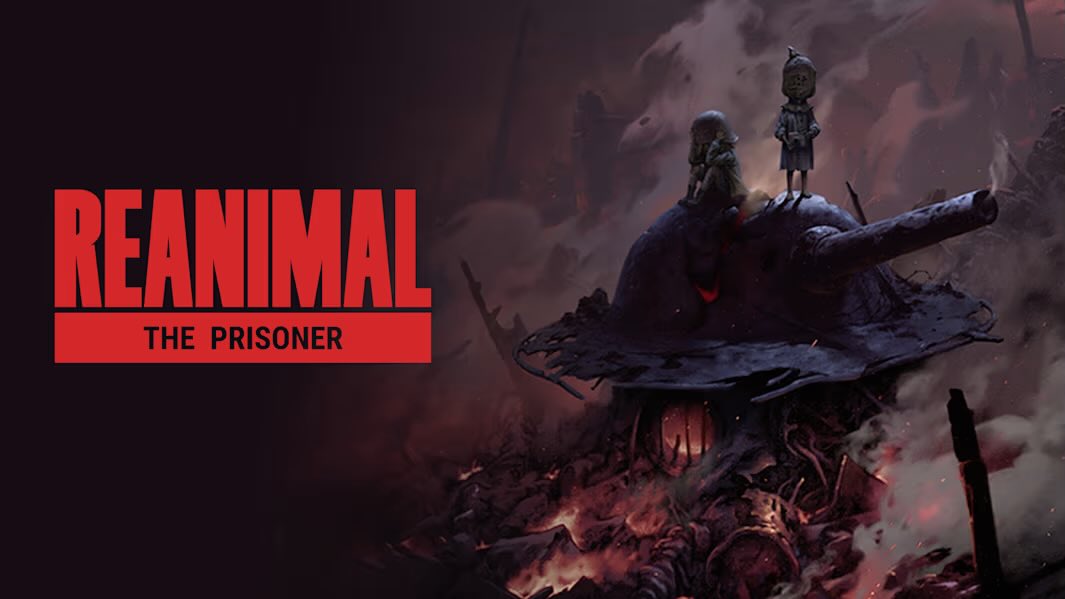
Tarsier Studios returns to its hallmark brand of silent, atmospheric horror in REANIMAL: The Prisoner, shifting focus away from the main game’s core duo to introduce two new protagonists; The Soldier and The Prisoner.
Stepping into a war torn urban landscape that feels both grotesque, and downright horrifying. Without relying on spoken dialogue, the expansion relies on environmental storytelling, subtle character animation, and visual symbolism to depict the fragile bond forming between two broken souls struggling to escape a ruined world.
This side of the story in Reanimate functions as the opening chapter of a planned three chapter trilogy, delving into the darker, military tainted fringes of the REANIMAL universe.
The backdrop of bombed out buildings, barbed wire barricades, and desolate alleyways establishes an eerie sense of historical tragedy mixed with surreal body horror. As The Prisoner and The Soldier make their perilous trek across the city, their personal histories are slowly revealed through background details, abandoned belongings, and terrifying encounters with monstrosities spawned from war.
What makes this story compelling is its thematic focus on desperate companionship amidst relentless dread. The central threat in this chapter is a looming, menacing Flamethrower Soldier. This huge flame wielding soldier acts as a manifestation of destruction that hunts the duo across every district. While the story is short and focused, it succeeds in deepening the lore of REANIMAL while leaving enough intriguing threads dangling to set up the remaining chapters of the future planned DLC.

In terms of the mechanics, nothing has changed here from the base game. Though this DLC does add something new to the mix, in the form of asymmetric mechanics. These mechanics between The Prisoner and The Soldier add fresh flavor to puzzle solving, with each character utilizing their unique physical attributes and items to help the other navigate tight spaces or reach higher ledges.
Stealth and chase encounters dominate the core gameplay loop, highlighted by intense cat-and-mouse sequences with the Flamethrower Soldier. It seems like this time around it’s more focused on this aspect here than in the base game. The inclusion of fire mechanics adds an extra layer of environmental hazards, as igniting materials can both block your path or create distraction opportunities to slip past roaming threats.
While the length of the DLC isn’t that long at around 3 hours or so to complete, the pacing remains tight from start to finish. The environmental puzzles are intuitive yet satisfying, favoring momentum and tension over a lock and key design.

Visually, REANIMAL: The Prisoner stands out as a showcase of Tarsier Studios’ mastery over simulated realism and dark art direction. The war torn city is crafted with meticulous texture detail, from crumbling brickwork and rusted metal debris to the ominous, flickering glow of open flames casting long shadows across drenched cobblestones. The contrast between deep, suffocating dark tones and brilliant fire effects elevates every scene into a cinematic nightmare.
Character and creature design remain a highlight by seamlessly blending childhood vulnerability with horrifying grotesque monstrosities. The Flamethrower Soldier is a terrifying presence, complete with heavy industrial armor, a glowing furnace chest, and fiery jets that illuminate the surrounding smoke and fog.
Dynamic lighting filters through broken glass and thick smoke to guide the player’s eye naturally across the environment without needing artificial HUD elements. Every screen space feels intentionally staged, making the expansion visually engrossing from every camera angle.

Reanimate: The Prisoner performs just as well as its base game counterpart. Really nothing has changed here with the performance on Xbox Series X. Though it does have a few issues.
Technical bugs are remarkably sparse throughout the short campaign. Collision detection is accurate, companion AI operates reliably without getting stuck on pathfinding geometry during solo play, and online co-op connectivity remains stable with minimal latency. With all of this being said, there are some instances where characters will get stuck dropping down into lower areas which will cause a soft lock where the characters will die. This will result in a trial and error of sorts, or will force you to restart the game and hope it fixes itself.
The sound design in REANIMAL: The Prisoner is just as good here as its base game counterpart. Christian Vasselbring’s musical score balances sparse, haunting piano notes with oppressive industrial synth drones that swell precisely when danger approaches. The absence of spoken voice acting shifts all narrative weight onto the soundscape, allowing every creak, distant explosion, and heavy breath to carry emotional significance.
Positioning audio shines brightly on Xbox Series X, particularly when using spatial audio or surround sound headsets. Hearing the heavy, metallic boots of the Flamethrower Soldier echoing through adjacent corridors or the sudden hiss of pressurized gas before a jet of fire erupts creates a deeply visceral sense of awareness. Subtle environmental ambient effects such as distant sirens, rain pattering on ruined roofs, and crumbling masonry work to further immerse the player in a city under siege.

REANIMAL: The Prisoner is an amazing expansion that successfully broadens the scope of Tarsier Studios’ nightmarish universe. By introducing compelling new protagonists and a terrifying antagonist, it delivers a standalone narrative that feels both self contained and vital to the overall lore. Its tight pacing, memorable set pieces, and environmental storytelling make it a must play for fans of atmospheric horror.
While its brief runtime leaves you yearning for more, The Prisoner sets a high bar for the remaining entries in this DLC trilogy. It reinforces Tarsier Studios’ status as masters of cinematic co-op horror, proving that even in a world filled with hopeless dread, a small spark of human connection can captivate from start to finish.
While it does have its issues with performance, it’s not nearly as bad as the base game is. If you managed to get through the base game despite its issues, you owe it to yourself to pick and play The Prisoner DLC. This DLC pack is better than the base game in every way and it makes me hopeful for the next two DLC releases in the future.
I would highly recommend picking up both Reanimal and The Prisoner DLC or even the Season Pass if you like survival horror with a heavy emphasis on co-op gameplay.
Disclaimer: A review key was provided

In addition to writing articles, Ryan Byers also creates content for his YouTube channel called "Obscure Games and Consoles", collects video games, and dabbles in video game development.