
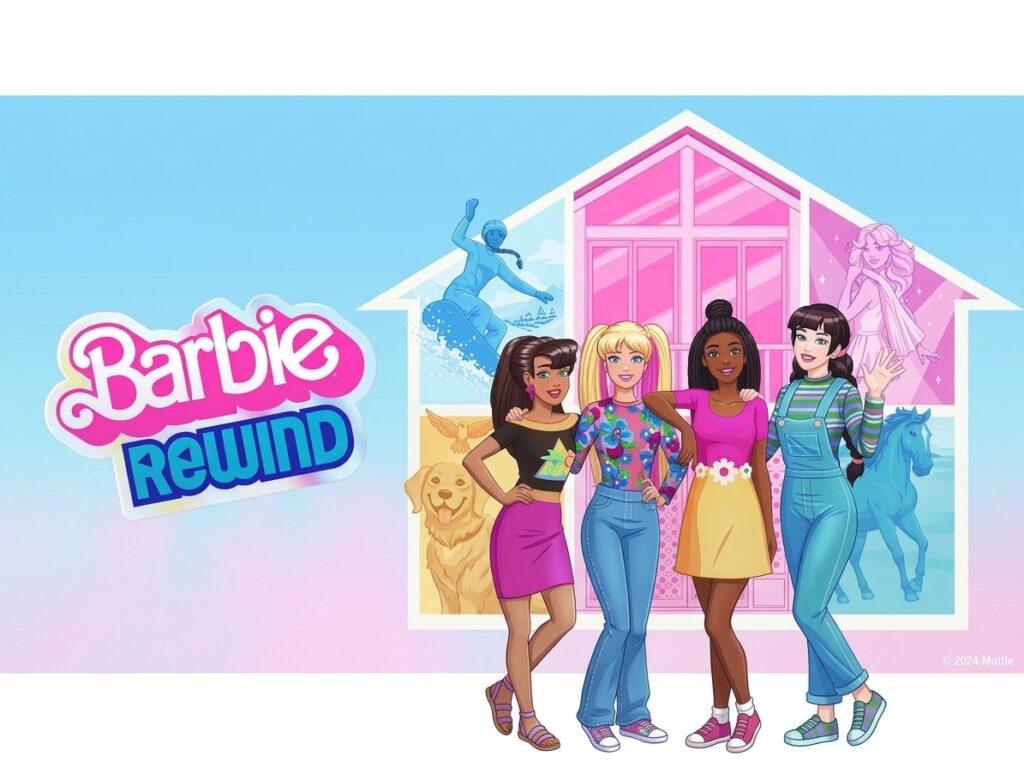
Leave it to Digital Eclipse and Atari to skip the boring, sterile main menu and hand us an absolute gem of a retro compilation. Barbie Rewind wraps sixteen classic games from 1991 through 2007 inside a fully customizable 3D DreamHouse hub. Barbie herself checks in to give you quests and hand over interior design loot, so every time you conquer a level or beat a game, you’re earning real-deal vintage furniture, funky wallpapers, and classic accessories straight out of Barbie’s toy line history to spruce up the place.
The narrative scope across this collection is a wild tour through sixteen years of handheld and console gaming. You get to jump into 8-bit and 16-bit adventures like Barbie on the NES (saving the Mermaid Kingdom inside her own dreams), Barbie: Game Girl on Game Boy (a desperate scramble to find a date outfit for Ken), Barbie: Super Model on Genesis/SNES, and even the unreleased Barbie: Vacation Adventure. Jump forward to the Game Boy Advance era, and you’re tackling undercover jewel-heist espionage in Secret Agent Barbie: Royal Jewels Mission, high school whodunits in The Barbie Diaries, and full-on fantasy stories in 12 Dancing Princesses and Island Princess.
The rest of the anthology dips into every weird and wonderful career spin-off Barbie ever tackled. You get sports compilations like Barbie Super Sports and Gotta Have Games on PS1, deep-sea exploration in Ocean Discovery, animal rescue missions in Pet Rescue, nautical sleuthing in Detective Barbie: The Mystery Cruise, and equestrian racing in Barbie Horse Adventures. Wrapped up with an interactive digital lookbook tracking real-world doll history, the whole package feels like a hilarious, affectionate love letter to pop-culture history.

Mechanically, Barbie Rewind is a massive, varied museum of retro game design. In the older 8-bit and 16-bit entries, you’re dealing with classic side-scrolling platforming, tossing charms at enemies, timing jumps, and dodging obstacles. Super Model throws in memory-based fashion minigames and rhythm sequences, while Vacation Adventure breaks things up with arcade-style volleyball and horseback riding.
Once you hit the Game Boy Color, Game Boy Advance, and PlayStation 1 era titles, the gameplay opens up a bit. Detective Barbie and The Barbie Diaries play out like point-and-click investigative mystery games, while Secret Agent Barbie actually hands you stealth gadgets to sneak past guards. Throw in animal care, obstacle courses, and movie-tie-in action platformers, and there’s a surprisingly deep variety of mechanics to mess around with.
Digital Eclipse did what they do best and added top-tier quality-of-life upgrades across the board. Every single game in the 16-title lineup gets instant save states, remappable controls, and a rewind button to save you from brutal retro difficulty spikes. Best of all, making progress in these games feeds directly into the DreamHouse progression system, unlocking over 250 pieces of furniture to deck out your hub.

The emulation engine handles every visual style flawlessly, preserving pixel ratios while offering CRT scanline filters and custom artwork borders. Sprites from 8-bit and 16-bit games scale up crisp and clear without any gross blur or screen tearing, while early low-poly 3D PlayStation titles like Detective Barbie stay crisp and stable on modern displays without breaking a sweat.
Performance stays locked at target frame rates across all sixteen titles, totally eliminating the lag and screen flicker that used to plague some of these old handheld cartridges. Whether you want a clean, razor-sharp digital view or an old-school CRT tv overlay, the visual options give you total freedom to play these games exactly how you want. While these games perform really well, remember that these are rather old titles. They aren’t going to have the graphics of today’s games and they are pixelated for sure. But these games are given graphical upgrades when and where they can.

The sound presentation does a fantastic job showcasing how video game audio evolved across two decades. The DreamHouse hub plays chill, lounge-style background tracks that make hanging out, checking the historical look book, and placing furniture super relaxing.
Inside the emulated games, the collection accurately reproduces the sound chips of each original machine. You get the harsh chiptunes of the NES and Game Boy, the dynamic FM synth audio of the Sega Genesis, and the compressed voice clips and redbook CD audio of the PS1 titles. Jump noises, charm throws, horse hooves, and item chimes play back rather nicely without any audio distortion or clipping.
Digital Eclipse included full volume controls in the system menu, so you can tweak background music and sound effect levels independently for each title. The audio mix keeps the fun 90s nostalgia front and center while making sure everything sounds great through modern speakers or soundbars.

Barbie Rewind is an outstanding retro preservation project that treats its source material with genuine respect, polish, and love. By combining sixteen classic games across multiple hardware generations with a cozy, interactive DreamHouse decorator and a massive toy archive, Atari and Digital Eclipse built something that works for hardcore retro preservationists and lifelong Barbie fans alike.
Adding modern features like rewind buttons, save states, retro borders, and native 4K hub visuals makes these games infinitely more fun to play today than hunting down expensive (hard to find in some cases) original games and legacy hardware.
At the end of the day, Barbie Rewind continues to set a phenomenal benchmark for how retro compilations should be handled. Whether you’re revisiting childhood handheld favorites or checking out unreleased curiosities like Barbie: Vacation Adventure for the first time, this anthology is a colorful, charming, and undeniably fun piece of gaming history.
Disclaimer: A review key was provided

In addition to writing articles, Ryan Byers also creates content for his YouTube channel called "Obscure Games and Consoles", collects video games, and dabbles in video game development.