

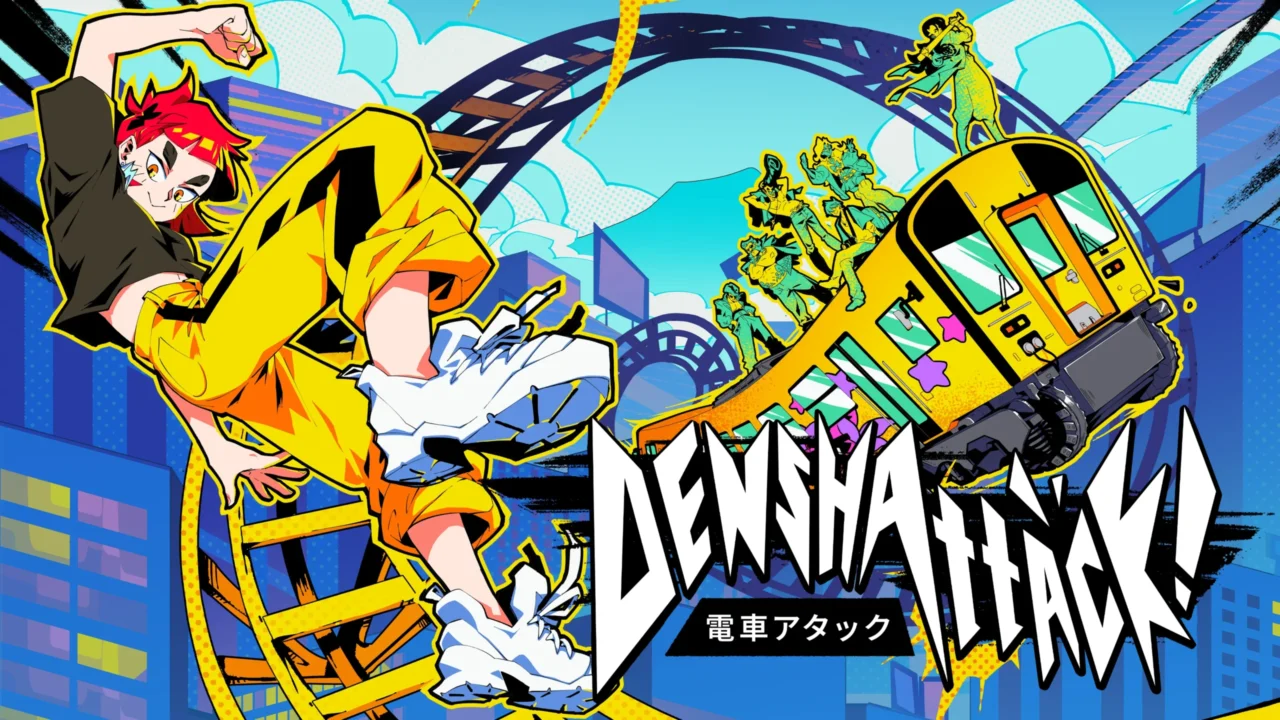
Denshattack is a stellar new indie game from developer Undercoders and publisher Fireshine Games that blends the action of a skateboarding game with anime train magic. It released on July 15, 2026 for Nintendo Switch 2, Xbox Series, PlayStation 5, and PC, and this review was played on Switch 2. It’s a brand new game from a new developer that deserves all the recognition, and hopefully a sequel at some point.
Emi Araki is a ramen delivery girl who drives a train through the wilds of Japan. The cities are all domed after trouble in the world, and it’s up to Emi to fight the bosses of those cities and become the best of the conductors. She loves driving trains, but after meeting a photographer she vows to be the very best. She’s the kind of girl who won’t back down easily, and she’s eager to learn all she can from anyone willing to teach her. She’s in for a long haul as she discovers the world of train battling, or Denshattack, a portmanteau of the Japanese word densha and the word attack.

The game is easy to learn but difficult to master. Players press a button and are on their way. They can jump over to other tracks, do tricks, and hit targets. The pace is fast, and most levels are short, though how long they last depends on the goal. Some levels are basic, and it’s enough to simply reach the end. Others have multiple objectives, which makes them more interesting. Then there are levels with no time limit at all, where players work toward goals like collecting items or knocking enemies away, and the level only ends when the player brakes. These are perfect for practicing.
Replaying levels is where the game really hooks you. It’s fun to grind for the best score, and the sign at the end of each level adds another layer, since players can break it for extra points. Watching the score climb with each run is great too, because there are medals to earn. Tricks matter here as well, since chaining them can raise the score immensely. There are plenty of places to pull off tricks in the air, but players can also jump wherever they please depending on where they are on the track.

After learning the tricks, the player battles groups led by conductors. In a way, these conductors are like the gym leaders in Pokémon, since each of them rules over a single place. They’re all different and have their own ways of doing things. They’re built on simple, easily defined archetypes, but it works. There’s a gyaru, a yakuza, and even a schoolgirl, to name a few. Each of them possesses immense strength and power, but Emi will do whatever it takes to take them down. The boss fights are just as varied. The first takes place against a gyaru, and defeating her cronies unlocks the final part of the battle. No spoilers, but this first boss fight is one of the best.
Players can also follow a substory of sorts. Fernando is a photographer who wants to be known nationwide. If Emi collects film on the track, he’ll take a shot, and those shots end up in a regional magazine. It’s cool to see the player’s accomplishments mapped out in an in-game publication, where Fernando documents the characters Emi meets and the craziness she runs into on her adventures. It might be a small touch, but it highlights the world in a way that works really well.
Players can also upgrade their train or swap to a different one entirely, with each train providing different buffs. Seeing which ones work best for which missions is half the fun. There’s quite a bit of customization too. Players can change the color of their train and add stickers, and it’s fun to collect them all. It’s purely aesthetic, but it lets players make the trains their own. Even the announcer is customizable. Players can keep the original voice or use codes to unlock others, like Ironmouse, who comes with her own stickers to unlock. It’s a small extra, but one worth appreciating.

The game has an amazing style, and everything is punchy. The gameplay is addictive and frenetic, so it’s easy to keep going without getting tired. It stands apart from other skateboarding-style games because there’s real force behind the vehicle the player controls. The art is great, and like most anime, the characters show a lot of spirit. There are voiced cutscenes, and the characters are just as important as their trains. It’s great to see them shine, and by the time the credits roll, they’ll matter to the player. The music is stellar too, with tracks from the likes of Shoji Meguro of Persona fame, Richard Jacques of Jet Set Radio fame, and even Alice Peralta, the voice of Marina from Splatoon. Each area has its own vibe, and the soundtrack is always changing. It’s thrilling to listen to, and it’s no surprise it varies so much with so many different musicians involved.
That said, Denshattack might not be for everyone. The pace is addictive, but it can also be a lot. It could be too frenetic for younger kids and for players who struggle with fast, twitchy controls. Still, it’s a game that gives as much as the player puts in.

Denshattack is a fantastic game that’s worth playing. It tells a fun story and has enjoyable gameplay. Even when a level gives the player trouble, the pull to jump back in and beat their score is what keeps it fun. It’s incredibly thrilling to see a new creator make such an amazing game. Emi has a lot of work to do to prove herself as the best, so will the player help her take Denshattack to glory?
Disclaimer: A review key was provided
