

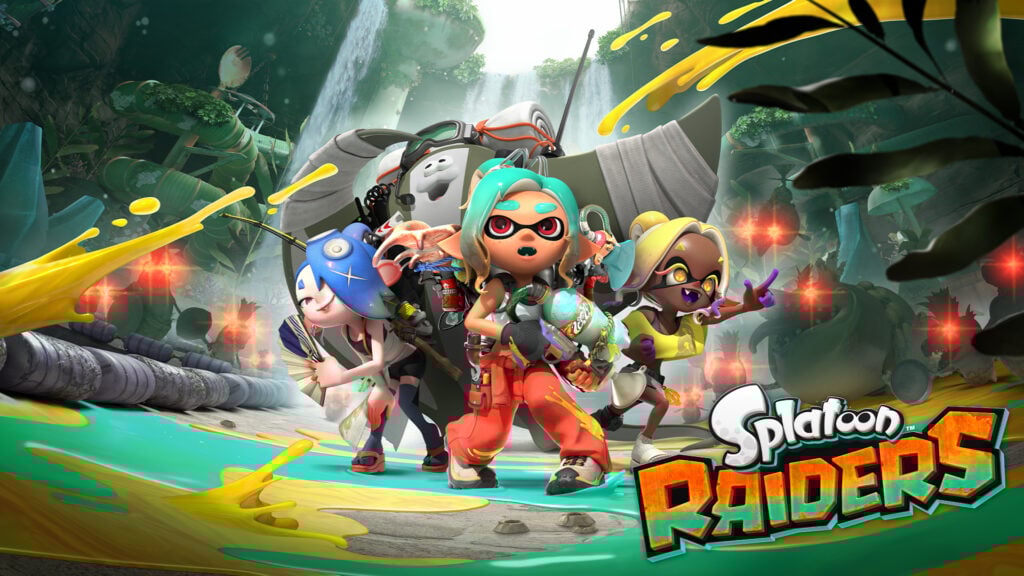
Splatoon Raiders is the newest entry in the Splatoon series, and this one takes on a different style, aiming to be a single-player Salmon Run. For the uninitiated, Salmon Run is a multiplayer mode in the main series where players team up to take down Salmonids and gather salmon eggs. Splatoon Raiders takes that idea and pumps it up to the max.
This is a looter shooter, and a fun one at that. Looter shooters are the kind of games that are playable forever if a player is having enough fun, and this one is no different. Players run through levels gathering weapons and materials to level themselves and their gear up, chasing that next upgrade the whole way.

The story revolves around the idols of Deep Cut from Splatoon 3, alongside a new character known as the mechanic. The mechanic is a brand-new character who’s mostly there to stand in for the player. Deep Cut, on the other hand, is well known to any Splatoon fan. Shiver is the leader of the group and is part shark. Frye is an Inkling with an Indian-inspired look who controls eels. Big Man is the most different of the three, as he’s a walking manta ray outright. This trio hosted the news broadcasts back in Splatoon 3, and now they’re on a treasure-hunting adventure of their own.
After a crash landing caused by a strange glow and fog in the distance, the group finds themselves stranded. The player quickly designs their hero, and the team gets to work crafting a base. This base is customizable through the collection of Spiralhite, and the Spiralhite islands, where the whole game takes place, quickly become the most important thing in the player’s life.

Players jump into their first level and immediately learn how to turn into a squid. The squid form provides more speed and healing, and using ink is as important here as it always is in the series. This game actually raises the stakes on that need, throwing waves of enemies at a single player who has to keep moving to survive.
Players can use all sorts of weapons pulled from Splatoon’s history, from rollers to shooters to dualies and sloshers. Each has its own strengths and weaknesses, but with no lives to worry about, players can keep playing forever as they craft their ultimate loadout.
The mechanic can be leveled up too. Using skill points, players can boost health, weapon damage, gadget damage, and gadget slots. It’s worth investing in all of these, since the game can get chaotic fast, with players suddenly swarmed at a moment’s notice.
The loadout is heavily customizable beyond that. Weapons level up for better stats, but gadgets require a little more finesse, since they have parts that can be slotted in to change a gadget from useless to necessary. The Splatchet, for instance, is a quick attack that doesn’t hit especially hard at first, but adding parts makes it quicker and lets it deal damage to airborne enemies. Splatelites, another gadget that surrounds the player with inky satellites, can also be improved by adding an inner circle, widening the main circle, or locking it in place.

It’s important to use these gadgets, since they can really help push back a swarm of Salmonids. They recharge after a set period, though that cooldown can be lowered through smart part selection, and it’s worth adjusting as the player progresses. Eventually, players can even upgrade parts to reduce the slots they need in the first place.
Players can also swap between tanks, which changes which gadgets are available to them. The Splatchet, for example, is only usable in the Power tank. The Speed tank unlocks the Blast Boot, and the Tactical tank gets the Shot Pot. Each style is leveled up by collecting salmon eggs, and maxing out all three is required to unlock the final tank and a special relic power. It’s impressive how effectively the game ties all of these systems together, and it makes for one of the cleanest, most satisfying progression loops in a while.
Shiver and Frye both pitch in at the base too. Shiver handles upgrading gadgets and their parts, while Frye takes care of dismantling and upgrading weapons. With so much gear to manage, the two of them stay busy. Frye can also use dismantled gadgets to buff weapons even further, letting players swap out weapon powers on the fly for another layer of near-limitless customization.

Being a single-player experience is key to what makes Splatoon Raiders work. Players are joined by a member of Deep Cut of their choosing, riding in a bot the player can hop off of at any time. That companion helps take out enemies without ever getting in the player’s way, and the player can call the bot over for a hand with platforming or treasure collecting.
Each Deep Cut member brings their own special ability to the fight. Shiver summons her shark, Mega, for a charge attack that wrecks everything in front of her. Frye can call down an eel rain to hit enemies caught within it. Big Man transforms into a larger version of himself that the player can ride and use to shoot enemies directly. All three also have friendship levels that grow the more the player uses their special attacks in levels, capping out at level three, and it’s well worth maxing all of them out to see what happens to their special attacks at the top end.
Levels task players with taking on different Salmonids while collecting Spiralhite to fuel their gear upgrades. The goal is always to dig into a giant Spiralhite crystal, which unlocks a treasure chest along with items used for further upgrades. Treasure chests provide a bit of lore along with a permanent buff, applied the moment the chest is opened, and many of these treasures combine with others to grow even more potent. Collecting treasure also increases the rate of Spiralhite collection, which matters, since players will need a nearly endless supply of it.

The permanent buffs players collect are equippable, up to five at a time, and they can change the game dramatically. Some adjust ink spray, some grant a double jump, and others add more damage the longer a player stays in the ink.
Three boss fights round out the main story, each paired with a specific Deep Cut member whose attacks come into play during the fight. These encounters add real weight to the world’s lore, and each one ends with the group performing a song that unlocks a piece of the final challenge.
Another style of level revolves purely around collecting Spiralhite. These levels never end unless the player dies or destroys the massive Spiralhite deposit at the center of the map, and the game tracks how long a player spends in each one, which makes for great grinding if a player is focused and nimble enough to keep at it.
Plenty of levels take place on the surface, but just as many happen underground. These tend to run three floors deep, with a time limit for each floor, ending in a soft boss fight against a super-powered version of one of the game’s bigger mid-bosses, who also show up in swarms in their regular forms and can do serious damage. These underground dungeons hand out a chest for each of the three tank styles, which makes them a great way to train players in every style of play and drives home just how important each tank actually is.

As the story progresses, players eventually reach an underground tower that demands they descend further than ever before, culminating in a ten-floor gauntlet unlike anything that came before it. Beating the final boss there opens up another fifty floors of mayhem, split into sets of three, each one an immense challenge in its own right. Players can keep leveling up past level fifty by tackling sampler dungeons found on the map, unlocked using compasses that reveal thirty different dungeons in total. Each one usually centers on a single gadget or weapon and rewards additional skill points that can only be earned this way.
Every level can also be played in Spicy or Super Spicy variants, with Super Spicy climbing as high as level 80 for an enormous challenge. A strong loadout goes a long way toward taming that difficulty, which makes all that earlier customization pay off. Clearing the full fifty-floor gauntlet doesn’t just provide hours of extra playtime, it also unlocks the game’s true ending, and it’s great to see Splatoon Raiders lock that ending behind a challenge worth earning.

There’s a multiplayer component here too. Players can call for help, and anyone can drop in to lend a hand to someone struggling, whether that’s through requesting help directly or jumping in on someone else’s level for extra rewards. The game can be played online or locally through nearly the entire experience, letting friends team up for the story, the bosses, and even the final challenge, which is a great touch for younger players who might find the game easier with a second person along for the ride. Multiplayer can be switched on or off with a single button, so it works just as well solo as it does with friends.
Players will also collect Briny Scrolls as they play, filling out the lore of the world and showing off what makes Splatoon so interesting in the first place. Big Man tracks everything gathered and rewards the player with more Spiralhite for the effort. The game even tracks how many of each enemy type a player has taken down, adding another layer of friendly competition for anyone comparing notes with friends.
The music isn’t bad, though it leans heavily ambient, with odd sound effects scattered through many of the tracks that might catch some players off guard. The main themes and battle music are a lot of fun, though, and the whole soundtrack invokes a wild, exploratory feel not unlike Breath of the Wild.

Players can dress their characters as they like, and collecting each outfit feels like unlocking a trophy. Different activities unlock different outfits, and so does scanning Splatoon amiibo. There’s no mixing and matching pieces, so players should aim to find a full look that fits them.
There’s no voice acting, but that’s just fine. The squid-talk sound effects work perfectly well, and the characters emote wonderfully through animation alone. There’s plenty of dialogue, and the game explains itself clearly throughout. Honestly, hearing human voices here would feel out of place without a lore reason behind it.

Splatoon Raiders is a fantastic looter shooter that offers near-infinite playtime and a ton of customization. The story is simple enough for anyone to jump in, while the systems underneath run deep enough to keep dedicated players hooked for a long time. Deep Cut and the mechanic are out for treasure and need help getting home. Will you answer the call and help them find their way?
Disclaimer: A review key was provided
