

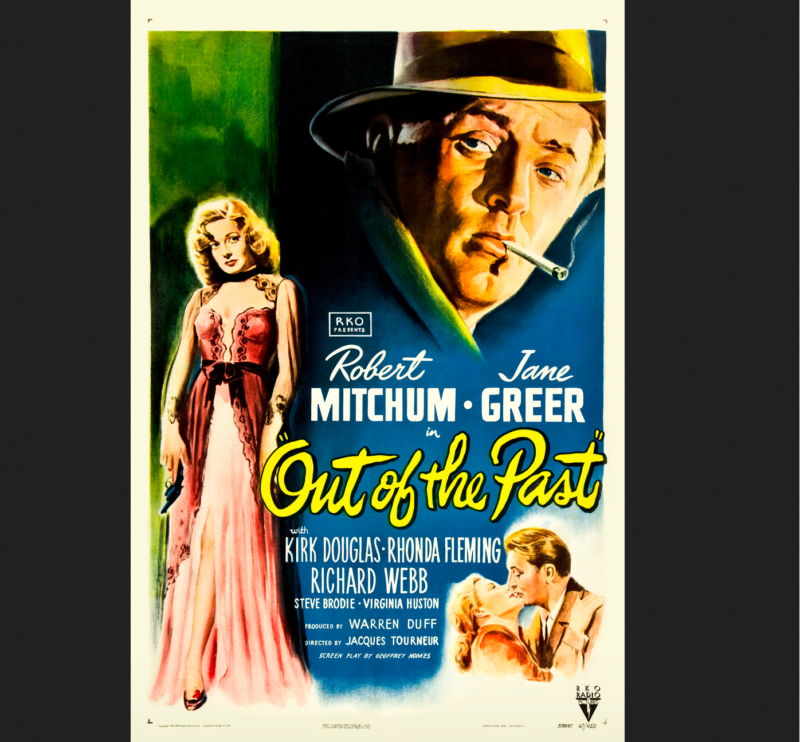
There is something particularly cruel about a man who believes he has finally escaped his past, only to discover that everything he has done to leave it behind has brought him closer to the same fate. Such is the predicament facing Jeff Bailey in Out of the Past, Jacques Tourneur’s 1947 film noir starring Robert Mitchum, Jane Greer, and Kirk Douglas. What initially appears to be a relatively simple story about a former private detective being dragged back into a dangerous criminal arrangement gradually becomes something much more complicated, examining obsession, deception, and the consequences of decisions that cannot be undone.
Jeff Bailey (Robert Mitchum) has seemingly found a comfortable existence in a small California town, operating a gas station and spending his time with Ann Miller (Virginia Huston), a woman who knows little about his previous life. His peaceful routine is interrupted when a figure from that life arrives with a message from Whit Sterling (Kirk Douglas), a wealthy gambler who has unfinished business with him. Before long, Jeff is forced to confront the circumstances that brought him into Sterling’s orbit in the first place, including his involvement with Kathie Moffat (Jane Greer), a woman whose disappearance and subsequent actions left considerable damage in their wake.
What makes Out of the Past particularly effective is how it establishes Jeff as someone who has already lost control of his circumstances before the main story has properly begun. His attempt to build a new life is understandable, but there is an underlying dishonesty to it. He has not necessarily made peace with his past or accepted responsibility for what happened. Instead, he has simply moved somewhere else and hoped that the people and decisions he left behind would eventually become irrelevant. The film understands that this is not how such things work, particularly when the people involved have their own reasons for keeping old arrangements alive.
The relationship between Jeff and Kathie is at the centre of this predicament, and Jane Greer gives one of the film’s most memorable performances. Kathie is introduced as an alluring and seemingly vulnerable woman, but the impression she creates is constantly challenged as more of her character is revealed. She is neither an uncomplicated romantic interest nor simply an obstacle for Jeff to overcome. Her actions are frequently calculated, yet there is enough ambiguity surrounding her motivations to make their relationship more interesting than a conventional battle between an honest man and a dishonest woman. Jeff is attracted to her despite having ample reason to distrust her, and his inability to separate those feelings from his own judgment becomes one of his greatest weaknesses.
Robert Mitchum is equally well suited to the material. His portrayal of Jeff is defined by a remarkable restraint, with much of the character’s personality communicated through his expressions, delivery, and general demeanour rather than elaborate displays of emotion. There is a weariness to his performance that makes Jeff’s circumstances feel almost inevitable, as though he has already accepted that things will end badly even while continuing to make decisions that could potentially change the outcome. Mitchum never makes him entirely sympathetic, either, which is important given how frequently Jeff’s own judgment contributes to his predicament. He is a man who wants to believe he can control his circumstances, but repeatedly demonstrates that he is just as susceptible to manipulation and desire as anyone else.
Kirk Douglas provides an effective contrast as Whit Sterling, whose wealth and apparent sophistication conceal a considerably more threatening personality. Sterling has an air of authority that makes his interactions with Jeff particularly uncomfortable, and Douglas gives him a confidence that rarely needs to become openly aggressive to be intimidating. His presence also complicates the relationship between Jeff and Kathie, ensuring that the film never settles into a straightforward romantic conflict. The supporting performances, including those of Rhonda Fleming and Steve Brodie, further contribute to a world where nearly everyone has their own interests and nobody can be trusted for very long.
Tourneur’s direction is another major reason the film works so well. Rather than relying exclusively on shadowy interiors and urban environments to establish its noir identity, Out of the Past makes effective use of its varied locations. The quieter California surroundings initially suggest that Jeff has found somewhere to escape the complications of his former life, while the flashbacks gradually reveal how little separation there really is between his present circumstances and the events that preceded them. The movement between locations also gives the film a sense of scale without losing its intimate focus on the characters and their increasingly destructive relationships.
The cinematography by Nicholas Musuraca deserves particular recognition. The contrast between light and shadow, the carefully composed interiors, and the way characters are framed within their surroundings all contribute to the film’s atmosphere. There is a persistent sense that something is lurking beneath the surface, even during conversations that might otherwise appear relatively ordinary. Tourneur understands that suspense does not always require immediate danger, and some of the film’s most effective moments come from the uncertainty surrounding what a character knows, what they are willing to reveal, and what they might be planning next.
The screenplay, adapted from Daniel Mainwaring’s novel Build My Gallows High, also deserves credit for how it approaches its complicated narrative. Jeff’s recollections provide the framework for much of the story, allowing the audience to gradually understand how he became entangled with Sterling and Kathie. There are plenty of shifting loyalties, revelations, and double-crosses along the way, and the sheer number of developments can occasionally make the plot difficult to follow. However, this complexity also reinforces the film’s central themes. Jeff is attempting to explain how he ended up in his current situation, but the further the story progresses, the clearer it becomes that there is no simple explanation for the decisions that brought him there.
What ultimately separates Out of the Past from a more conventional crime thriller is its understanding of fatalism. Jeff is not simply a man being pursued by dangerous people. He is someone who repeatedly finds himself making choices that undermine the possibility of a better future. His attraction to Kathie, his dealings with Sterling, and his reluctance to fully confront the consequences of his previous actions all contribute to the increasingly narrow path ahead of him. The film’s conclusion brings these ideas together in a way that feels consistent with everything that has come before, reinforcing the uncomfortable possibility that some people are incapable of escaping the circumstances they have created for themselves.
Out of the Past remains a remarkably effective film noir because its atmosphere and criminal intrigue are supported by characters whose motivations are considerably messier than their outward appearances suggest. Mitchum and Greer give the film an especially compelling central relationship, while Douglas adds another layer of tension to an already unstable arrangement. Tourneur’s direction and Musuraca’s cinematography provide an equally memorable visual foundation, making the film as engaging to watch as it is to follow. Its story may occasionally become tangled in its own web of deception, but that is also part of its appeal. Jeff Bailey wants to believe that the past is something he can leave behind, yet the film understands that the consequences of our choices rarely remain where we put them.