

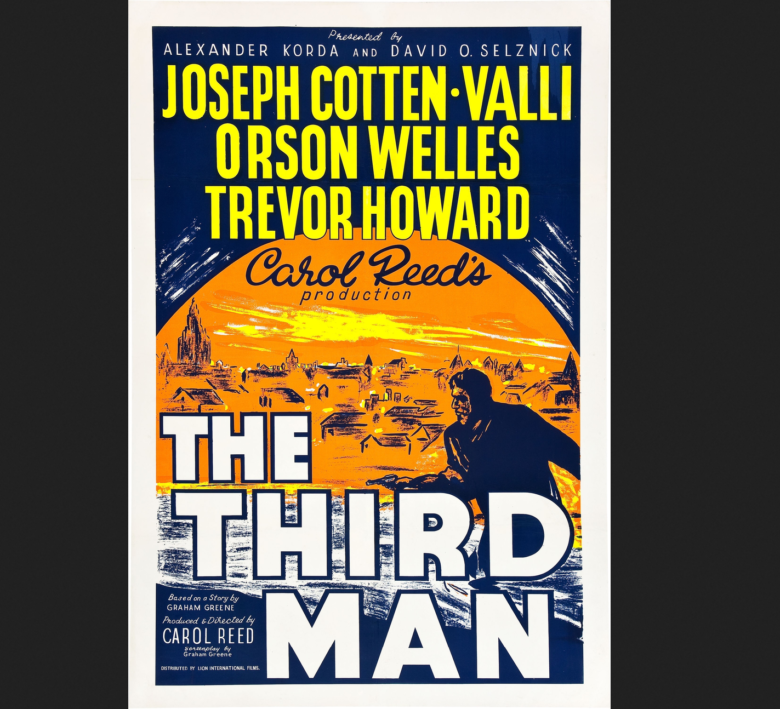
Few films capture the atmosphere of film noir quite like Carol Reed’s The Third Man. Set against the ruins of postwar Vienna, the 1949 British film noir transforms a city struggling to rebuild itself into a labyrinth of corruption, betrayal, and moral uncertainty. Written by Graham Greene and photographed by Robert Krasker, it combines striking cinematography with Anton Karas’ unmistakable zither score and one of cinema’s most fascinating criminals, creating a world where the environment feels just as dangerous as the people inhabiting it.
The story follows Holly Martins (Joseph Cotten), an American writer of pulp Westerns who travels to Vienna after receiving an invitation from his childhood friend Harry Lime (Orson Welles). Holly arrives to discover that Harry has supposedly died in a traffic accident. What looks like a tragedy becomes increasingly suspicious as Holly speaks with the people who knew his friend. Their accounts don’t quite agree, down to how many men carried Harry’s body off the street, and the circumstances become harder and harder to reconcile. Determined to understand what happened, Holly begins investigating and uncovers a much darker story than he ever anticipated.
Vienna is arguably the film’s most important character outside its central cast. Rather than presenting the city as a picturesque European destination, Reed captures a place still struggling with the consequences of the Second World War. Divided into American, British, French, and Soviet occupation sectors, with its central district jointly administered by the four powers, Vienna becomes a setting where authority is fragmented, criminal activity flourishes, and ordinary people are left navigating an uncertain existence. Its ruined buildings, narrow streets, underground passages, and shadow-filled alleyways create an environment that feels almost impossible to read. Holly arrives looking for an old friend, but he quickly discovers that he has entered a world governed by unfamiliar rules.
This atmosphere is essential to the film’s identity as a noir thriller. The mystery of Harry’s death is compelling, but the uncertainty surrounding the people Holly encounters is what makes the investigation so effective. Nobody seems entirely trustworthy, and even those Holly initially distrusts, particularly British military policeman Major Calloway (Trevor Howard), have motivations he struggles to understand. The film recognizes that corruption doesn’t necessarily announce itself through obvious villains or elaborate criminal schemes. Sometimes it exists quietly within the institutions and relationships people depend upon.
Holly Martins makes for an interesting protagonist because he is fundamentally unprepared for the situation confronting him. He’s not a skilled investigator, nor does he have the instincts of a traditional detective. Instead, he’s an idealistic writer who believes the truth should be relatively straightforward to uncover. His determination to defend his friend becomes harder to maintain as the evidence contradicts everything he thought he knew. Joseph Cotten gives the character an appealing sincerity, allowing Holly’s confusion and frustration to develop naturally without making him feel entirely helpless.
Harry Lime, meanwhile, is one of the film’s greatest achievements. Despite being the subject of much of the story, he remains an almost mythical presence for more than half of it. Different characters offer conflicting recollections of him, creating a complicated picture of a man who apparently meant very different things to different people. His eventual appearance is one of cinema’s most memorable character introductions, with a brief glimpse of his face in a darkened doorway instantly changing the direction of the story.
Orson Welles brings enormous personality to Harry, presenting him as someone whose charm and confidence make his criminal behaviour even more unsettling. He’s not simply a conventional villain hiding behind a friendly exterior. Harry has been selling diluted penicillin on the black market, with deadly consequences for patients, including children left with severe brain damage. Yet he genuinely seems to believe his actions are justified. His conversation with Holly aboard the Ferris wheel is among the film’s most revealing moments. Looking down at the people below, Harry waves them off as tiny dots and asks whether Holly would really feel pity if one of them stopped moving. It exposes the gulf between their understandings of morality: Harry sees ordinary people as insignificant, while Holly struggles to comprehend how someone he once called a friend could become so completely detached from the consequences of his actions.
The film’s cinematography is equally important to its lasting appeal. Robert Krasker’s photography makes bold use of shadows, tilted camera angles, and distorted perspectives, giving Vienna an almost nightmarish appearance. Streets and buildings frequently seem to lean into the frame, while characters are often positioned in ways that make their surroundings feel oppressive. The visual language owes much to German Expressionism, but Reed uses these techniques to create something particularly suited to the film’s postwar setting. The city becomes a maze of uncertainty, with Holly frequently looking overwhelmed by the architecture and unfamiliar spaces around him.
The sewer sequences bring the film’s visual and thematic elements together in a memorable climax. Vienna’s underground infrastructure becomes another world entirely, filled with dark tunnels, echoing footsteps, and seemingly endless passageways. The environment is both physically threatening and symbolic of the corruption that has been festering beneath the city’s surface. Reed makes excellent use of the space, turning what could have been a conventional pursuit into a highly atmospheric sequence.
Another defining element is Anton Karas’ zither score, which Reed discovered after hearing him perform in a Vienna wine bistro. Its distinctive sound gives The Third Man an identity that would be difficult to replicate, largely because it contrasts so sharply with the disturbing events on screen. Rather than relying on traditional orchestral suspense music, Karas’ compositions introduce a playful, almost mischievous quality that makes the film feel strangely unpredictable. The music is immediately recognizable, yet it never feels disconnected from the world Reed has created. Instead, it contributes to Vienna’s personality, capturing both its charm and its underlying instability.
What makes The Third Man so effective is how well these elements support its central examination of friendship and moral compromise. Holly’s investigation isn’t simply about discovering what happened to Harry. It’s about confronting the possibility that someone he admired was never the person he believed him to be. The film gradually dismantles Holly’s romanticized understanding of their friendship, replacing it with an uncomfortable recognition of the damage Harry has inflicted on others. Even when the mystery is resolved, the emotional consequences remain.
That understanding carries into the film’s final moments, which deliver one of cinema’s most famous endings. After everything Holly has endured, the possibility of finding companionship in Anna Schmidt (Alida Valli), Harry’s grieving lover, seems to offer a small chance at something resembling happiness. The film refuses such an easy resolution. Anna’s final walk past Holly is a devastating rejection of the romantic expectations that another film might have embraced. Her loyalty to Harry, even after learning what he did, and her refusal to simply move on give the ending an emotional weight that extends beyond the immediate circumstances of the story.
The Third Man remains a standout example of how film noir can explore the darker aspects of human nature without relying entirely on conventional crime narratives. Its Vienna is a place where the distinction between right and wrong has become increasingly difficult to recognize, and its characters struggle with the consequences of a world in which friendship and morality are easily sacrificed. Carol Reed’s direction, Graham Greene’s screenplay, Robert Krasker’s cinematography, Anton Karas’ music, and the performances of Joseph Cotten, Alida Valli, Trevor Howard, and Orson Welles combine to create something entirely distinctive. Even after the mystery has been solved, the film’s shadows linger, leaving behind the uncomfortable realization that discovering the truth doesn’t necessarily make the world a better place.