

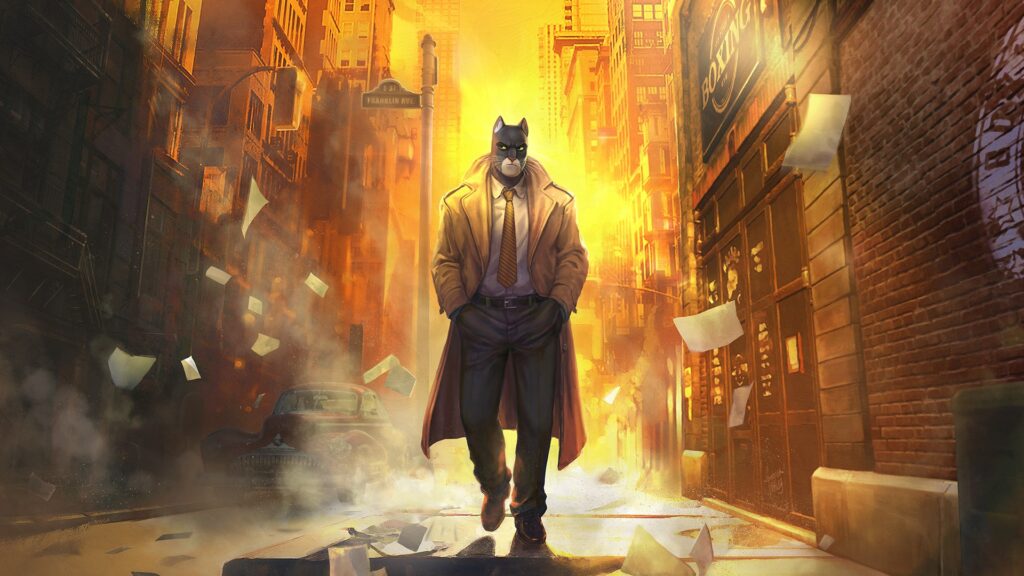
There are few comic book series that capture the atmosphere of classic film noir quite like Blacksad. For this year’s Noirvember, the focus turns to a detective who looks rather different from the usual hard-boiled private investigator. Created by Spanish writer Juan Díaz Canales and artist Juanjo Guarnido, and first published in French by Dargaud, the series follows a feline private investigator navigating a world of murder, corruption, organised crime and political intrigue. Set in an alternate version of 1950s America populated by anthropomorphic animals, it might sound like an unusual premise for a hard-boiled detective story. Yet, beneath its distinctive appearance lies a remarkably traditional noir experience, one that understands the genre’s fascination with flawed characters, moral ambiguity and the darker side of society.
The first volume appeared in November 2000, and Blacksad has since grown into an internationally recognised graphic novel series. Its licensing agent, Mediatoon, cites more than three million copies sold in over 27 languages, and the series has collected multiple Eisner and Harvey Awards along with an Angoulême prize for Best Series. Its success is hardly surprising. While the anthropomorphic characters initially provide an unusual visual hook, the real strength of the series comes from its storytelling and the extraordinary artwork that brings its world to life. That artwork has an impressive pedigree, too. Guarnido previously worked as an animator for Disney, contributing to films including Tarzan and Atlantis: The Lost Empire.
At the centre of it all is John Blacksad, a private investigator whose feline appearance is matched by the familiar characteristics of the hard-boiled detective. He is cynical, occasionally violent, frequently unlucky in love and perpetually surrounded by people whose interests are rarely as innocent as they first appear. He operates in a world where money and influence can determine who gets justice, while those without either are often left to fend for themselves. Blacksad might be a cat, but his problems are recognisably human. He is rarely alone, either. Weekly, a talkative weasel and tabloid reporter, is his occasional sidekick, while police commissioner Smirnov, a German shepherd, is an uneasy ally who sometimes feeds him information he cannot act on himself.
The series begins with Somewhere Within the Shadows (2000), introducing Blacksad through an investigation into the murder of Natalia Wilford, a former lover who has become a successful film actress. It is an appropriately grim introduction to the character, establishing the detective’s personal motivations while showing how far a wealthy man will go to place himself above the law. There is an unmistakable affection for classic detective fiction here, particularly the hard-boiled tradition popularised by authors such as Raymond Chandler and Dashiell Hammett, both of whom Canales has credited as influences.
However, Blacksad is not simply interested in recreating familiar detective stories. Its second instalment, Arctic Nation (2003), takes its characters into considerably more uncomfortable territory. Blacksad is hired to find a missing girl in a racially divided town, where a white supremacist group and a militant Black power group are on a collision course. The use of anthropomorphic characters makes these themes particularly effective. Physical characteristics become markers of social identity, allowing the creators to explore prejudice and discrimination through a fictional society that nevertheless reflects some very real aspects of American history. It is also where Weekly joins Blacksad’s investigations.
This social commentary continues with Red Soul (2005), which draws upon the political paranoia of the Cold War and the anti-Communist witch hunts associated with McCarthyism. A job as a bodyguard pulls Blacksad towards his old teacher, a nuclear physicist, and a web of espionage and betrayal. The book also fills its world with thinly veiled caricatures of real figures, from a rooster senator standing in for Joseph McCarthy to animal versions of artists and writers of the era. Suspicion, ideological persecution and the abuse of political influence become central to the mystery, demonstrating that the series is just as interested in the corruption of institutions as it is in individual criminals. These are not merely backdrops for Blacksad’s investigations. They are fundamental to the world in which he lives.
Later stories take the detective in different directions. A Silent Hell (2010) brings him to New Orleans, where he and Weekly search for a missing jazz musician struggling with addiction. As Blacksad digs in, former bandmates turn up dead in staged suicides, and the trail leads back to an old fraud and a cover-up that powerful people would prefer stayed buried. Amarillo (2013) takes a more unconventional approach. Blacksad, hoping for a break from detective work, agrees to drive a wealthy client’s Cadillac from New Orleans to Tulsa, only to have it stolen by two drifting writers. The chase that follows takes him across the Southwest and into a meditation on art, ambition and violence, with one of the writers drawing upon the Beat Generation. The two-part They All Fall Down (2021 and 2023 in French) returns to New York, placing the detective in the middle of a struggle involving organised labour, the mob, political influence and a powerful construction magnate who will let nothing stand in the way of his projects. Weekly is framed for murder along the way, and Blacksad’s lost love Alma returns. Together, the seven main volumes demonstrate how much variety can exist within the framework of a hard-boiled detective series.
English-language readers originally came to the series through iBooks, which published the first two volumes in 2003 and 2004. Following the publisher’s bankruptcy, Dark Horse Comics collected the first three stories in a hardcover edition in 2010, bringing Red Soul to English-language readers for the first time. Dark Horse has continued publishing the series, including the English editions of They All Fall Down in 2022 and 2024.
Much of what makes Blacksad so memorable, however, comes from Guarnido’s artwork. His illustrations give the series a distinctly cinematic quality, with expressive characters, carefully composed panels and beautifully rendered environments. His background in animation is particularly evident in the way he approaches movement, perspective and composition. Individual panels frequently resemble carefully framed film stills, using lighting, camera angles and character positioning to communicate information without relying on dialogue. The use of colour is equally impressive, recreating the atmosphere of different locations while drawing upon the visual traditions of classic crime cinema. Rain-soaked streets, dimly lit interiors, smoky establishments and imposing city skylines all contribute to an unmistakable noir identity.
The decision to populate this world with anthropomorphic animals also provides Guarnido with an enormous range of visual possibilities. The characters’ appearances communicate personality and emotion in ways that might otherwise require considerably more exposition. Their animal characteristics are not simply decorative, nor are they limited to providing the occasional visual joke. They are part of the storytelling itself, helping establish relationships, social divisions and the personalities of the people Blacksad encounters. This is particularly important when considering the series’ recurring exploration of racism and prejudice, as the characters’ physical differences become an integral part of its social commentary.
The franchise has continued to grow beyond the seven main albums. In October 2025, Dargaud published Blacksad Stories: Weekly, a spin-off written by Canales and illustrated by Giovanni Rigano. Rather than simply continuing the detective’s adventures, the story follows Dustin, a young weasel growing up in New York alongside his grandmother. His circumstances eventually lead him into the world of comic book publishing, where he runs into the threat of censorship. It offers another look at the world of Blacksad while giving readers an opportunity to explore the experiences that helped shape Weekly. Rigano takes over the art, following the look Guarnido established while adding his own touch.
Although the original graphic novels remain the heart of the franchise, the world of Blacksad has expanded into several other forms. One particularly interesting example is the tabletop role-playing game from Nosolorol Ediciones, first published in Spain in 2015, with an English-language edition following later. Based on the comics, it allows players to explore the same anthropomorphic version of 1950s America, creating their own characters and becoming involved in detective stories and other noir-inspired adventures. It is a natural extension of the source material, particularly given how much of the series revolves around investigations, morally questionable decisions and encounters with people who have something to hide.
The franchise has also received a French-language audio adaptation from Blynd, working with Dargaud. Featuring Éric Herson-Macarel as the voice of John Blacksad, the production takes the series into another medium, replacing Guarnido’s visual storytelling with performances, sound design and music. It is an especially appropriate format for a property so heavily influenced by crime fiction and cinematic atmosphere, although non-French speakers will have to look elsewhere to experience it.
Fans can also step into the detective’s shoes through Blacksad: Private Detective, an escape room from Escape Prod in Brussels. Players must infiltrate a criminal mastermind’s hideout, uncover its secrets and find the documents needed to save Blacksad. The experience accommodates teams of two to six players and runs for approximately 60 minutes. It is an unusual extension of the franchise, but one that demonstrates how readily its detective premise can be adapted into an interactive experience.
Perhaps the most substantial adaptation, however, is Blacksad: Under the Skin, a narrative adventure game developed by Pendulo Studios, with assistance from YS Interactive, and published by Microids in 2019. Rather than adapting one of the existing graphic novels, the game introduces an original investigation set between Arctic Nation and Red Soul, making it an interesting piece of the timeline for fans. It was also Pendulo’s first licensed game and its first full 3D production. The original creators, Juan Díaz Canales and Juanjo Guarnido, were closely involved as consultants, reviewing the story, character designs, environments, voice performances and other creative elements. Their input helped the developers preserve the identity of the comic while translating its world into an interactive format.
The case takes place in 1950s New York and revolves around a boxing club. After its owner, Joe Dunn, dies, his daughter Sonia asks Blacksad to find the club’s rising star, Bobby Yale, who has vanished shortly before an important fight. What first looks like a straightforward missing-person job gradually exposes the corruption surrounding professional boxing, a theme the creators had not yet explored in the comics. The decision to create an original story was a sensible one. That freedom gives players a new mystery to solve while introducing them to the characters and setting that make the comics so distinctive. Its combination of exploration, clue gathering, interrogations, puzzles and dialogue choices attempts to translate the experience of being a private investigator into an interactive format. Decisions can also influence Blacksad’s character and the eventual outcome of the investigation, with several possible endings.
Visually, the game has the difficult task of translating Guarnido’s beautifully illustrated world into three dimensions. Its environments, character designs and jazz soundtrack all attempt to recreate the atmosphere of the original comics, while its 1950s New York setting provides an appropriate backdrop for another tale of institutional corruption. Critics were generally kind to the story and its faithful atmosphere, but reviews were mixed overall, with Metacritic scores landing in the 59 to 69 range across platforms. Bugs, clumsy controls and technical problems were among the most common complaints. The game later reached PlayStation 5 and Xbox Series X|S in June 2024.
Even so, the game is worth noting because Blacksad‘s appeal extends beyond its visual identity. Its mysteries, characters and storytelling are just as important as the artwork, and an adaptation needs to capture all three to be successful. Under the Skin does not have to be a perfect video game to demonstrate that the franchise has considerable potential outside the pages of a graphic novel.
There may be more to come. Mediatoon Licensing has confirmed that a second Blacksad game is in development, though no studio, platform or release date has been announced. A film adaptation has also been discussed for many years. A proposed production involving producer Thomas Langmann and director Louis Leterrier was reported by Variety in 2006, while filmmaker Alexandre Aja at one point expressed interest in directing. However, none of these projects has made it into production, and John Blacksad has yet to make his cinematic debut.
What makes Blacksad such an interesting addition to the world of noir is how comfortably it embraces the genre without being restricted by its conventions. Film noir is often associated with a particular period of American cinema, its shadows, morally compromised protagonists and stories of crime and betrayal. Yet its influence has extended far beyond Hollywood, inspiring everything from modern crime fiction and graphic novels to video games and animation.
Blacksad is a particularly effective demonstration of that versatility. Its anthropomorphic characters might initially seem at odds with the familiar imagery of the hard-boiled detective, but the combination works precisely because the stories understand what makes noir compelling in the first place. Beneath the animal faces are familiar human weaknesses, prejudices, ambitions and desires. The characters may look different, but the world they inhabit is every bit as cruel and unforgiving as the one found in classic crime cinema.
That is ultimately what makes Blacksad such a fitting subject for Noirvember. Beneath the anthropomorphic characters and beautifully illustrated settings lies a world of corruption, desperation, moral compromise and people struggling to survive. It may look different from the familiar streets of classic film noir, but the shadows are very much the same. John Blacksad did not walk the mean streets of Chandler’s Los Angeles or Hammett’s San Francisco, but he belongs alongside the great detectives of noir fiction. His adventures are proof that the genre’s appeal has never depended on the appearance of its characters, but on the darkness of the world they are forced to navigate.


