

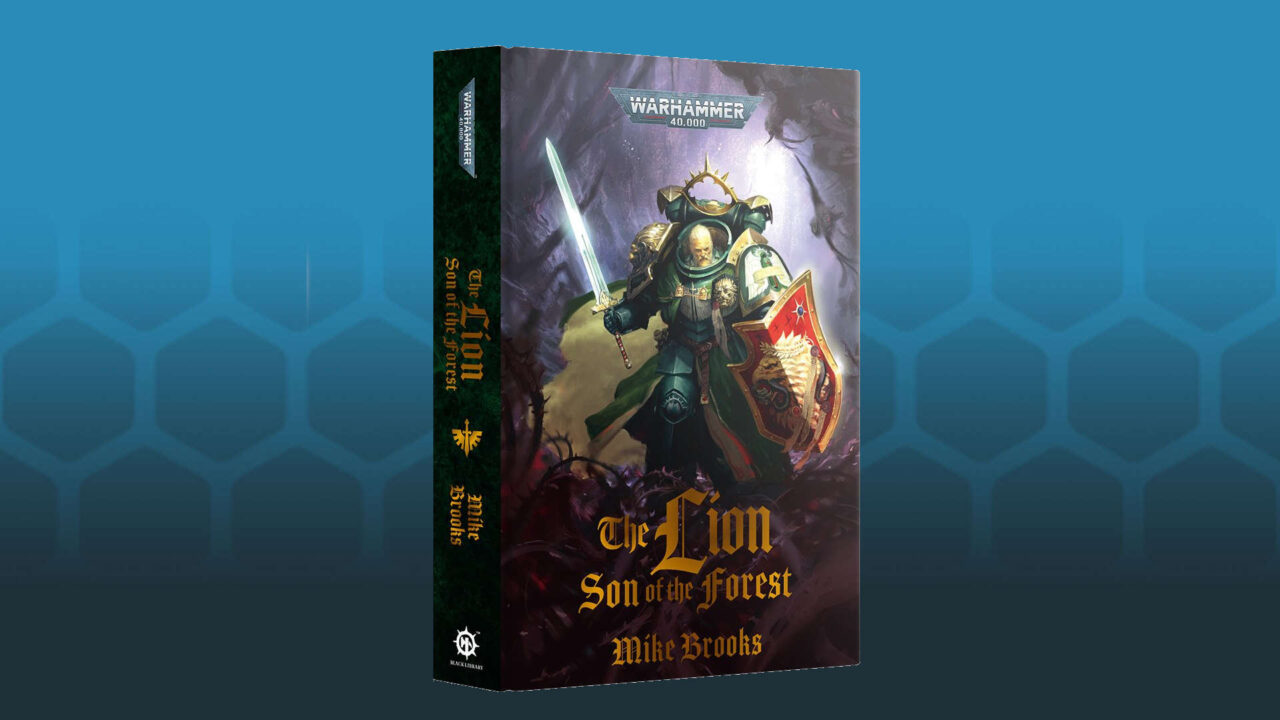
Mike Brooks’ The Lion: Son of the Forest brings back one of Warhammer 40,000’s most important characters at a moment when he barely recognizes the setting. After 10,000 years of slumber, Lion El’Jonson, the Primarch of the Dark Angels, awakens to an Imperium that has changed beyond recognition. The galaxy is consumed by endless war, the Emperor’s dream has curdled into a religious nightmare, and the sons he once commanded have spent millennia living with the consequences of his disappearance. Brooks isn’t content to simply return another Primarch to the board. He uses the Lion’s return to ask what happens when someone is forced to confront the mistakes of their past.
The Lion’s journey is as much about rediscovering himself as it is about understanding the Imperium he has returned to. He is still a Primarch, with all the strength, authority, and martial ability that entails, but the passage of time has left him isolated from the people and institutions that once defined his existence. The Imperium has become something he would barely recognize, and the Dark Angels have spent thousands of years building their identity around secrets he can no longer fully understand. His return is not simply a triumphant homecoming. It is an uncomfortable confrontation with a legacy that has continued without him.
One of the novel’s strongest ideas is its treatment of the Fallen, the Dark Angels who were scattered following the events of the Horus Heresy. The Lion’s encounters with them offer a different perspective on a conflict that has defined his sons for millennia. Rather than treating every Fallen as an irredeemable enemy, the story explores the possibility of reconciliation. The distinction between the Fallen and the Risen becomes an important part of the novel, giving the Lion an opportunity to reconsider his relationship with those who were once his sons.
The characters accompanying the Lion help give this journey its emotional weight. Zabriel, Kai, Borz, and Lohoc each bring their own personalities and experiences to the story, making the group more than a collection of warriors following a legendary Primarch. Their conversations and disagreements give the novel room to explore the consequences of the Lion’s absence, as well as the different ways his sons have survived in a galaxy that has offered them little mercy. Zabriel is particularly important to this dynamic, serving as one of the clearest examples of what reconciliation between the Lion and the Fallen might look like.
Brooks also gives the story a distinctive atmosphere through its Arthurian influences. The Lion’s return, his encounters with knights and outcasts, and the emphasis on loyalty, honour, and redemption give the novel an identity that separates it from many other Warhammer 40,000 stories. These elements feel appropriate for a character whose identity has always been closely tied to the legends and symbolism surrounding the Dark Angels. The result is a story that can be brutal and recognizably Warhammer while still making room for something more reflective.
That does not mean the novel is without weaknesses. Some aspects of the Lion’s return, including the recovery of his equipment and the circumstances surrounding his reappearance, could have benefited from more explanation. The central antagonist also feels less developed than the characters surrounding the Lion, which limits the impact of some of the conflict. The pacing can be uneven, and readers looking for constant large-scale battles may find that the novel is more interested in character development and the relationships between its protagonists than in extended action sequences.
Even so, The Lion: Son of the Forest succeeds because it understands that bringing back a character as important as Lion El’Jonson requires more than demonstrating how powerful he remains. It gives him a reason to question himself, confront his past, and reconsider what being a father and leader means after an absence of 10,000 years. The novel also makes the Risen an interesting addition to the Dark Angels’ story, creating possibilities that extend well beyond this one adventure.
Spoiler warning: The following editorial discusses major story developments, including important encounters and events from the novel’s climax.
Why It Would Make a Great Video Game
There is an obvious temptation to imagine a game starring Lion El’Jonson as another third-person action title built around mowing down waves of enemies. The Primarch is certainly capable of that, and Warhammer 40,000 has no shortage of games focused on large-scale combat. However, The Lion: Son of the Forest suggests a more interesting possibility: a third-person action RPG that combines challenging, Souls-like combat with exploration, memorable boss encounters, and a proper companion system.
The Lion’s diminished state following his awakening provides a natural foundation for character progression. After 10,000 years, he is not simply returning to the galaxy at the height of his former abilities. His memories are fragmented, his understanding of the Imperium is outdated, and his journey forces him to rediscover parts of himself. A game could build its progression around this idea, allowing players to recover memories, regain lost abilities, and gradually become more familiar with the Lion’s history. Rather than relying on arbitrary experience points to explain why a Primarch becomes stronger, progression could be tied directly to his rediscovery of his identity and capabilities.
Fealty, the Lion’s signature sword, could serve as the centrepiece of the combat system. Its presence would immediately distinguish the game from the ranged weapon-focused approach of Space Marine, while still allowing the Lion to use his considerable arsenal when appropriate. Combat could borrow from the deliberate timing, stamina management, enemy patterns, and demanding boss encounters associated with Souls-like games. The Lion should feel immensely powerful, but that does not mean every encounter needs to be effortless. Dangerous enemies, overwhelming numbers, environmental hazards, and limited opportunities to recover could make combat challenging without undermining the character’s status as a Primarch.
The novel’s forestwalking concept could provide the foundation for the game’s world structure. Initially, the Lion’s journeys through the mysterious forest are unpredictable, with the paths and destinations not entirely under his control. As he becomes more familiar with this strange ability, forestwalking could gradually become a more reliable way to travel between locations. This would create a distinctive hub-and-destination structure, with the forest acting as a mysterious connective space between different regions and encounters.
There is room here to borrow ideas from the interconnected world design of Dark Souls and Hollow Knight. Rather than creating one enormous open world, the game could feature a series of substantial areas connected through forestwalking. Each destination could contain its own enemies, secrets, characters, and challenges, with shortcuts and new routes opening as the player progresses. The forest itself could evolve alongside the Lion, becoming less unpredictable as his connection to it grows. This would make forestwalking more than a convenient fast-travel mechanic. It would become one of the defining features of the adventure.
The boss encounters are another area where the novel offers plenty of material. Markog and the Green Knight provide an obvious opportunity for a memorable duel, one that could test the player’s understanding of the combat system. Baelor and Seraphax could offer very different challenges, while the shapeshifter capable of taking the forms of the Lion’s brothers could make for a particularly unsettling encounter. These fights would not need to be simple tests of damage output. Each could have distinct mechanics, attack patterns, and narrative significance, helping the encounters feel like important parts of the Lion’s journey rather than obstacles placed along the way.
However, the companions are arguably the biggest opportunity for making this adaptation stand apart from other Warhammer 40,000 games. Zabriel, Kai, Borz, and Lohoc should not simply be treated as temporary allies who provide additional firepower. A companion system closer to Dragon Age or Mass Effect would give them room to develop their own relationships with the Lion and with one another. Conversations, personal quests, disagreements, and changing loyalties could provide a substantial narrative layer between the battles.
Zabriel would make a particularly strong first companion, introducing the player to the possibility of reconciliation with the Fallen. As the group expands, each character could bring different combat abilities and perspectives to the adventure. Players could select companions before major missions, with their skills providing tactical advantages in certain encounters. More importantly, their personal histories and reactions to the Lion’s decisions could make the group feel like a genuine party rather than a collection of interchangeable support characters.
The novel’s local conflict with Chaos could also provide an effective framework for the adventure. A manageable warband and its influence over the surrounding region would give the Lion and his companions a clear enemy to confront without requiring the game to escalate into a galaxy-spanning war. This would leave room for exploration, smaller encounters, and character-driven storytelling while still providing a substantial threat. It would also help keep the narrative focused on the Lion’s return and the people caught up in the conflict.
The climax offers another opportunity to do something different. The Lion’s capture and the subsequent rescue could become a sequence in which control shifts to the Risen. Rather than simply treating the companions as supporting characters, the game could allow players to experience their abilities and relationships firsthand. Such a sequence would give the Risen a meaningful role in the story and reinforce the idea that the Lion’s journey is not one he can complete alone.
Balancing the Lion would be one of the biggest challenges for a game adaptation. A Primarch should not feel like an ordinary soldier, and making him struggle against every common enemy would undermine the character. The solution would be to build encounters around the scale of the threat rather than artificially weakening him. Large numbers of enemies, dangerous terrain, powerful champions, and attrition could create meaningful challenges without making the Lion seem incapable. The player could be overwhelmingly powerful in individual engagements while still having to think carefully about positioning, resources, and the wider battlefield.
A fixed ending would also make sense for an adaptation of this particular story. The central events and the Lion’s return should remain intact, rather than turning the novel into a branching narrative with radically different conclusions. However, players could still make meaningful decisions about how the Lion interacts with his companions, how he approaches certain conflicts, and what kind of relationship he builds with the Risen. Those choices could influence dialogue, companion development, and individual character outcomes without sacrificing the story’s central direction.
This would be a very different kind of Warhammer 40,000 game from Space Marine, and that is precisely the point. The setting is broad enough to support more than one style of action game. A third-person RPG built around the Lion, his companions, and the mysteries of forestwalking could offer something that has not been explored in quite this way before. It could combine the demanding combat and boss design of a Souls-like with the party dynamics and character writing of a BioWare RPG, all within a distinctly Warhammer setting.
The Lion: Son of the Forest is a strong character-focused Warhammer 40,000 novel that gives one of the setting’s most important figures a compelling reason to return. Mike Brooks understands that the Lion’s story should not simply be about demonstrating his power. It is about a warrior forced to confront a galaxy that has moved on without him, the sons he left behind, and the possibility that some of his greatest failures might still be addressed.
The Risen are among the novel’s greatest strengths, giving the Lion’s journey a cast of characters whose stories deserve to be explored further. Their relationships with one another and with their returned Primarch provide the emotional foundation for the adventure, while the Arthurian atmosphere gives it a distinctive identity within the wider setting.
That is also what makes the novel such an appealing foundation for a video game. A third-person action RPG with Souls-like combat, challenging boss encounters, forestwalking exploration, and a companion system built around the Risen could be something genuinely special. It would give the Lion room to be the formidable warrior he is meant to be while also exploring the relationships and personal conflicts that make this particular story interesting.
The Lion: Son of the Forest has the characters, the setting, and the gameplay possibilities to support an adventure that would do justice to both the novel and the wider universe.


