
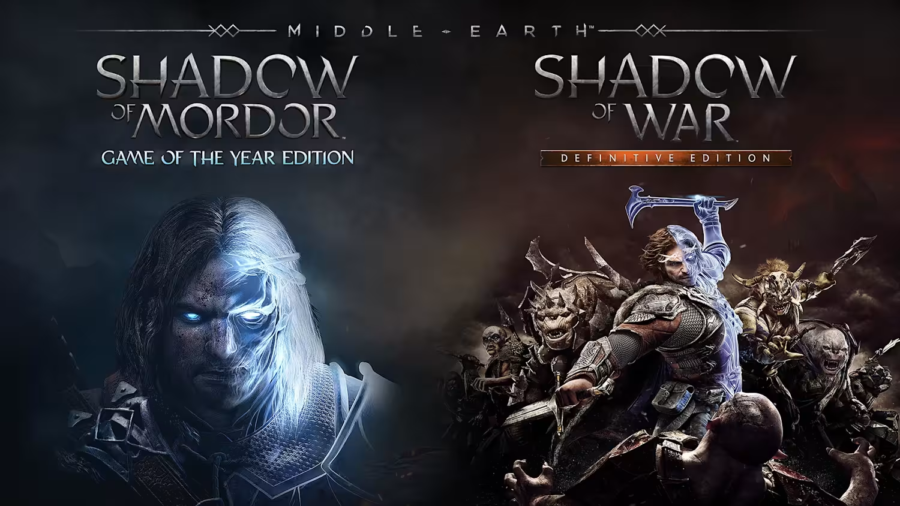
You’ve probably played Middle-earth: Shadow of Mordor or Middle-earth: Shadow of War. They came out quite a while back at this point – 2014 and 2017 respectively in fact. At the time they were groundbreaking unique takes on the Lord of the Rings universe, taking the gap between The Hobbit and LotR and filling it with the story of a ranger-turned-wraith on a quest for vengeance that felt all too real. Now, both games are back in a single package, the Middle-earth: Shadow Bundle including both games for Switch 2 courtesy of Aspyr Games. You can either game individually of course, but if you wanted both, you might as well get them together!

We’ll start with Shadow of Mordor as it’s the first game in the Middle-earth: Shadow Bundle and the first in the series. Here we’re introduced to Talion, a ranger who loses his family and his life to the Uruk but is resurrected as a wraith. Fortunately (or unfortunately) for Talion, his soul is linked to the dead elf lord Celebrimbor, maintaining his humanity and allowing him to seek vengeance upon the orcs. And what a vengeance it is!

Shadow of Mordor is a particularly open-world game, allowing you to proceed at your own pace and hunt down the generals of Sauron’s army one by one. You probably already know this too, but on top of the fluid, open world gameplay that allows for a fantastic customizable experience based on your play style, Shadow of Mordor included the Nemesis system. This unique combat system lets you hunt down high ranking Uruk captains and slaughter them, creating runes to add to your weapons and increase your power. Unfortunately, if you aren’t careful or don’t master combat and stealth, those same Uruk captains will kill you. Unlike other games, if you die, the Uruk get more powerful and when you come back (since you’re a wraith), they’ll be even harder to defeat!

The Nemesis system elevates Shadow of Mordor far above the status of an Assassin’s Creed knockoff with Lord of the Rings Skins or a Batman: Arkham Asylum combat simulator. While those are both valid parallels, the fluid gameplay and mechanics and clean controls combine with the complex Nemesis system to create a much deeper game, even if the lore throughout the experience is only somewhat compelling. Through Nemesis, you can pit enemies against each other, brand them and turn them to your side against Sauron, and even exploit their weaknesses by capturing, interrogating, and slaying some orcs that will reveal information. In fact, the Nemesis system is so unique that it’s actually patented and has never been used in any other title besides Shadow of Mordor and Shadow of War.

Moving on to Shadow of War, everything has been upgraded. The combat chains were replaced with Might, there is a full gear system, skill trees are more complex, and the areas to explore are much bigger. The plot is noticeably more complex, but it’s also more convoluted, so expect a lot of strange twists and turns. You’re not here for the plot though, because the plot is mostly just driving the excellent gameplay in Middle Earth: Shadow of War. The Nemesis system is also more complex, with enemy Uruks able to taunt and ambush Talion, a more complex enemy AI that learns from your patterns and adapts, and a number of complex interactions with Talion’s recruited forces including assassinations support missions, and lots more, all in the service of subverting Sauron’s orc armies.

There are tons of detailed reviews of both of these games, so there’s no point in going into too much detail for breakdowns of either title. Instead, let’s talk about the Switch 2 versions of both games. What you really need to know is that the Middle-earth: Shadow Bundle is framelocked at 30 FPS. Is the Switch capable of more? Probably, but you won’t get to find out as there are no options to unlock it. That means you get a fairly stable experience at higher resolution, though there are occasional slowdowns and visual dips when too many orcs swarm you (which happens a lot until you get the hang of things). Handheld mode is capped at 1080p and also experiences some occasional drops. There are no visual improvements or upgrades to the game and essentially, you’re playing the exact same game as before, only it’s on Switch and portable on a console, which is neat.

There are a few issues with the controls however, especially if you have giant hands like some of us. It’s far too easy to hit the wrong shoulder buttons on the Switch 2 joycons, often messing up careful stealth missions. This was not an issue on the Switch 2 Pro controller of course, but if you want to play in handheld mode, it’s a bit of a challenge. The sheer amount of detail in the game also makes handheld play a bit tougher, even with the added screen size of the Switch 2. That being said, there’s a pleasant little surprise hiding for those of you that are interested. Bow aiming has gyroscopic controls enabled, allowing you to fine tune your aim with motion controls. That’s the only gyro control implemented, but it’s still pretty neat to have!

As you’d expect with a game that hasn’t received any notable upgrades, there isn’t a lot to say about the visuals that hasn’t already been said. Yes, the Middle-earth: Shadow Bundle looks good and Shadow of War looks a tiny bit better than Shadow of Mordor, but both games are around a decade old at this point and it shows. That’s not to say the aesthetic isn’t amazing, it’s just that there’s nothing new here in the visual department. You can run both games at 60 FPS on the PC, so if you’re looking for visual fidelity, that’s the best that can be had on any version of the games. On the Switch, it still looks great and it seems unlikely that anyone will be disappointed. Sadly, the sound hasn’t been fixed from the original releases and the Switch 2 version of the game has some slight audio issues here and there. The voice work is impeccable though and the soundtrack is excellent, but the sound quality itself could still use a bit of updating. Most players will probably barely notice however, and on the little Switch 2 portable speakers, it’s even less of an issue.

Aside from the framerate lock and lack of modernization updates, there aren’t many issues here. The biggest one most players will have, especially those that played prior iterations of the Middle-earth: Shadow Bundle, is that both games are now entirely offline. In Shadow of Mordor, the Vendetta missions are now gone among other elements. The Nemesis Forge still works between games, but is no longer online. For Shadow of War, the Garrison system still exists but it is local only, Conquests and Vendettas are gone, and there are no longer any microtransactions. Basically anything that could be preserved was preserved in some form, but you won’t be able to play anything online anymore. That’s a bit of a shame for a portion of the fanbase for sure, but having all the DLC makes up for a fair bit of that. The only other big issue is the sheer size of the games, around 50 and 75 GB each respectively, which takes up a huge chunk of the Switch 2’s onboard 256 GB. If you’ve sprung for an SD card though, no biggie.

All DLC and bonus content for Shadow of War has been preserved and added to the collection in the Switch 2 release. For Shadow of War, that even goes one step further and includes all the story and expansion DLC. Naturally a fair bit of that has been modified for offline play, but the surprising addition here is the Sword of Dominion, which was previously a preorder bonus. That’s a pretty expansive release for a game that’s almost a decade old now. Added to the portability of the Switch 2, it all makes for a pretty attractive package for newcomers and old hands at the series alike. Of course, some people might balk at the price a bit. While Shadow of Mordor is only $20, Shadow of War clocks in at $50, a pretty hefty price considering how cheap the game has been on other digital storefronts on occasion. At that point it comes down to how badly you want the game, but it’s not like you’re not getting a ton of excellent gameplay for your money.

The Middle-earth: Shadow Bundle is definitely a lot of game to play through and while it isn’t any different than previous releases aside from the changes to online content, it’s great to have it available on the Switch 2. Both games play equally smoothly as on other consoles, and if this is your primary console, they’ll definitely be worth your time. Simply put, this is a great way to experience both Shadow of Mordor and Shadow of War and you’re not going to regret picking either or both titles up!

This review is based on a digital copy of the Middle-earth: Shadow Bundle provided by the publisher. It was played on a Nintendo Switch 2 in both docked and undocked modes. Both games in the Middle-earth: Shadow Bundle performed slightly better in docked mode. The Middle-earth: Shadow Bundle is also available for PS5, Xbox, and PC on Steam.

Nate Van Lindt has been a gamer since the days of yore (aka Commodore 64), and has played a bit of virtually everything out there. He's also an avid comic book collector, both vintage and current, and reads a fair amount of sci-fi and fantasy. On top of that, he watches a fair number of movies and TV shows as well. Oh, and he has a family, a full-time job, and lives somewhere in the urban wilds of Southwestern Ontario, Canada, foraging for old video cables and forgotten game soundtracks.