
There are plenty of games out there that simulate board games. Games like Catan, Sagrada, Dune Imperium, Fury of Dracula and many more are available digitally for those that don’t have the room or cash to buy a bunch of high-priced board games. As a result, board game style video games have become a much larger genre than they used to be in the last decade or so and a lot more refined as well. Also popular is the genre of “make numbers big” incremental games that seems to have started with Balatro. There’s something about numbers spinning out of control based on semi-randomized combos that gets people excited. Just check out our review of Clover Pit or the forthcoming The Incentive Program for just a couple of games in that quickly-growing genre.

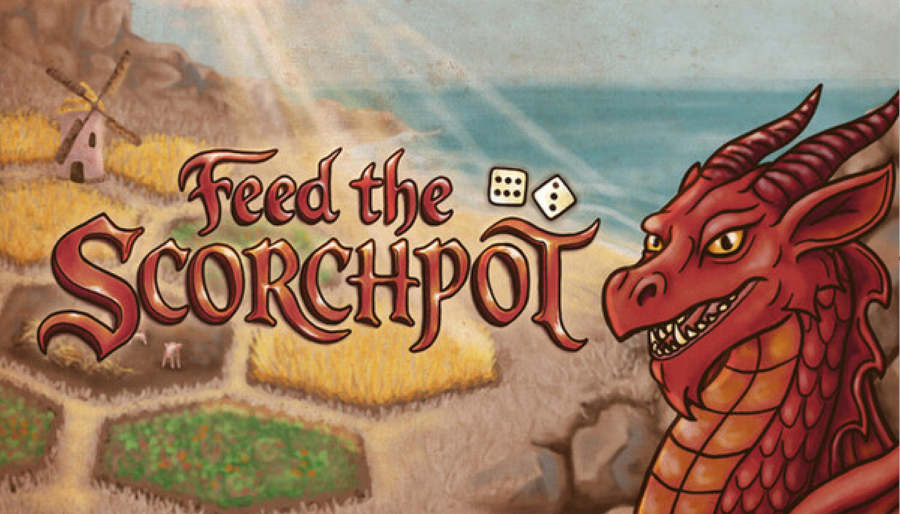
Feed the Scorchpot from indie developer Moravian and indie publisher Indieformer does both of these things. It takes a Catan-like board game design and combines it with the big number combos of games like Balatro. In the game, you play a nameless peasant coordinating the food supply produced by your 19 hexagonal grid of farmable areas, each with a random number mark on it. There are seven different types of food called ‘fodder’ produced by these hexes. Your job is to populate the grid with a combination of farms and buildings that maximize food production. It isn’t just for fun though…there’s an existential threat to the kingdom from eight dragons that demand tribute in the form of cooked food! Creating that food depends entirely on the design of the buildings you choose and rolls of the dice, which means that there’s a high chance of success or failure depending on how things shake out.

Each year you need to fill the needs of the increasingly hungry dragon, forcing you to generate more and more food and money in order to survive. Every five years the dragon attacks you no matter what, making you to plan ahead and struggle through as well. It might scorch the store and block you from essential purchases, take out one of your dice, or even a whole source of fodder. All of this means a lot of careful planning in order to get the best results from your builds, tools, and recipes by designing combinations that work together with the marks on each tile. Rolling the dice means matching any two dice to a number on the marks in order to generate food from that tile…if there’s a farmstead on its corner. The more marks, the more chances you have. The more dice, the more chances you have. The more recipes, the more combos you can make. You get the idea.

The game starts with two humble farmsteads and 10 gold coins. Placement of the farmsteads is key, as is visiting the shop immediately, where there will be any combination of either another farmstead, a cairn, a merchant post, or a dock (the level 1 buildings). At 5 coins each, you can only buy two, but there are also recipes and tools for sale as well. Recipes start at 8 coins and tools start at 4, so you’re extremely limited in what you can buy. Pick the wrong items or buildings and you won’t make enough money each year to get far. There’s a pretty steady learning curve in Feed The Scorchpot. Basic strategies include things like ensuring your Merchant Posts are close to your farms, that you place the docks in the right spots, and that you maximize available building slots by supplementing with tools. That’s just to start however and things get complex very quickly.

Once you start strategically building to gain the right benefits and multipliers and start utilizing tools more effectively, the game quickly opens up into exponential builds and that’s just the start. Once you survive 20 years the first time (years are made up of 3-5 turns called seasons), you unlock the next level of difficulty. There are ten in total and they include additional challenges and hurdles to overcome with each progression. You also unlock dragons by meeting their requirements and those dragons compound the difficulty in a number of ways as well. Strategies that worked fine in the early portions of the game suddenly have to be revised or abandoned and you’ll be frustrated as you look for alternative combos and solutions. There’s always something changing in Feed The Scorchpot as you navigate your way through the various parameters of different difficulties and dragons and just when you think you’ve got a strategy, it fails.

Specific goals also help to unlock things. Some dragons require you to build certain buildings, others need you to earn enough fodder of the right types. There are ordeals that show up during gameplay as well in a tiny box at the bottom of the screen. These ordeals unlock additional buildings, recipes and more but they’re quite hard to pull off. To succeed at the “Build nine shrines” ordeal, we had to cripple our run and sell all our regular buildings in order to pull it off. Unlocking is probably the main challenge of Feed The Scorchpot, but unlike other games, it’s quite engaging to work towards unlocking more of the game. Speaking as a player who very rarely enjoys that part of gaming, Feed The Scorchpot manages to hit the exact sweet spot of gameplay and unlocking that creates an engaging system which you want to fully explore. That’s rare these days.

What you aren’t getting here however is visual complexity. This is a tiny indie game and there are no fancy 3D effects or anything. Fortunately, that doesn’t matter as the game looks spectacular and the watercolor-style artwork is both masterful and captivating. A lot of loving care went into the gorgeous artwork of Feed The Scorchpot and it absolutely shows. While it could be argued that the actual combo visuals don’t really have as much flair as they could when gathering resources and the scorchpot itself could have a bit more pizzazz, the overall game looks great. There are lots of little details moving around in the background that seem to call out to ancient maps and everything is clear and easy to read. The GUI in general is quite well-designed and you’re never left wondering how to do anything. The music is similarly excellent, though it would have been nice to have a few more tracks or maybe a few more shifts in the music as the changes at year 7/8, 16/17, and 20 didn’t feel like quite enough to us. The original dev music is also included, but the revised soundtrack is noticeably better and surprisingly catchy. While you won’t be rushing out to try to download it, the music is nearly as well done as the art here, where even the load screens are truly special.

Is Feed The Scorchpot a perfect game? Probably not. But it’s pretty close. We did notice a few minor issues but they aren’t terrible. Usually there’s one big glaring fault and there’s just not here. The challenge level jumps VERY fast with difficulty increases, almost too fast. Once you get far enough, the Level 1 buildings tend to disappear entirely forcing you to depend on tool copy effects and often screwing up building in a run. The music is a bit too repetitive and the visuals could use a bit more spice to them because the board is so quiet during your turns. But are those really flaws? Nah. The game is awesome. In fact the only real complaint to be had is that the Steam Deck integration for Feed The Scorchpot isn’t optimized for touch controls – something that the game is just begging for!

Simply put, Feed The Scorchpot is FUN! Once you start a run, it’s hard to stop. It’s one more season…then one more year…then an hour is just gone. It’s been a while since we played a game that just pulls you in like that to the point you don’t want to get up. Yes, you can adjust the speed in the menu and if time is a factor for you, you probably should (it roughly halves the time of a full game), but regardless of how long you spend playing it, Feed the Scorchpot will have you thinking about new strategies and approaches even when you shut the computer down. That’s really damned impressive for a new game from a small indie studio and a brand new publisher. If you like board games or incremental games (or both like some of us), Feed The Scorchpot is absolutely a must-own game and you need to buy it and at only $15 plus a new release discount, you can’t go wrong!

This review is based on a copy of Feed The Scorchpot provided by the publisher. It was played on a gaming PC and tested on the Steam Deck where it is working but not optimized for touch interfaces. Feed The Scorchpot is a Steam exclusive at this time.

Nate Van Lindt has been a gamer since the days of yore (aka Commodore 64), and has played a bit of virtually everything out there. He's also an avid comic book collector, both vintage and current, and reads a fair amount of sci-fi and fantasy. On top of that, he watches a fair number of movies and TV shows as well. Oh, and he has a family, a full-time job, and lives somewhere in the urban wilds of Southwestern Ontario, Canada, foraging for old video cables and forgotten game soundtracks.