
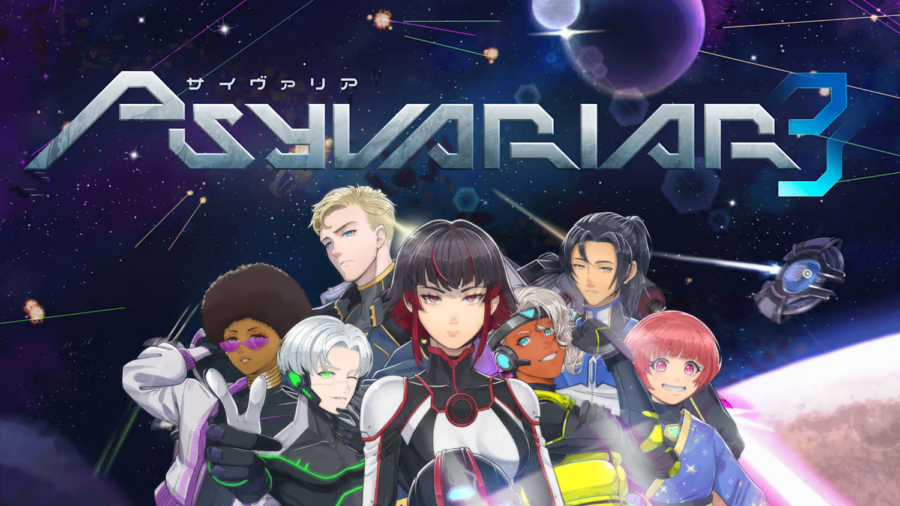
If you’re a shmup fan, you’ve probably heard of Psyvariar. If not, this is going to be an entirely new experience. The Psyvariar games are bullet hell shmups that use a unique mechanic called buzz where you have to get as close to enemy shots as possible without touching them. It’s a challenging mechanic that shakes up traditional shooter combat by forcing you into dangerous situations for score progression and to power up your ship. The series is popular with long-time shmup players because of the high challenge level and interesting mechanics, as well as excellent visuals in the original games.

The Psyvariar series has been around since 2000 when the original game, Psyvariar Medium Unit, was released in arcades on the Taito GNet motherboard. It was followed up by Psyvariar Revision only five months later that rebalanced all the enemy fire patterns and changed some of the mechanics, a common practice for shmups at the time. That was followed up by an arcade release of Psyvariar 2: The Will to Fabricate on the Naomi hardware, also released a year later for home consoles in Japan on the Dreamcast. The series went into a long hiatus afterwards, eventually releasing Psyvariar Delta over a decade and a half later. Delta re-released the first two games in HD and added a remixed Delta mode as well and a plethora of options. Whew. That was a lot of background!

As you can see, Psyvariar has a long history with a number of excellent releases that you may or may not be familiar with, but we’re here today to look at an entirely new entry into the franchise over a quarter century after the original release! Psyvariar 3 from Brazilian indie developer Banana Bytes and publisher Red Art Games has just been released and as the first Psyvariar game in 7 years, it’s time to find out if it lives up to its pedigree.

Psyvariar 3 drops you into the middle of a complex interstellar war with a huge text-based exposition at the beginning. Previous titles in the series had limited or no plot, but the focus on the introductory story adds a lot of context to the game. Once the introduction is over, you’ll jump directly into the game menu, allowing you to choose from a variety of options. There are actually six different game modes in the game, though some are much more compelling than others. The primary mode you’ll probably be playing is Arcade mode, providing a traditional linear game experience. While previous versions of Psyvariar opted to allow you level options based on how well you performed in the previous stage, Psyvariar 3 eschews this approach and instead allows you to select the difficulty of stages based on your previous stage performance. In other words, the better you do, the harder you can make the game.

That sounds fun, right? Your reward for hard work is…more work! But that buzz mechanic is a primary one here as well and the more bullets on screen, the faster you can level up. The more levels you gain, the more powerful your shots, both your standard spread shot and the powerful charge shot. There are no powerups to gather in Psyvariar 3 so you’ll have to buzz and kill enemies to boost your power. One of the weird changes with this new game is that buzz is a bit minimized. Killing enemies also levels you up and each of the seven different playable characters also have different complementary powerup and scoring abilities, from shield chaining to bomb mechanics and everything in between. One of those characters is Cotton from the venerated shmup franchise, a neat surprise that just drops in with no fanfare at all. All of the playable characters are unlocked from the start of the game so there’s no fiddling about with trying to complete tasks to access characters.

As you’d expect, the ‘waggle’ mechanic that allows you to buzz large bullet patterns and dodge through dense clusters of enemy fire are intact here but there are definitely a few caveats, especially for the Switch which we’ll talk about later. Basically, you can jiggle the left analog stick back and forth to slip between the bullets and pump up your buzz. It takes a bit of practice because if you do it too slowly or too hard, you usually die. Once you get the hang of it though, you’ll be blasting away with ease…in theory. As the patterns get more and more dense, the buzz mechanic becomes more and more important. Killing enemies and buzzing their shots also cranks up your weapon power and at the end of each stage, you have options for difficulty that directly correlate to your progress on the powerup system. The further you crank up the difficulty, the bigger and faster the enemy bullet patterns are, but that also allows you to buzz more frequently and destroy enemies faster, raising your power even further. Staying on easy is basically only for learning how to play and you’ll have to start choosing higher difficulties if you want to see all Psyvariar 3 has to offer.

There are seven main stages of the game and a number of unlockable areas and bosses. By the time you get good enough to make it through most of that, you’ll be more than ready to move on to the other gameplay modes. These include Arrange mode where you’re fully powered all the time, Mission mode where you have to succeed at specific tasks to gain stars, the traditional timed Caravan mode usually used for game competitions, Endless mode which is a randomized procedurally generated level where you only get a single life, and Practice mode which allows you to refine your approach to any of the levels you have previously reached in Arcade mode. Endless mode is particularly challenging with the random seed that’s chosen and varies wildly in difficulty from play to play, and Mission Mode becomes very challenging very quickly as well.

That’s a lot of content right? Seven playable character with unique weapons and mechanics, seven main stages and some unlockable stages and bosses, and even a story? But here’s where things shift a bit, so save your acclaim. Let’s start with the visuals. Psyvariar 3 seems like a step down from previous iterations of the game. Ship models are simplistic and oddly boxy and the enemies are similarly designed. Sure, you’re not staring at the ship for aesthetics when you’re trying to survive an onslaught of bullets, but at the same time, the basic polygonal designs lack pizzazz. Backgrounds are interesting and well-done however, but you won’t be able to look at them. That’s not just because you’ll die while playing either. It’s also because the bullets are hard to see against the backgrounds of Psyvariar 3 and to compensate, there’s a menu option to literally dim the backgrounds and highlight the bullets just to allow for you to see better. This is even an issue in the story cinema, as the scrolling text is completely obfuscated by the backgrounds, only allowing you to read a portion at a time. Yes, there are some cool backgrounds and some decent enemy designs, but they’re mostly eclipsed by the issues here.

Naturally, the OST is a solid release with powerful electronic tracks and some good riffs that get your properly excited to play, but that’s really all that can be said for the audio here. There’s no dialogue, the level up voices sound recycled, and the sound effects are average and suited to the game. There will probably be some hardcore shmup music fans that are into the soundtrack and it’s a solid track set, but aside from that, there’s nothing to truly write home about here. Unfortunately, that also goes for a number of other aspects to the game that we’re going to look at now.

First is the speed of play. Bullets and bullet patterns are intentionally fast in Psyvariar 3 and you’re supposed to dodge them by waggling to roll your ship through the fire and graze them for buzz. You also need to take out the majority of ships while building your buzz, but that’s almost impossible because no matter which ship you choose, they’re really, spectacularly slow. They respond like they’re barges, not high end fighters and you’ll have to be careful which ships you choose because some of them make it even harder to survive. Can’t level up fast enough? You won’t build your buzz up. The worst thing you can do to a shmup is make it unresponsive and the Switch version of Psyvariar 3 is so responsive it’s practically unplayable due to lag.

There’s a noticeable delay in response time between your stick inputs and the on-screen response on the original Switch. Psyvariar Delta ran like a dream on the system but Psyvariar 3…well…it chugs. There are noticeable frame skips during gameplay, especially when things get more frantic and bullets fill the screen. These jumps in gameplay often immediately kill you as well. That’s not a surprise though, since your ships already all move like they’re in molasses even when you’re not using focused shots. Psyvariar 3 has the slowest ships in the series. Yes, you’re supposed to dodge shots and squeak past them for buzz, but you literally can’t even get out of the way of some of the faster shots at all. That would be fine if the buzz waggle worked well, but on the Switch, it simply doesn’t. The system can’t keep up and waggling often results in an inadvertent death instead of a roll that slide you past the bullets. The Switch simply can’t keep up with gameplay here.

Even without the problems of the Switch version, Psyvariar 3 is simply less responsive than its counterparts. We compared the arcade version of Psyvariar Medium Unit, Psyvariar 2 on Dreamcast, and Psyvariar Delta (with all 3 orisons of the original game) and of the games in the franchise, Psyvariar 3 was both the least interesting looking in terms of ship and enemy design and the slowest moving entry in the franchise by a noticeable margin. It was also the least responsive overall, even accounting for lag on the Switch. Yes there are plenty of modes and yes you can build up additional credits by playing to credit feed through the game, but that’s the problem. You shouldn’t have to credit feed. Each playthrough of Psyvariar 3 felt like starting fresh and hoping for the best even after we learned the patterns simply because the game doesn’t move as fast as your reaction time at least part of the time. This isn’t a complex game either, and there’s no way it should run as badly as it does on the Switch, implying a failure to optimize for the console.

It’s difficult to recommend Psyvariar 3 on the original Switch. It just doesn’t move the way it should, the design work (excluding backgrounds) is weak, and the whole game feels slapped together, especially in comparison to other major shmups. While it’s not a complete disaster, it’s not a good game either, and it’s hard to enjoy yourself playing when the deaths often don’t feel like they’re your fault. When you die in a Cave game, you know it’s entirely because you failed, not because the game skipped frames or your ship didn’t move when you moved the stick or dpad. With Psyvariar 3, there are no such guarantees and with character mechanics that were obviously designed to compensate for these shortfalls, it’s clear that Psyvariar 3 simply isn’t up to snuff. The optimization for Switch isn’t there and the core gameplay is just too slow and unwieldy for how interesting and unique the mechanics are. Ultimately, if you’re a massive fan of the IP or want to play every shmup, give it a shot, but for everyone else, it might be better to wait for a sale.

This review is based on a digital copy of Psyvariar 3 provided by the publisher. It was played on a Nintendo Switch in both docked and undocked modes. Psyvariar 3 is also available on Nintendo Switch 2, PS5, Xbox Series X/S, and PC on Steam.

Nate Van Lindt has been a gamer since the days of yore (aka Commodore 64), and has played a bit of virtually everything out there. He's also an avid comic book collector, both vintage and current, and reads a fair amount of sci-fi and fantasy. On top of that, he watches a fair number of movies and TV shows as well. Oh, and he has a family, a full-time job, and lives somewhere in the urban wilds of Southwestern Ontario, Canada, foraging for old video cables and forgotten game soundtracks.