

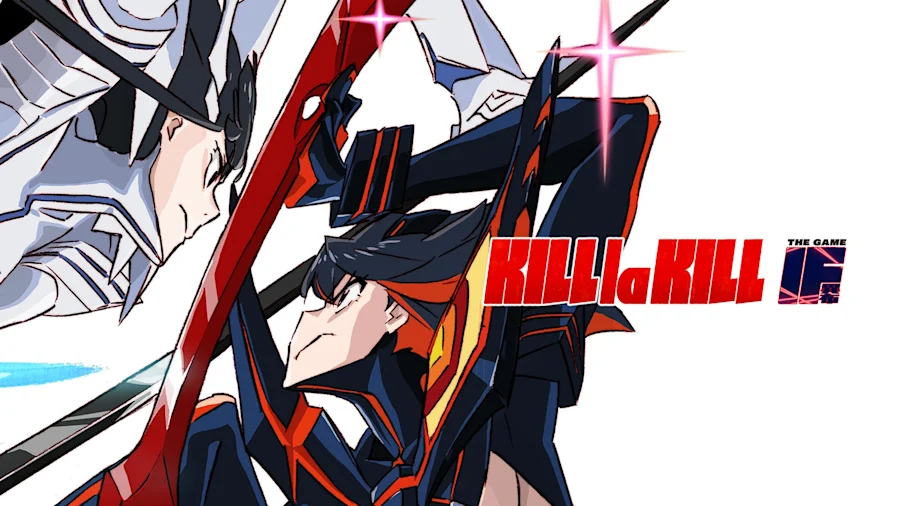
Kill la Kill -IF delivers a surprisingly robust narrative experience that avoids the typical retelling of anime plotlines often found in licensed fighters based off of anime. Developed under the watchful eye of Studio TRIGGER and the anime’s original writer, Kazuki Nakashima, the game presents a brilliant “What If” alternate universe scenario. Instead of placing you immediately in the shoes of the fiery protagonist Ryuko Matoi, the story flips the perspective entirely to focus heavily on her fierce rival, the student council president Satsuki Kiryuin.
This narrative detour kicks off right around the middle of the original anime’s timeline, completely altering the trajectory of the plot. For fans who know the source material inside and out, watching Satsuki command the spotlight and unraveling a new path toward her ultimate goals feels incredibly fresh and rewarding. It injects a heavy dose of high-stakes drama and fan service that manages to honor the tone of the show while forging its own completely unpredictable path over its roughly four-hour campaign.
As neat of a direction as this is for a game like this to take, if you are someone that has never seen the anime, like myself… this story is going to make you feel lost and rather disappointed. The game assumes a baseline familiarity with the lore, plunging you directly into the chaos of life-or-death tournament arcs and sentient, power-inducing clothing (Goku Uniforms) without providing much context. While the character motivations remain clear and the theatrics throughout is rather entertaining, the rapid pace will have those that aren’t fans rather confused and like I mentioned before, completely lost.
The only reason I know this is because I had to do some deep dive research into why I was so lost, and well given the games assumptions and basis, it’s easy to see why those of us that have never seen the show feel this way after a few hours with it.

At its core, the gameplay presents itself as a wide-open, 3D arena fighting game. The mechanics are highly streamlined, operating essentially as a tactical, three-button brawler. Every character (of which there are ten of them to play as) has direct access to a short-range melee attack, a long-range projectile, and a dedicated guard break.
With input commands being so accessible, pulling off visually spectacular combos requires very little mechanical execution, offering immediate gratification to players who just want to feel like a powerful anime warrior. It is a system built around spacing and momentum instead of timing and technique.
Unfortunately, this simplicity means the combat loop can quickly border on repetitive during longer play sessions. This is due to most matches devolving into button mashing sessions once you get a good enough feel for your character. Yes, this is one of those games that lets you button mash your way to victory. Love it or hate it, this is one of those kinds of games.
Visually, the game is cell-shaded and really looks like an anime that has become interactive. presentation. The characters look crisp, bold, and bursting with personality, featuring thick ink outlines and exaggerated facial expressions that make them look as if they leaped from your TV to your game console. As cheesy as it may sound, that’s really the way it feels when you are playing and watching the game unfold on screen.
The attack animations are refreshingly dynamic, with slashing blade effects, massive explosions, and dramatic camera pans framing every major impact. When you land a powerful finishing move, the screen explodes into a striking black, white, and red color palette that temporarily freezes the frame before letting the carnage roll back in slow motion. This aspect of the game really makes it stand out as a fighter. It also gives kind of a Kill Bill aspect to it with the monochrome ascetic and touch of blood red color.
As awesome as the characters are, the environmental design is rather lackluster. Combat stages are incredibly flat, barren, and visually uninspiring. You will spend most of your time fighting in grey, empty courtyard ruins or generic, featureless fields that look incredibly dull compared to the vibrant fighters clashing on top of them. It kind of makes the characters feel like they are out of their element. A fish out of water if you will, and it just feels off. The camera can also become quite erratic in multi-person free-for-all fights. It has a tendency to struggle at tracking the action and could make someone with motion sickness end up losing it.

When it comes to performance on the Switch, the game plays at a standard and acceptable 30 frames per second in both docked and handheld modes. Die hard fans of fighting games may find this slower FPS limit a bit of an issue. But coming from the era of Street Fighter on the SNES, I am perfectly fine with this respectable frame rate lock down. I feel that if it was any faster, they would have to strap down the camera and make it fixed for it to do the player any favors. I mean it struggles at 30FPS to keep up, I can only image how chaotic it would have been if they allowed the game to run at double the frame rate.
On the positive side, that 30 FPS target is remarkably stable for the vast majority of standard one-on-one matches. When docked, the game renders at a crisp 1080p, and it drops gracefully to 720p when taken on the go in handheld mode.
While this is great for one on one fights, when you get multi-opponent matches, the performance takes a hit at the frame rate it performs at. It almost feels like what you would get when the NES slows down to a crawl with too much action on screen. I feel though that this comes down to just poor optimization. I think that if more time would have been put in to optimize this game for the Switch, it would have fared a lot better in the performance department.
The audio design is easily one of the most flawless packages of the entire experience, heavily lifting the game’s overall cinematic atmosphere. The soundtrack is full of high energy rock and orchestral arrangements, featuring iconic tracks from the anime composer Hiroyuki Sawano, including the fan favorite hype anthem “Before My Body Is Dry.” The music swells beautifully during climatic moments, which works well to keep your adrenaline pumping even when the gameplay itself starts to feel a bit repetitive.
Rounding out the overall experience is the complete, original voice casts from both the Japanese and English versions of the anime are present. The actors bring an incredible level of passion and intensity to their roles, shouting out their absurd attack names and trading vicious barbs with the exact same theatrical energy that fans of the show I am sure will appreciate and enjoy. Hearing the characters scream at each other with pristine audio clarity adds an immense layer of authenticity to the “What If” story mode.

Kill la Kill -IF on the Nintendo Switch is a highly specialized piece of fan service that perfectly understands its target audience, even if it compromises on mechanical depth. As a celebration of Studio TRIGGER’s iconic universe, it succeeds on almost every front, offering an incredibly written alternate storyline, spectacular visuals, and a roaring soundtrack that honors its legacy. It looks like the anime, sounds like the anime, and seems to capture the chaotic soul of the franchise from little I have seen.
This is great and all but I think that the game leans too heavily on the fans of the show and leaves those of use that have never really watched much of the anime series feeling both rather lost and left out. I would have liked to have seen some kind of synopsis where the game gives a bit of a back story of the anime to a degree so that those that have never seen the show can still follow the narrative.
As a fighting game, the simplified three button control scheme makes the game feel a bit too simple and rather easy if you will. Also the 30 FPS limit the game is forced into leaves the game rather poorly optimized and likely will have fans of fighting games gravitating toward other games in the genre that will feel more robust and play much better than this title does.
Ultimately if you love the source material, then you will likely love this game. Fans of the series are sure to find reasons to love and enjoy this game, despite its issues. But if you’re like me and have never really watched much of the series this game is based off of, I can’t see this game being for you. On that note, I will say that I can’t recommend this game, even if it is fun to play in short sessions. The technical issues, the heavy reliance on the source material, make the game nearly impossible to recommend. I would definitely look at other fighters to play on the Switch and steer clear of this one.
Disclaimer: A review key was provided

In addition to writing articles, Ryan Byers also creates content for his YouTube channel called "Obscure Games and Consoles", collects video games, and dabbles in video game development.