

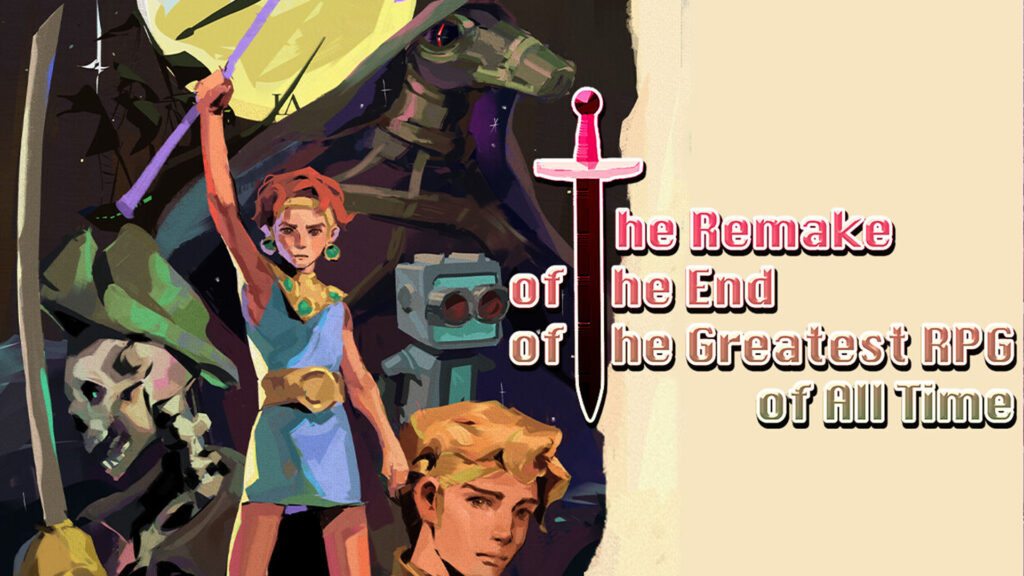
CoinDrop Games and Glootschke Games have taken an unusual premise and transformed it into one of the most inventive puzzle adventures in recent memory. The Remake of the End of the Greatest RPG of All Time masquerades as the climactic finale of a long-lost 16-bit role-playing classic before steadily revealing itself to be something far more ambitious. While its vibrant pixel art, turn-based combat, and nostalgic presentation immediately evoke the golden age of Super Nintendo RPGs, those familiar trappings exist primarily as the foundation for an intricate web of puzzles, environmental storytelling, and sharp meta commentary. Rather than celebrating retro design through imitation alone, the game constantly challenges expectations, creating an experience that feels equally inspired by classic RPGs and modern genre-defying titles like Tunic and Inscryption.
The opening immediately establishes this philosophy. Instead of introducing an expansive fantasy world or patiently explaining its mechanics, players are thrown directly into the closing moments of an adventure that seemingly began dozens of hours earlier. A save file sits at 99.54% completion before the action jumps into the final dungeon, where Rose, Robert the Robot, and Darkhart are already facing the towering Chronobeast. There are no lengthy tutorials, no exposition explaining relationships between the party members, and almost no context surrounding the journey that led to this confrontation. It intentionally recreates the feeling of loading an old save file after months away, struggling to remember both the controls and the events that preceded the finale.

That initial confusion is anything but accidental. Rather than asking players to master traditional RPG systems, The Remake of the End of the Greatest RPG of All Time transforms uncertainty into its defining mechanic. Every unanswered question becomes another mystery to investigate, encouraging curiosity instead of relying on conventional progression. Exploration is no longer about uncovering treasure chests or stronger equipment alone. Instead, it revolves around assembling fragmented information hidden throughout the dungeon, slowly reconstructing both the fictional game’s history and the reality surrounding its remake.
Developer commentary, discarded instruction manual pages, production videos, forgotten design documents, and cryptic notes become just as valuable as weapons or healing items. Every collectible offers another piece of an increasingly elaborate puzzle, rewarding players who carefully absorb every detail rather than rushing toward the next objective. The result is an adventure that frequently feels closer to solving an elaborate escape room than completing a traditional role-playing game, constantly encouraging observation, deduction, and experimentation over grinding levels or optimizing statistics.

Combat reflects this design philosophy perfectly. At first glance, battles resemble a fairly standard turn-based RPG, complete with familiar attack commands, magical abilities, and party management. However, those expectations quickly disappear once enemy weaknesses begin dictating every encounter. Each opponent is completely resistant to every damage type except a single specific vulnerability, meaning victory depends entirely on discovering the correct solution rather than simply dealing larger numbers.
An early battle demonstrates this brilliantly. Two Chronobats accompany a Chronocube, with manual pages revealing that bats fear fire while cubes are susceptible to electricity. Fire magic is immediately available, but producing electrical damage requires interpreting another instruction manual page explaining that combining Whirl with two Slash attacks generates an electrical combo attack. Understanding that interaction suddenly reframes the entire combat system. Battles are no longer contests of endurance but carefully constructed logic puzzles where success comes through experimentation and observation.
This structure remains remarkably engaging because every new enemy introduces another layer of mechanical complexity. Instead of repeating familiar combat loops, encounters continually demand fresh solutions, preventing battles from becoming repetitive despite the relatively straightforward command menu. Each victory delivers the satisfying realization that another puzzle has been solved, replacing the gratification typically associated with character progression with the equally rewarding feeling of intellectual discovery.

The brilliance of this approach lies in how naturally it complements the game’s central themes. Traditional RPGs often reward persistence through increased levels and stronger equipment, but The Remake of the End of the Greatest RPG of All Time places knowledge above statistics. Information becomes the most valuable resource available, encouraging players to think carefully about every clue they uncover. Keeping handwritten notes nearby quickly becomes less of a novelty and more of a genuine advantage, evoking memories of an era when instruction manuals, notebook sketches, and playground conversations often proved just as valuable as anything found within the game itself.
Beyond the fictional RPG lies another equally important layer. At various points players can effectively step outside the game world, entering a stark first-person liminal environment that exists separately from the fantasy adventure. This alternate space introduces an entirely different style of puzzle solving while remaining deeply interconnected with the RPG itself. Progress rarely exists in isolation, as discoveries made in one world frequently unlock opportunities in the other.
A seemingly insignificant developer interview may reveal a hidden code needed to unlock a passage within the liminal environment. Solving that puzzle could provide an item capable of advancing progress inside the RPG dungeon, which in turn uncovers another piece of developer commentary that reshapes understanding of the broader narrative. This constant interplay between realities ensures that exploration remains consistently rewarding because every document, environmental detail, or overlooked interaction could contain the missing piece required somewhere else.
Rather than separating gameplay and storytelling into distinct categories, the game merges them together seamlessly. Narrative revelations often arrive through solving mechanical puzzles, while gameplay progression depends upon understanding fictional development history, production decisions, and hidden developer conversations. Every system feeds naturally into the next, creating an unusually cohesive experience where story and mechanics continually reinforce one another.

This layered structure also gives the fictional world surprising authenticity. The original Greatest RPG of All Time never existed, yet the scattered developer interviews, remake discussions, archival footage, and instruction manual excerpts gradually convince players otherwise. An entire history is constructed piece by piece, complete with development anecdotes, community speculation, controversial remake decisions, and passionate fan reactions. The illusion becomes increasingly convincing as additional evidence accumulates, making the fictional game’s legacy feel remarkably tangible despite existing solely within this adventure.
Particularly entertaining is the game’s willingness to poke fun at modern gaming culture. Discussions surrounding faithful remakes, unnecessary gameplay changes, nostalgia, preservation, and online discourse all become targets throughout the adventure. One especially vocal character embodies the endless cycle of internet debates surrounding beloved franchises, delivering exaggerated opinions that simultaneously parody social media outrage while acknowledging the genuine passion shared by gaming communities. Rather than feeling cynical, these moments remain playful and self-aware, recognizing both the absurdity and enthusiasm that often accompany discussions surrounding classic games.
The biggest challenge with such an ambitious structure is maintaining a consistent sense of pacing, and this is where The Remake of the End of the Greatest RPG of All Time occasionally shows its rough edges. The game is at its strongest when guiding players through carefully constructed discoveries, but the freedom it provides early on can sometimes work against it. Because several areas become accessible relatively quickly, it is possible to push ahead before fully understanding the intended path, uncovering solutions or locations before having the necessary context.
For players who enjoy experimenting and testing the limits of a game’s systems, this openness can be exciting. Discovering an unexpected route or stumbling into a hidden area creates the same sense of curiosity that defines the rest of the adventure. However, those moments can also lead to confusion, as progressing too far ahead may result in missing essential information needed for later puzzles. Without the proper clues or items, certain sections can feel far more difficult than intended, occasionally forcing players to backtrack and determine which piece of information was overlooked.

A little more guidance during the opening hours could have helped smooth out these situations without compromising the game’s emphasis on discovery. The mystery is a major part of the appeal, but the difference between feeling challenged and feeling lost can sometimes be surprisingly narrow. Fortunately, these issues never undermine the larger experience, as careful exploration and attention to detail will eventually reveal the solutions waiting to be uncovered.
At its core, The Remake of the End of the Greatest RPG of All Time succeeds because it understands why classic RPGs remain so beloved while also understanding that simply recreating their surface-level qualities is not enough. The colorful towns, memorable characters, dungeon exploration, and turn-based encounters all capture the spirit of the 16-bit era, but the game is far more interested in examining the player’s relationship with those experiences.
It explores the excitement of discovering hidden mechanics, the satisfaction of piecing together obscure clues, and the feeling of being part of a community attempting to understand a mysterious game. In that sense, it captures something that existed around older RPGs just as much as within them. Before everything was documented online, there was an undeniable magic in trading theories, discovering secrets, and experimenting with unexplained systems. This adventure recreates that feeling while adapting it into a modern puzzle-driven format.
Fans of recent genre experiments will also appreciate the numerous clever references scattered throughout the experience. The influence of games like Tunic, Inscryption, and Undertale can be felt in the way information, world-building, and player expectations are constantly manipulated. However, these inspirations never overwhelm the game’s own identity. Instead, they serve as part of a larger conversation about how interactive storytelling can continue evolving beyond traditional formulas.
The result is a rare kind of remake — one that is not attempting to restore a forgotten classic, but rather exploring the idea of what a legendary game and its revival would look like if they existed. It questions why certain games become iconic, how communities preserve memories of them, and what happens when creators attempt to satisfy impossible expectations surrounding beloved works. These themes could easily have become overly complicated or self-indulgent, but the game’s playful tone keeps the experience approachable throughout.
Even with its occasional pacing issues, the overall adventure remains consistently rewarding. Few games capture the satisfaction of uncovering a secret quite as effectively, whether that means deciphering a combat mechanic, discovering a hidden developer message, or finally understanding how multiple seemingly unrelated clues connect together. Every revelation feels earned, creating the same sense of accomplishment that comes from solving a particularly clever puzzle rather than simply reaching the next story checkpoint.

The Remake of the End of the Greatest RPG of All Time is a remarkable example of how familiar genres can be reinvented through creativity rather than nostalgia alone. It celebrates the RPGs of the past while refusing to simply replicate them, transforming classic mechanics into the foundation for something much more experimental. The result is an adventure filled with clever puzzles, memorable discoveries, and a genuine appreciation for the history and culture surrounding role-playing games.
CoinDrop Games and Glootschke Games have crafted something that feels both like a tribute and a challenge to the genre. It respects the traditions that shaped RPGs while asking players to reconsider what those traditions can become. For anyone who enjoys games that reward curiosity, careful observation, and a willingness to explore beyond the obvious path, this is an experience that deserves attention.
Rather than being merely a parody of classic RPGs or a collection of nostalgic references, The Remake of the End of the Greatest RPG of All Time stands confidently as its own unique adventure. It is a clever, ambitious, and frequently surprising puzzle RPG that demonstrates there are still countless ways for the genre to evolve. Long after the final mystery has been solved, its inventive approach to storytelling and gameplay design remains difficult to forget.
Disclaimer: A review key was provided