

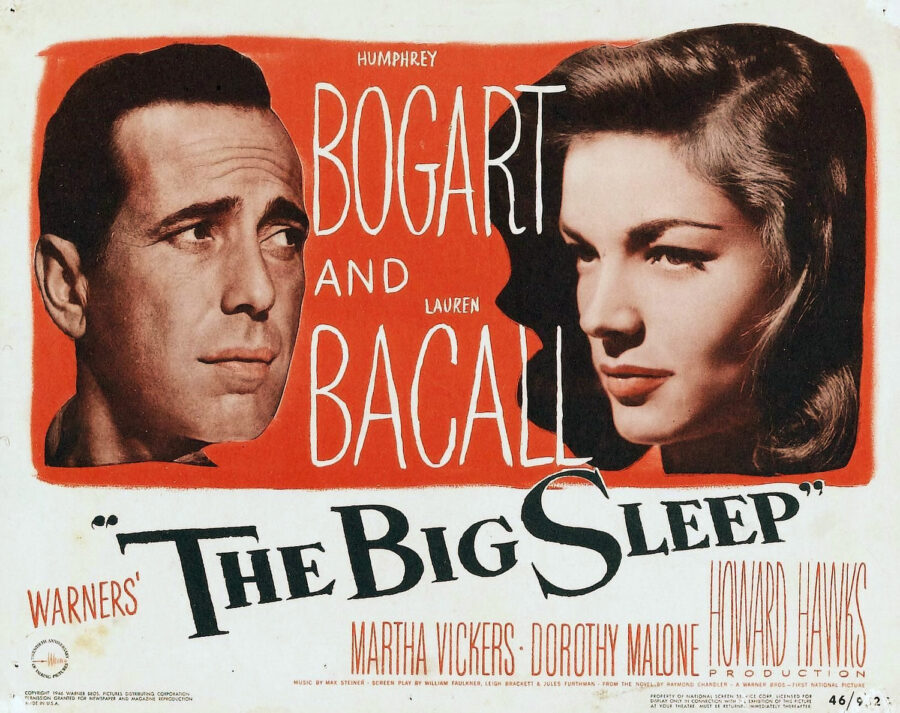
Few detective films have managed to remain as captivating and influential as Howard Hawks’ The Big Sleep. Released in 1946 and starring Humphrey Bogart and Lauren Bacall, this adaptation of Raymond Chandler’s celebrated novel brings one of literature’s most recognizable private investigators to the screen in a story filled with blackmail, murder, deception, and a tangled web of criminal activity. Yet, for all its intrigue, The Big Sleep is perhaps most remarkable for how little importance it places on making sure its audience understands everything that happens.
The film follows private detective Philip Marlowe (Humphrey Bogart), who is hired by wealthy General Sternwood to investigate a blackmail attempt involving his younger daughter, Carmen (Martha Vickers). What initially appears to be a relatively straightforward assignment quickly turns into something far more complicated, as Marlowe encounters gamblers, criminals, blackmailers, and several people with reasons to keep their activities hidden. His investigation also brings him into contact with Sternwood’s elder daughter, Vivian Rutledge (Lauren Bacall), whose involvement in the situation becomes increasingly difficult to ignore.
Where many detective films build their appeal around gradually revealing the truth behind a mystery, The Big Sleep takes a rather different approach. Its narrative becomes increasingly difficult to follow as Marlowe moves between suspects and discovers additional complications, with certain developments receiving surprisingly little explanation. There are moments when the audience may find itself questioning exactly what has happened, why certain characters are involved, or how one particular discovery connects to the larger investigation. Even by the time the story reaches its conclusion, not every narrative thread feels particularly satisfying.
This is an unusual weakness for a detective film, especially one built around a character whose profession revolves around uncovering the truth. However, it is also an important part of what makes The Big Sleep so distinctive. Rather than allowing the mystery to dictate every aspect of the experience, the film places considerably more emphasis on its characters, dialogue, and atmosphere. The investigation ultimately serves as a framework for exploring a world populated by opportunists, criminals, and people whose outward respectability conceals considerably darker intentions. Even when the individual pieces of the mystery fail to come together convincingly, the characters Marlowe encounters make the journey worthwhile.
Bogart is particularly effective as Philip Marlowe, delivering a performance that captures the character’s intelligence, cynicism, and dry sense of humour. His detective is rarely intimidated by the people he encounters, even when dealing with wealthy businessmen, dangerous criminals, or individuals who believe their social standing puts them above suspicion. Marlowe is also far more comfortable exchanging sarcastic remarks than offering lengthy explanations, giving Bogart plenty of opportunities to demonstrate the screen presence that made him such an important figure in classic Hollywood cinema. There is a confidence to his performance that makes the character immediately engaging without requiring him to constantly demonstrate how clever he is.
Lauren Bacall is equally important to the film’s appeal. As Vivian, she brings a combination of confidence, intelligence, and unpredictability to a character who could otherwise have easily become another familiar femme fatale. Her relationship with Marlowe provides some of the film’s most entertaining exchanges, with their conversations frequently becoming verbal contests filled with flirtation and double entendres. The chemistry between Bogart and Bacall is particularly strong, making their scenes together feel livelier than the investigation itself. Their performances also give the film an additional dimension, as Vivian is not simply someone Marlowe needs to question but an individual who can challenge him on his own terms.
That chemistry was no accident. The film was completed in January 1945 and previewed before being shown to American servicemen overseas. However, Warner Bros. delayed its general release, eventually deciding to revisit the production and film additional scenes that would capitalize on the popularity of Bogart and Bacall’s pairing in To Have and Have Not. These changes gave Vivian a more prominent role and placed greater emphasis on her relationship with Marlowe, helping shape the identity of the theatrical version. The revisions also meant that some of the original material was removed, further complicating an already convoluted investigation.
The supporting cast further contributes to the suspicious world surrounding Marlowe. Martha Vickers makes Carmen an unsettling presence, while John Ridgely, Dorothy Malone, and Elisha Cook Jr. help populate the story with characters who each bring their own complications to the investigation. Even relatively brief encounters can leave an impression, which is particularly important in a film where the sheer number of people involved can make it difficult to keep track of everyone’s motivations. Dorothy Malone’s appearance as a bookstore clerk is especially memorable, providing one of the film’s more entertaining diversions from the central mystery.
Howard Hawks’ direction is another major reason the film remains so enjoyable. Despite the complicated screenplay, he maintains a remarkable sense of momentum, allowing conversations and character interactions to carry scenes that might otherwise feel needlessly confusing. The film rarely becomes bogged down in its own exposition, and its pacing benefits from Hawks’ ability to move between suspense, humour, and romantic tension. There is also an appealing confidence in how the film approaches its material, as though it has little interest in slowing down simply because the audience might need additional time to understand what is happening.
Cinematographer Sid Hickox also gives the film a visual identity that complements its increasingly suspicious world. The wealthy Sternwood mansion, with its imposing interiors and carefully controlled atmosphere, contrasts with the darker establishments and shadowy corners Marlowe encounters throughout his investigation. The black-and-white photography reinforces the sense of moral uncertainty surrounding the characters, while even seemingly respectable environments can feel threatening. These visual choices help establish an atmosphere of corruption and distrust without requiring the story to constantly explain itself.
Its connection to Raymond Chandler’s original novel is also worth considering. The screenplay, written by William Faulkner, Leigh Brackett, and Jules Furthman, makes various adjustments to the source material, including placing greater emphasis on the relationship between Marlowe and Vivian. The Hollywood Production Code also influenced the adaptation, requiring the filmmakers to remove or soften aspects of the novel’s more explicit sexual material and criminal subject matter. Some important narrative explanations were also lost during the revisions, including a sequence in which Marlowe explains the crimes to investigators. These changes help explain why certain developments feel particularly abrupt or underexplained in the finished film. Nevertheless, the adaptation retains much of Chandler’s cynical view of wealth, corruption, and human behaviour, while demonstrating how effectively his characters and dialogue translate to the screen.
Eighty years after its release, The Big Sleep remains an important example of what makes classic film noir so appealing. Its mystery is undeniably convoluted, and the theatrical version occasionally sacrifices narrative clarity in favour of its romantic subplot and entertaining character interactions. Nevertheless, these shortcomings rarely diminish the pleasure of watching Bogart and Bacall share the screen. Their performances, combined with Hawks’ assured direction and Chandler’s memorable dialogue, create an experience that remains compelling even when the investigation itself becomes difficult to follow. The Big Sleep might not be a particularly satisfying detective story when judged by the clarity of its mystery, but its characters, atmosphere, and unmistakable sense of style make it considerably more than the sum of its narrative complications.