

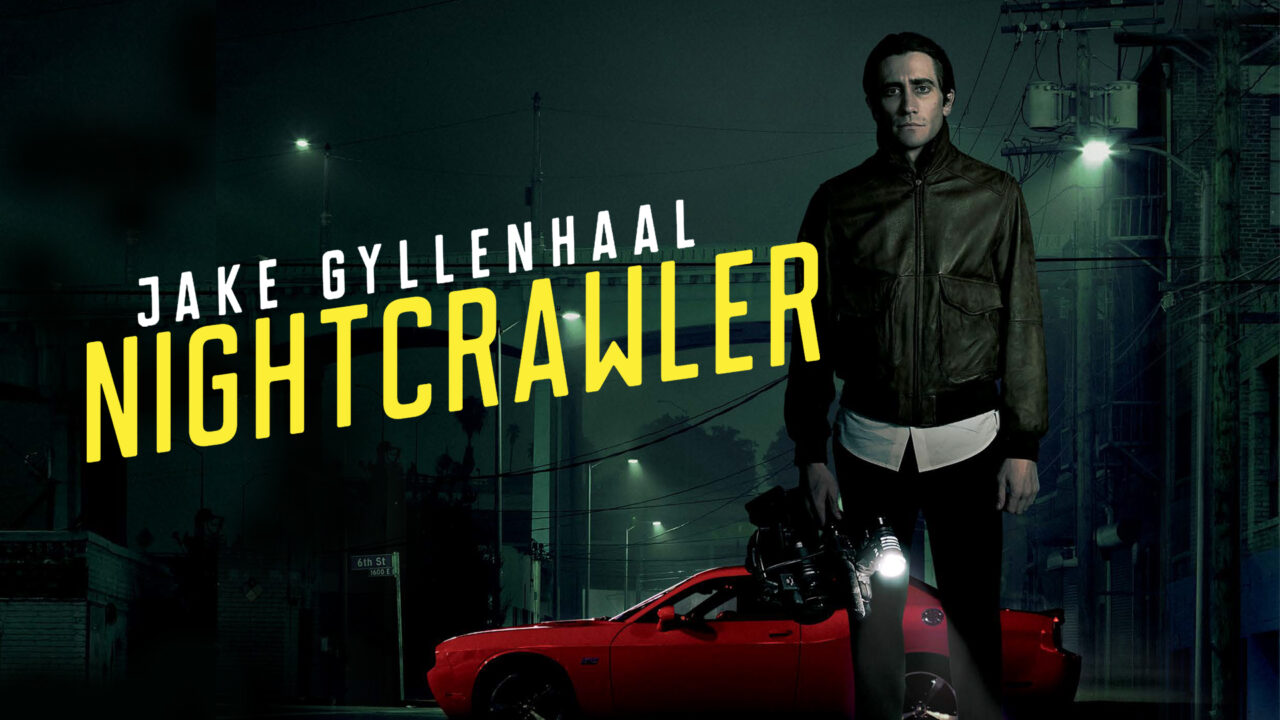
The American Dream has always had a darker side, and few films expose it quite as effectively as Dan Gilroy’s Nightcrawler. Premiering at the Toronto International Film Festival in September 2014 before reaching theatres on Halloween, this neo-noir thriller takes audiences into the nocturnal world of Los Angeles television news, where violence is a commodity, tragedy is an opportunity, and the pursuit of professional success can become an excuse for almost anything. Starring Jake Gyllenhaal as Louis Bloom, the film offers a particularly unsettling modern interpretation of noir, one in which the traditional criminal underworld is replaced by a media industry that has learned to profit from the worst moments of other people’s lives. Spoilers follow, so consider this your warning if you haven’t seen it.
The film’s origins are a good place to start. Gilroy’s interest in the subject originally began with Weegee, the legendary New York crime photographer whose work captured the city’s darker side during the 1930s and 1940s. However, rather than making a film about Weegee’s life, Gilroy eventually found his inspiration in the modern equivalent: freelance cameramen who race through Los Angeles at night looking for crime scenes to film for local television news. With his brothers Tony producing and John editing, Gilroy made his directorial debut with a screenplay that earned him an Oscar nomination for Best Original Screenplay.
Lou Bloom is hardly a conventional noir protagonist. An unemployed drifter who makes ends meet by stealing fencing and scrap metal, he is introduced assaulting a security guard who catches him in the act, which tells us what lies beneath his calm surface before he has said much of anything. He stumbles upon the world of crime photography after passing a car wreck and seeing a crew led by veteran stringer Joe Loder (Bill Paxton) filming the aftermath for the local news. Intrigued by the possibility of turning disturbing footage into a business, Lou steals a racing bicycle and trades it for a camcorder and a police scanner. He then begins racing through Los Angeles in search of accidents, shootings, and other violent incidents that might interest local television stations, and what initially appears to be an unconventional career opportunity quickly becomes an increasingly disturbing obsession.
There is something particularly fascinating about how Lou approaches his newfound profession. He treats everything as a business transaction, studying management techniques, memorizing motivational language, and approaching potential clients with the enthusiasm of someone who believes he has discovered the secret to success. His carefully rehearsed professionalism is often almost comical, but there is an ugliness underneath it. Lou doesn’t appear to understand human relationships beyond what he can gain from them, and his interest in other people’s suffering is entirely detached from any sense of empathy. He sees opportunities where others see tragedy, and his willingness to cross ethical and eventually criminal boundaries becomes the foundation of his growing success.
This makes Lou an especially compelling addition to the tradition of noir protagonists, even if he has some distinguished ancestors. Noir has always had room for schemers who trade on other people’s misfortune, from the press agent of Sweet Smell of Success to the reporter of Billy Wilder’s Ace in the Hole, who manipulates a human tragedy into a career-making story. Lou, however, doesn’t seem particularly concerned about the consequences of his actions. He isn’t a fundamentally decent person being dragged into a criminal world, nor is he someone struggling to escape the mistakes of his past. Instead, he is an opportunist who discovers that society has plenty of room for someone with his particular set of instincts, provided he can make himself useful to the right people.
The film’s portrayal of Los Angeles further strengthens its noir identity. Rather than relying on the familiar visual language of shadowy offices, smoky bars, and rain-soaked streets, cinematographer Robert Elswit, an Oscar winner for There Will Be Blood, presents a sprawling city illuminated by neon signs, headlights, storefronts, and the flashing lights of emergency vehicles. The production shot its night scenes on a digital Arri Alexa, which could capture the glow of the city with very little added lighting, while the daytime scenes were shot on 35mm film. Gilroy and Elswit also deliberately avoided the downtown core so often seen in Los Angeles movies, favouring the San Fernando Valley, West Hollywood, and other less familiar areas. The result is a striking nighttime landscape that feels both inviting and alienating, and Lou spends much of his time travelling through it, moving from one disaster to another while the city continues operating around him. Its beauty is difficult to separate from its underlying ugliness, creating an atmosphere that feels entirely appropriate for a story about someone who has learned to exploit the darkness hidden within an otherwise ordinary world.
What makes Nightcrawler particularly effective as a modern noir, however, is its decision to place the television news industry at the centre of its criminal ecosystem. Lou’s relationship with news director Nina Romina, played by Rene Russo, reveals an environment in which ethical considerations are increasingly secondary to ratings and commercial success. From their first conversation, Nina makes it clear that her station prioritizes graphic footage of accidents and violent crime, particularly incidents in affluent, predominantly white neighbourhoods, because those stories appeal to the audience the station is trying to attract. Her own desperation to keep her job makes her increasingly willing to accommodate Lou’s behaviour, and that arrangement is anything but a comfortable partnership. Lou realizes how much she needs his footage and uses it as leverage, pressuring her into a date and eventually into sleeping with him by threatening to stop supplying her station. It is a blackmail dynamic worthy of classic noir, with the added twist that the victim is just as compromised as the man exploiting her.
The film’s criticism extends beyond the people working inside the newsroom. Lou is certainly responsible for his own actions, but the demand for his footage doesn’t originate with him. Television audiences are drawn to sensational stories, and the station is eager to provide the material that keeps viewers watching. This creates an uncomfortable cycle in which human suffering becomes entertainment, while the people responsible for delivering it can convince themselves that they are simply responding to what the public wants. Lou is an extreme example of this mentality, but the industry around him is hardly presented as innocent.
As the story progresses, the distinction between documenting violence and manufacturing it becomes increasingly difficult to maintain. Lou begins by moving a body at a crash scene to improve his shot, but his desire for increasingly valuable footage soon pushes him much further. When Joe Loder keeps beating him to the best stories, Lou sabotages Joe’s van, and when it crashes and leaves Joe severely injured, Lou is there to film the aftermath. His most chilling work comes after a triple-homicide home invasion, where he and his new assistant Rick (Riz Ahmed) arrive before the police. Lou hides what he discovers there, then uses it to orchestrate a confrontation that he can capture on camera. When it turns violent, Rick is shot, and Lou films him as he lies dying. His camera becomes an extension of his own ambition, allowing him to control what others see while concealing the extent of his involvement, and the person who began as a bystander ends up an active participant in the very violence that provides his livelihood.
Gyllenhaal’s performance is central to making this transformation so disturbing. Lou’s awkward mannerisms, unnaturally enthusiastic delivery, and carefully constructed professional persona make him difficult to read, particularly because he rarely displays the emotional responses expected of someone in his position. There is an almost artificial quality to his behaviour, as though he has assembled his personality from motivational videos and business advice without understanding the basic human values that are supposed to accompany them. Rather than playing Lou as an obviously threatening figure from the beginning, Gyllenhaal makes his outwardly agreeable demeanour part of what makes the character so unsettling. His gaunt, hungry look, the result of losing a significant amount of weight for the role, adds to the sense of a predator who spends his nights prowling for food. Despite earning nominations at the Golden Globes, BAFTAs, and Screen Actors Guild Awards, Gyllenhaal was notably absent from the Academy Award Best Actor nominations, a disappointing omission given how much of the film’s success rests on his performance.
Nightcrawler ultimately offers a particularly bleak examination of ambition and the idea that anyone can achieve success through enough determination. Lou gets what he wants, not because he has discovered some admirable secret to professional advancement, but because he understands how to exploit a system that rewards results without asking too many questions about how they are achieved. Along the way, he trades up to a red Dodge Challenger, and by the end he has expanded his operation with two vans and a team of interns, assuring them that he would never ask them to do anything he wasn’t willing to do himself. His success is presented as a grotesque distortion of the entrepreneurial ideals that American culture so often celebrates. The film’s most uncomfortable observation is that Lou doesn’t necessarily need to hide his personality to succeed. He simply needs to find people willing to benefit from it.
That is what makes Nightcrawler such an effective addition to Noirvember. Its Los Angeles is a contemporary noir landscape, its protagonist is a predator navigating a world of equally compromised interests, and its criminal underworld is an industry that has discovered how to turn human misery into a profitable product. The traditional ingredients of noir may have changed, but the underlying corruption remains remarkably familiar. Lou Bloom isn’t searching for a way out of the darkness. He has found a way to make a living from it.


