

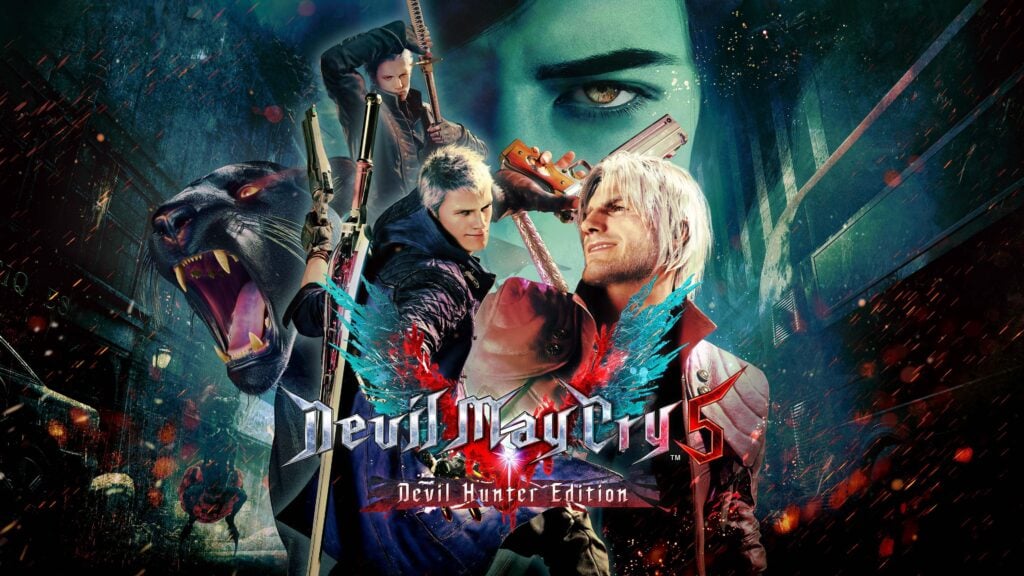
Capcom has been one of the most reliable third-party partners the Switch 2 has going for it, and after the strong native ports of Resident Evil 7: Biohazard and Resident Evil Village, the publisher has now brought over Devil May Cry 5 in the form of the Devil Hunter Edition. This is not the first time Capcom has had to prove a demanding action game can hold up on Nintendo’s hybrid hardware, and once again the results show a developer that understands exactly what it is doing, even if a few pieces from other platforms did not make the trip over.
The first and most important thing to talk about is performance, since Devil May Cry 5 lives and dies on precise timing, animation cancelling and split-second dodges. Capcom has delivered a locked 60 frames per second in both docked and handheld mode, with no notable drops or hitching even in the busiest fights, where the screen fills with enemies and every particle effect the RE Engine can throw at the camera. Frame pacing stays consistent throughout, which is exactly what this kind of combat needs to feel right.
Docked mode gives you the sharper image, running at a higher native resolution before upscaling, with clean environmental detail and all of the game’s dense visual effects rendering the way they should. Handheld mode drops the native resolution and leans on upscaling to compensate, and while the difference shows up in a side by side comparison, it is genuinely hard to notice in motion, since the frantic combat pace leaves little time to inspect individual textures. Reflections, lighting and shadow work all survive the transition to the smaller screen far better than one might expect from a game originally built for PS4 and Xbox One.

Loading is fast in either mode. Stage transitions do not take long, retries after a death are close to instant, and restarting missions does not carry the wait times the original console releases had back in 2019. Combined with that steady framerate, this is one of the more technically composed Switch 2 ports Capcom has put out, and there is nothing here on the level of the docked mode stuttering that has plagued other recent third-party releases on this system.
Controls are just as sharp, whether you are using Joy-Con 2 or a Pro Controller. Inputs register immediately, which matters enormously in a series that has always rewarded precision over button mashing. Chaining through Dante’s fighting styles or working through Nero’s Devil Breakers feels completely natural, with no noticeable input lag getting in the way, even during the game’s more demanding combo sequences.

There is also an unadvertised bonus for anyone willing to dig into the system settings. Devil May Cry 5: Devil Hunter Edition ships with an unlocked framerate mode that Capcom has not marketed anywhere. Switching the Switch 2’s system output to 120Hz bypasses the game’s usual 60 FPS cap entirely, and with VRR handling the pacing, the game runs anywhere from 90 to 120 FPS in both docked and handheld modes. This is not something most players will stumble into unprompted, but for anyone chasing the smoothest experience possible, it is a genuine bonus hiding in plain sight, and a good sign Capcom built real headroom into this port rather than tuning it to just barely hit 60.
As for the game itself, it holds up exactly as well as it did on release. Rather than trying to reinvent things after the divisive DmC: Devil May Cry, Capcom went back to what the series does best and refined nearly every system around it. This is still one of the best character action games available, with enough depth for genre veterans while staying approachable for anyone jumping in for the first time.

Each of the four playable characters brings something distinct. Nero is the most immediately approachable, combining the Red Queen sword, Blue Rose revolver and his interchangeable Devil Breaker arms into a moveset that stays aggressive without overwhelming newcomers. The Breakers reward experimentation, letting fights play out differently depending on which arm you bring into a given encounter.
Dante remains the technical showcase of the roster. Switching on the fly between Swordmaster, Gunslinger, Trickster and Royalguard opens up an enormous range of combat options, and mastering him is one of the more rewarding challenges the genre has to offer. The stable performance here means all of that translates to Switch 2 without feeling compromised in the slightest.
V plays completely differently again, commanding Griffon, Shadow and Nightmare from a distance instead of engaging directly. It is a slower, more deliberate style built around positioning rather than aggression, and it keeps the campaign from feeling repetitive across its full runtime.

Vergil is playable from the very start here rather than needing to be unlocked, and his swordplay, built around the Yamato, the Mirage Edge and his signature Judgement Cut, makes him arguably the most satisfying character for anyone who already knows the game well. Newcomers should know his campaign largely reuses the existing missions though. Outside of a pair of additional cutscenes, playing as Vergil works more like an advanced difficulty option than a separate story thread.
On the narrative side, Devil May Cry 5 wraps up several long-running threads while introducing memorable new faces. Nero, Dante and the mysterious V team up to deal with Urizen, whose Qliphoth tree is draining Red Grave City dry in pursuit of something much bigger. The story balances big action spectacle with surprisingly effective character beats, and the reveal tying V, Urizen and the Sparda family together lands well by the credits. Returning favourites like Lady and Trish get their moments, and Nico establishes herself immediately as one of the series’ better supporting characters through her chemistry with Nero.
The package on offer is generous as well. Devil Hunter Edition rolls in all the previously released DLC, extra music tracks, cosmetic content, alternate voice options, bonus weapons and the live-action bonus cutscenes, essentially everything released for the game since 2019. That is a strong value proposition for newcomers, and a real convenience for returning players who no longer need to track down separate purchases.

The one real catch is what got left behind. Switch 2 does not include Legendary Dark Knight mode or the Turbo Mode speed option that Special Edition players have access to on other platforms. Neither exclusion changes the core campaign in any meaningful way, but if you already know those modes from elsewhere, you will notice they are gone. Everything else about the experience is fully intact, and the strength of the port more than makes up for those two absences.
All told, Devil May Cry 5: Devil Hunter Edition adds to Capcom’s growing reputation for genuinely strong Switch 2 conversions. Stable 60fps in both modes, minimal visual compromise, tight controls and very few technical shortcomings combine into a great portable version of one of the best action games around. It is missing a couple of features Special Edition has elsewhere, but the optimization, the amount of content included and how smoothly it all runs on Nintendo’s hardware make this an easy recommendation regardless. Whether you play it docked or entirely on the go, Devil May Cry 5 is still every bit the stylish, over the top action game it always was, and this port gives Capcom another strong showing for third-party support on Switch 2.
Disclaimer: A review key was provided