

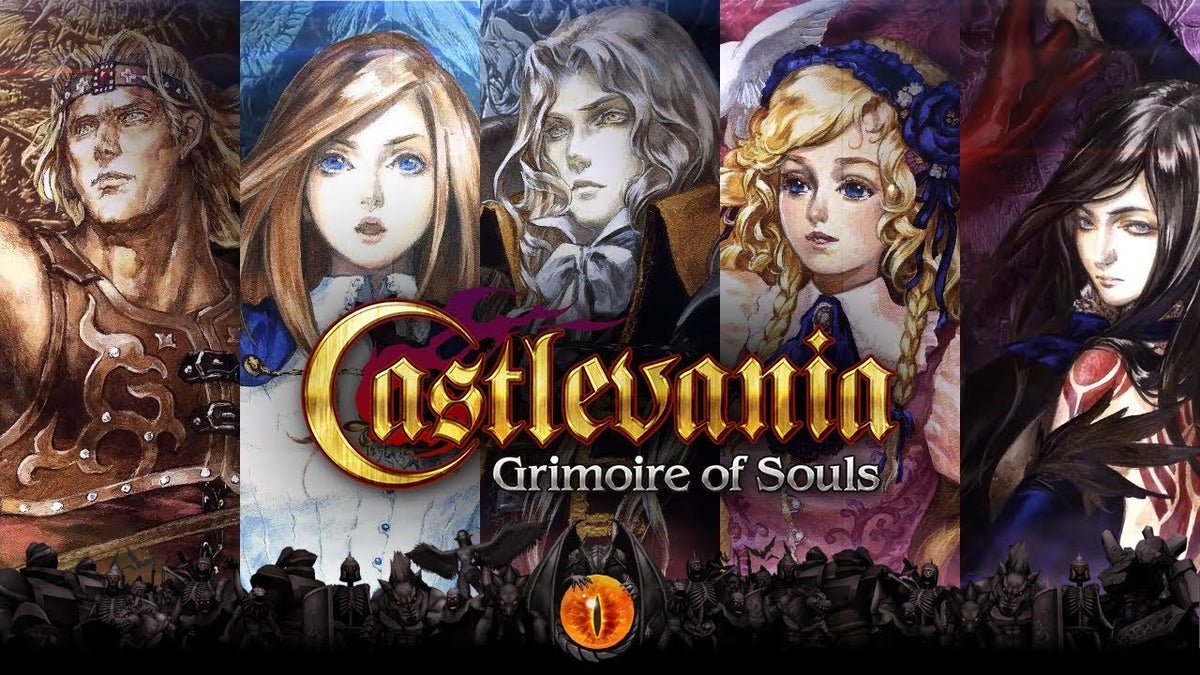
With Castlevania: Grimoire of Souls officially shutting down on September 3, 2026, I can’t say I’m particularly surprised by its fate. Originally launched as a free-to-play mobile game in Canada in 2019, it was discontinued the following year before returning as an Apple Arcade exclusive in 2021. While that gave the game another opportunity to find an audience, it also left behind a curious experiment that never quite figured out what it wanted to be. Removing the microtransactions made the experience more appealing, but it didn’t address the underlying design issues that came with building a game around them in the first place. Now that Grimoire of Souls is gone for good, I think it’s worth considering whether the concept itself was ever the problem.
For all its shortcomings, Grimoire of Souls had something that could have made it a much more interesting Castlevania spin-off. Its roster brought together characters from across the franchise, including Alucard, Simon Belmont, Charlotte, Shanoa and Maria, allowing players to experience different eras of the series through a single game. That is an appealing premise, especially for a franchise with such a rich history of protagonists, weapons and supernatural abilities. Unfortunately, the game never really did enough with that potential. Its short, mobile-friendly stages and relatively limited gameplay loop made the experience feel more like a collection of activities than a meaningful celebration of the series. The characters were there, but the game didn’t give them enough room to shine.
I don’t think Konami needs to abandon the idea of bringing these characters together. Instead, I would like to see the company take another crack at Grimoire of Souls as a premium action roguelike, with a structure similar to Dragon Is Dead and a much greater emphasis on character progression and storytelling. There is already a strong foundation for this kind of game within Castlevania’s history, and I think the combination of multiple playable characters, challenging combat and a deeper narrative could give the franchise a spin-off that feels distinct from its traditional Metroidvania entries.
One of the biggest advantages of this approach is that it would give Konami an opportunity to make each character feel meaningfully different. Simon Belmont could focus on traditional whip combat and sub-weapons, while Alucard could make use of his transformations, magic and weapon combinations. Shanoa’s glyphs could offer a more flexible approach to combat, while Maria and Charlotte could have their own distinct abilities and mechanics. Rather than simply offering different character models with slightly different stats, each protagonist could have their own skill trees, unlockable abilities and progression systems that encourage players to experiment with different playstyles.
This would also give the game a reason to embrace the roguelike format beyond simply making its stages more replayable. Castlevania has an enormous collection of weapons, relics, enemies and abilities that could serve as the foundation for a variety of builds. Holy water, axes, crosses and the soul-based abilities from games like Dawn of Sorrow could all be incorporated into a system where players discover new combinations during each run. A particular combination of relics might turn Simon into a powerful ranged fighter, while another could allow Alucard to focus on transformations and close-range combat. The possibilities are already there, and I think a roguelike structure could make them more interesting than simply unlocking everything through a traditional progression system.
However, I wouldn’t want Konami to focus entirely on the gameplay loop. One of the biggest opportunities with Grimoire of Souls is the possibility of bringing together characters from across the franchise and giving them a story that takes advantage of that premise. Castlevania has a rich history of characters, but many of them have never had the opportunity to interact with one another. A game that brings together Alucard, Simon Belmont, Shanoa, Maria and Charlotte could do much more than simply give players a collection of familiar faces to control.
I think Dracula’s castle could serve as the central hub for a game like this, with the various protagonists gradually uncovering the mysteries behind the grimoires and the reason they have been brought together. Rather than treating each run as a disconnected attempt to defeat Dracula, the game could use its structure to develop the characters and reveal more of the story over time. Alucard having to confront his father after a failed attempt to escape the castle could be an interesting narrative moment, while Simon Belmont finding himself working alongside characters whose methods are completely different from his own could create some entertaining interactions.
This is where I think a game like Hades could serve as a useful reference point, even if I wouldn’t want Grimoire of Souls to follow its structure too closely. Hades succeeds because its characters have something meaningful to contribute after each attempt, and returning to the hub feels like an important part of the experience rather than a punishment for failing. A new Castlevania spin-off could take a similar approach, with conversations, relationships and character-specific storylines developing as players make their way through the castle. The narrative should give players a reason to keep playing beyond the usual roguelike loop, while the gameplay provides the structure for exploring the story.
At the same time, I wouldn’t want the game to rely entirely on procedural generation. One of the defining characteristics of Castlevania is its carefully designed environments, particularly the castles themselves. A completely randomized collection of rooms would risk losing the atmosphere and sense of discovery that make these games so memorable. Instead, I would prefer a structure built around handcrafted rooms, recognizable locations and carefully designed boss encounters, with randomized routes and item drops providing some variety between runs. Ability-gated shortcuts that remain unlocked between attempts could also introduce a degree of Metroidvania-style exploration, giving players something to work towards beyond simply reaching the end of another run.
Progression would be particularly important to get right, especially considering the original game’s history. If Konami were to replace the old gacha system with a grind for currencies and character upgrades, it would be repeating many of the same mistakes under a different name. I would much rather see characters and abilities unlocked through story milestones, relationships and meaningful gameplay achievements. Stamina systems and daily missions should be nowhere to be found, and difficulty modifiers could provide additional challenges for players who want to test their skills. The goal should be to create an experience where progression feels rewarding because of what players accomplish, not because of how many hours they spend grinding.
The business model would be just as important as the gameplay itself. One of the unfortunate realities of Grimoire of Souls is that its existence was tied to a subscription service, and its online infrastructure meant that Konami could eventually pull the plug. A new version should be a premium release that can be played offline, giving players the opportunity to own and revisit the game without worrying about its eventual disappearance. Releasing it on Nintendo Switch, PC, PlayStation and Xbox would also give the game a much better chance of reaching the audience that would actually be interested in a Castlevania crossover.
Of course, there are reasons to be cautious about this idea. Dragon Is Dead and other action roguelikes demonstrate that there is an audience for challenging combat and replayable progression, but simply borrowing their structure would not be enough to make a new Grimoire of Souls worthwhile. Konami would need to approach the project with a clear understanding of what makes Castlevania special, rather than treating the roguelike format as a convenient way to produce a smaller spin-off. There is also the matter of Dead Cells, which received its own Castlevania crossover in 2023. A new game would need to offer something beyond the novelty of combining the franchise with another genre.
With Castlevania: Belmont’s Curse having launched on October 15, 2026, I also think Konami should give the series’ latest release some room to breathe before announcing another project. Still, that doesn’t mean the company should forget about Grimoire of Souls. Its original premise remains appealing, and I think there is a much better game hiding beneath the limitations of its mobile origins.
Ultimately, I would like to see Castlevania: Grimoire of Souls become something that can stand on its own rather than being remembered as another mobile game that eventually disappeared. A premium action roguelike built around Dracula’s castle, the franchise’s extensive roster and a meaningful progression system could be an excellent way to explore the series from a different perspective. Konami has already demonstrated that there is still an audience for Castlevania, and I think giving Grimoire of Souls a proper second chance could be another way to build on that momentum. The idea was never the problem. It just needed a game worthy of it.