

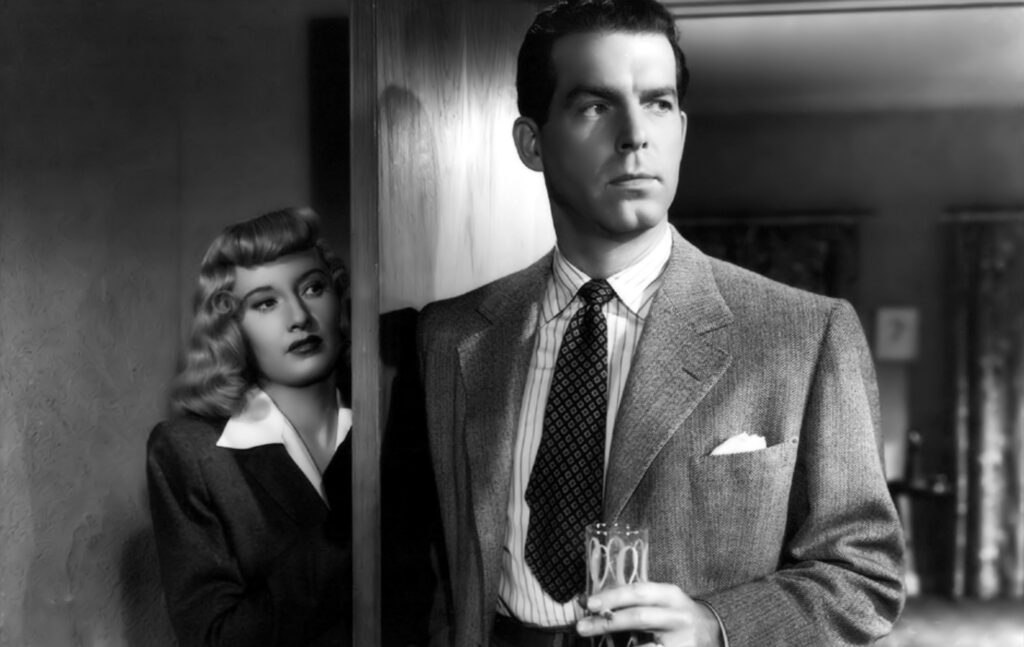
Few films have captured the darker side of human nature as effectively as Billy Wilder’s Double Indemnity. Released in 1944, this crime thriller helped establish many of the conventions associated with film noir, combining murder, deception, greed and doomed romance into a story about two people whose confidence in their own intelligence ultimately becomes their greatest weakness. More than eight decades later, its reputation remains well deserved, not simply because of its influence on cinema, but because the film itself remains an exceptionally constructed piece of storytelling.
Based on James M. Cain’s 1943 novella, Double Indemnity follows Walter Neff (Fred MacMurray), an insurance salesman whose seemingly ordinary professional life takes a dangerous turn after meeting Phyllis Dietrichson (Barbara Stanwyck). What begins as an encounter involving an insurance policy gradually develops into a scheme built around murder and financial deception. Neff believes his knowledge of the insurance business gives him the necessary advantage to carry out the plan, but the consequences of his involvement prove considerably more complicated than anticipated.
One of the film’s greatest strengths is how effectively it establishes the relationship between Neff and Phyllis. Their attraction is immediate, but there is always something unsettling about their interactions. Neither character is particularly forthcoming about their intentions, and their conversations frequently feel like negotiations between two people attempting to determine who has the upper hand. Rather than presenting their relationship as a conventional romance, Wilder makes it an increasingly uncomfortable partnership built on mutual temptation and distrust. Their willingness to pursue murder is disturbing, but the film is equally interested in the arrogance that allows them to believe they can escape its consequences.
Barbara Stanwyck delivers one of her most memorable performances as Phyllis Dietrichson, creating a character whose calculated demeanour makes her difficult to read. She is often regarded as one of cinema’s definitive femme fatales, and it is easy to understand why. However, what makes the performance so effective is that Stanwyck never reduces Phyllis to a collection of familiar genre characteristics. Her expressions, delivery and interactions with Neff suggest someone who understands the power she holds over others, even when the situation begins to move beyond her control.
Fred MacMurray is equally effective as Walter Neff. Known primarily for lighter comedic and romantic roles, MacMurray brings an interesting quality to the character. Neff isn’t introduced as an experienced criminal or someone who appears particularly dangerous. Instead, he is a confident insurance salesman whose professional experience gradually becomes intertwined with increasingly questionable decisions. His performance captures the character’s initial self-assurance while allowing the cracks in that confidence to become more apparent as the story progresses.
Edward G. Robinson provides another essential contribution as Barton Keyes, an insurance investigator whose instincts and attention to detail make him a formidable presence. His character could easily have been reduced to a conventional obstacle for the central duo, but Robinson gives Keyes considerably more personality and intelligence. His relationship with Neff is particularly important, adding an unexpected emotional dimension to a story otherwise dominated by manipulation and suspicion. Their exchanges also provide some of the film’s most engaging dialogue, especially when Keyes begins examining the details surrounding the increasingly suspicious insurance claim.
The screenplay, written by Wilder and Raymond Chandler, deserves considerable recognition for how economically it develops its characters and central mystery. Cain’s original novella provided a strong foundation, but the film’s structure and dialogue give the story a distinctive cinematic identity. Neff’s narration, delivered through a confession recorded after the events have unfolded, establishes an atmosphere of inevitability from the beginning. The audience knows that something has gone terribly wrong, making the gradual reconstruction of the events leading to that point particularly compelling.
Wilder’s direction is equally important to the film’s enduring appeal. The use of shadows, Venetian blinds and tightly framed interiors creates an atmosphere in which the characters frequently appear trapped by their surroundings. These visual choices are not simply decorative elements associated with the genre. They reinforce the increasingly suffocating circumstances surrounding Neff and Phyllis, while giving the film a distinctive visual identity. The contrast between seemingly ordinary domestic and professional environments and the criminal activities taking place within them also makes the story considerably more unsettling.
Although Double Indemnity is frequently celebrated as one of the defining examples of film noir, its influence should not overshadow its effectiveness as a crime thriller. Its central premise remains compelling because the characters’ downfall is not dependent on an elaborate conspiracy or an extraordinary series of coincidences. Instead, their problems emerge from their own decisions, misplaced confidence and inability to recognize the limits of their control. The insurance investigation provides the framework for the story, but the real tension comes from watching two people gradually discover that their carefully constructed arrangement is not nearly as secure as they imagined.
More than 80 years after its release, Double Indemnity remains an essential piece of American cinema. Its performances, dialogue, direction and carefully constructed narrative have helped it withstand the passage of time, while its examination of greed, manipulation and self-destruction continues to resonate. Plenty of crime films have borrowed from its visual language and narrative approach, but few have matched the precision with which Wilder brings these elements together. It is not simply a historically important film noir. It is an outstanding thriller that remains just as engaging today.