

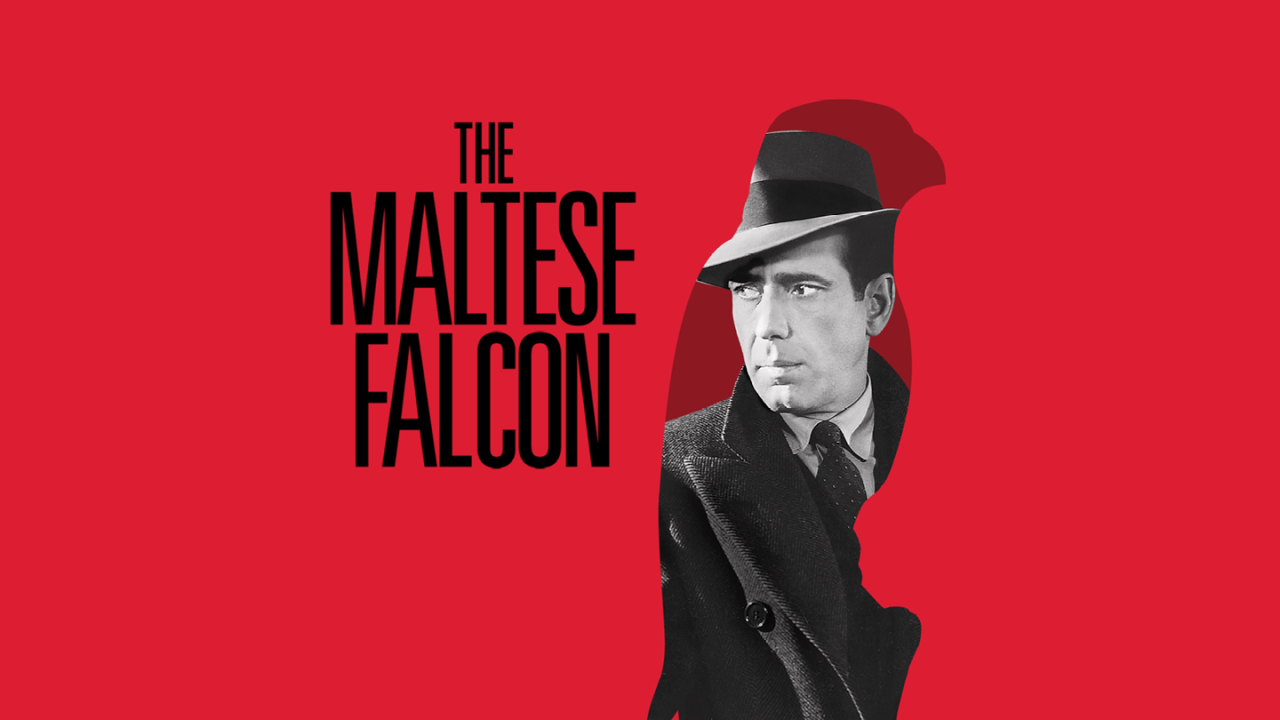
Let’s start with the bird. The black statuette at the centre of The Maltese Falcon is one of the most famous MacGuffins in cinema, and it racks up a body count that would embarrass most slasher villains. Of course, it’s also a fake, which is rather the point. The real treasure in The Maltese Falcon was never the bird. It’s the rogues’ gallery of liars, schemers, and opportunists who are ready to destroy each other for it.
Released in 1941, The Maltese Falcon was John Huston’s debut as a director, and what a way to start. Adapting Dashiell Hammett’s novel, Huston handed Humphrey Bogart the role of private detective Sam Spade, helping establish the hard-boiled detective as one of Hollywood’s most enduring character archetypes. Plenty of crime stories owe it a debt. That said, I’d argue its reputation has less to do with history than with how much fun it still is to watch people lie to one another.
The setup is simple enough. Spade and his partner, Miles Archer, take a job from a woman calling herself Miss Wonderly, who says her sister has run off with a dangerous man named Floyd Thursby. Archer turns up dead, then so does Thursby, and Spade finds himself stuck between the police, a client whose story keeps changing, and a crew of criminals hunting for a priceless statuette. A routine case becomes a tangle of double-crosses where practically nobody can be trusted.
That uncertainty is the engine of The Maltese Falcon. Spade isn’t just solving a murder or chasing a stolen trinket. He’s trying to stay in control of a situation where everyone in the room is working an angle on him. The mystery keeps changing shape, but his stubborn independence gives the story something solid to stand on.
Bogart is a huge part of why it works. Before The Maltese Falcon, he’d spent much of his career playing gangsters and supporting heavies, usually on the wrong side of the law. Spade was something different. His toughness comes from his brain, his cynicism, and his knack for spotting the moment someone is trying to play him for a sucker.
That said, Spade is no knight in a trench coat. He’s calculating, sometimes cruel, and perfectly willing to manipulate people when it suits him. His relationship with his dead partner’s wife adds another layer of moral murk, and his dealings with the police make it clear he has no interest in being seen as respectable. Yet he has a personal code, and it’s the one thing that separates him from the people surrounding him.
Bogart plays all of this with remarkable control. The pauses, the expressions, and the delivery often say more than the dialogue does. He can look amused one second and dangerous the next without ever feeling inconsistent, and that performance helped set the template for the private eye in film and crime fiction for decades.
Mary Astor’s Brigid O’Shaughnessy matters just as much. Introduced as Miss Wonderly, Brigid keeps rewriting her story as she tries to work Spade and everyone else after the falcon. It’s almost impossible to tell where her vulnerability ends and the act begins, which makes her one of the film’s most memorable characters.
The Spade and Brigid dynamic is the best part. Neither one fully trusts the other. She leans on her charm, and he stays fascinated even though he knows she’s lying. Every scene between them crackles with attraction and suspicion, with both of them holding something back. Brigid gets filed under femme fatale, but that label sells her short. She survives by adapting, deceiving, and reading the people around her, and Astor gives her just enough vulnerability to keep her sympathetic, even as her actions become harder to defend.
The supporting cast fills out the film’s rogues’ gallery beautifully. Peter Lorre’s Joel Cairo is eccentric and unpredictable, with refined manners hiding a willingness to turn violent. Sydney Greenstreet, making his film debut, gives Kasper Gutman a warm, polite surface that makes him far more unsettling than any thug. Gutman doesn’t need muscle. His intelligence, patience, and greed are what make him dangerous. Elisha Cook Jr. brings a different kind of menace as Wilmer, Gutman’s young gunman, who keeps getting treated as disposable by the very people he works for. It reinforces the film’s cynical view that loyalty is mostly a temporary arrangement.
Together, they make for a cast that’s a blast to watch precisely because nobody’s motives are easy to pin down. Their conversations are often as dangerous as their actions, and the dialogue has the kind of bite that became shorthand for hard-boiled storytelling.
The Maltese Falcon also shows how much atmosphere can do for a mystery. Cinematographer Arthur Edeson’s black-and-white photography leans into shadows, cramped interiors, and moody lighting. His San Francisco is a city of dim offices, hotel rooms, and late-night meetings where the truth rarely stays visible for long. Huston keeps things moving without losing the details that make the characters tick. The movie is built mostly on conversation, yet those scenes never feel static, because every meeting brings another complication, another lie, or another attempt to grab the upper hand.
Some critics call The Maltese Falcon the first true film noir. That’s debatable, since films like Stranger on the Third Floor (1940) are often cited as important precursors. Still, Huston’s film pulled urban corruption, moral ambiguity, hard-boiled dialogue, and shadowy cinematography together so effectively that it became a big part of noir’s visual and storytelling vocabulary.
It also wasn’t the first time Hammett’s novel hit the screen. Warner Bros. adapted it in 1931, and Satan Met a Lady took a looser, lighter run at it in 1936. The 1941 version remains the definitive adaptation, largely thanks to its performances and the way Huston translated Hammett’s writing into a tightly constructed film.
Then there’s the statuette itself. The falcon’s history is elaborate and its supposed value is enormous, yet the film cares far more about what the chase reveals about the people pursuing it. By the end, the statuette is revealed to be a counterfeit, a lead imitation of the priceless original. Gutman and Cairo respond by planning to continue their search for the real thing, which tells you everything about what greed does to a person. Spade, meanwhile, hands Brigid over to the police, despite his feelings for her. His final description of the statuette as the stuff that dreams are made of is as cynical as it is memorable. He doesn’t walk away from the mess unscathed, but he refuses to let it dictate his code.
The film’s reach goes well beyond 1941. It helped shape later movies, TV series, and novels, and Bogart’s Sam Spade is still one of crime fiction’s most recognizable faces. The film earned three Academy Award nominations, including Best Picture, Best Supporting Actor for Greenstreet, and Best Adapted Screenplay for Huston. It also launched Huston’s career as a major filmmaker, one that kept coming back to greed, ambition, and the messiness of human behaviour.
What keeps The Maltese Falcon alive, though, isn’t just its place in the history books. The characters are still engaging, the dialogue still has teeth, and the mystery still holds your attention because the people involved are so much more interesting than the thing they’re chasing.
The Maltese Falcon is about people who think they can outsmart everyone around them, only to learn that deception is a game nobody is guaranteed to win. Spade emerges from the mess because he knows where his own line is, even when respecting it costs him something he wants. For a movie that helped define film noir, that’s a pretty fitting legacy. The Maltese Falcon is not just a mystery about a missing statuette. It’s a story about greed, deception, and the fragile codes people cling to when everything else falls apart.