

Jon’s Thoughts
Few licensed games have captured the appeal of their source material quite like Godzilla: Destroy All Monsters Melee. Originally released for the Nintendo GameCube in 2002, Pipeworks Studios’ kaiju brawler understood that the appeal of controlling Godzilla was not simply about trading attacks with other monsters, but about watching entire city blocks crumble in the process. More than two decades later, the original developer has returned with Godzilla: Destroy All Monsters Melee Remastered, bringing its monster-sized battles to modern platforms with rebuilt visuals, a revised progression system, additional single-player content and online multiplayer.
The premise is appropriately ridiculous, taking inspiration from Toho’s 1968 film Destroy All Monsters. An alien race known as the Vortaak has invaded Earth and taken control of its giant monsters, sending them on rampages across the planet. Players take control of one of the few kaiju to escape that influence, fighting through the remaining monsters before taking the battle directly to the invaders. The story is delivered through a handful of cinematics and is hardly going to win any awards, but the campy science fiction charm that has always been part of the franchise comes through, and that is all a game like this really needs.
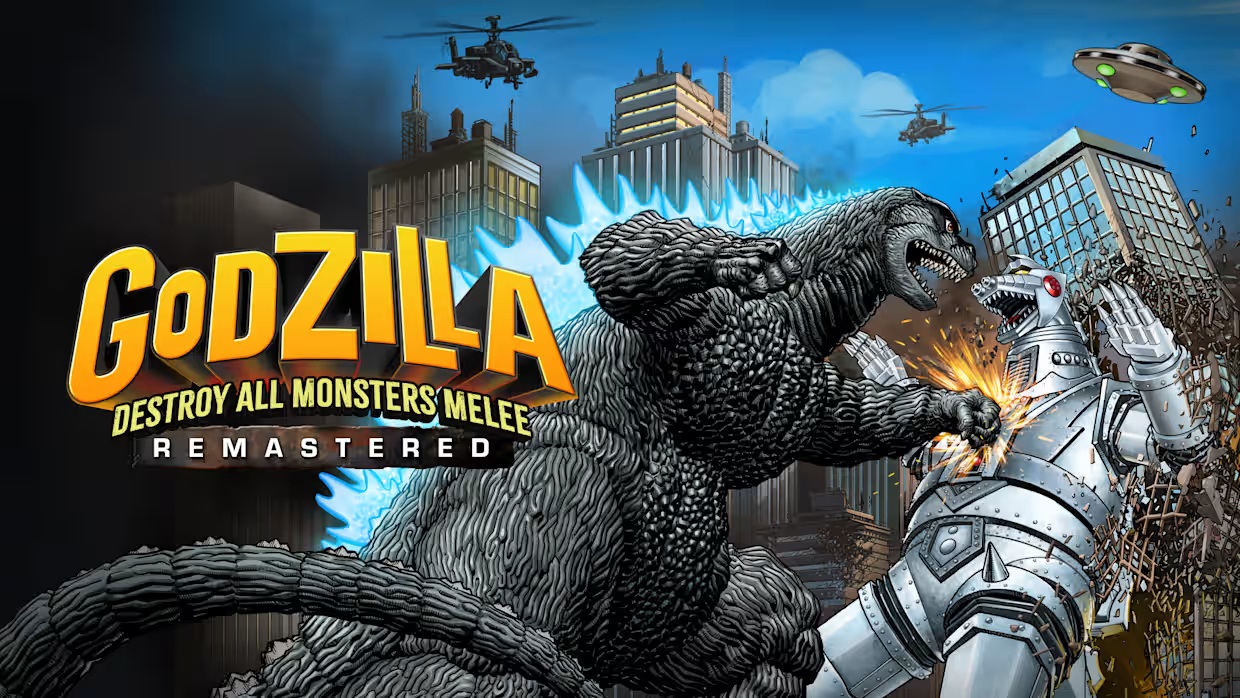
The biggest improvement is immediately apparent when the monsters take the stage. Rebuilt in Unreal Engine 5, Godzilla: Destroy All Monsters Melee Remastered features significantly enhanced character models, environments, lighting and visual effects. Individual scales, metallic textures and smaller details help bring the kaiju to life on modern displays, while the cities benefit from improved textures and lighting that give them a much-needed facelift. The destruction also remains an important part of the presentation, with collapsing buildings and the various effects accompanying the monsters’ attacks helping sell the scale of each encounter. A visual overhaul can sometimes strip away what made an older game special, but Pipeworks has largely avoided that trap.

What makes the presentation so effective is how well the remaster preserves the original’s identity. The exaggerated proportions and colourful personalities remain intact, so the monsters still look like oversized versions of their cinematic counterparts rather than dramatically redesigned interpretations. The resulting battles retain the same wonderfully silly energy that made the GameCube release memorable, and watching Godzilla and King Ghidorah trade blows in the middle of a city while buildings collapse around them is as entertaining as it sounds.
The Switch 2 version is particularly impressive, considering the demands that can come with Unreal Engine 5. The game generally maintains a smooth 60 frames per second in both docked and handheld play, with only minor fluctuations during the most chaotic four-player encounters. These occasional dips do little to undermine the overall experience, and performance remains consistent enough that the action rarely feels compromised. Loading times are also quick, making it painless to jump between battles, while the portability is a real advantage for a game that lends itself so naturally to local multiplayer. The PC version on Steam offers additional graphical options, providing more flexibility for players who want greater control over the presentation.
Improved visuals would mean very little if the fighting were not enjoyable, and thankfully this is where the remaster continues to shine. This is not a traditional fighting game built around complicated motion inputs and extensive combo routes. Instead, it is an accessible 3D arena brawler that emphasizes positioning, environmental interaction and the individual abilities of its monsters. Punches, kicks, stronger attacks, blocks, grabs and special abilities form the foundation of combat, while directional inputs can be combined with attacks to perform additional moves without making the controls unnecessarily complicated. The emphasis is on improvisation and making the most of each monster’s abilities rather than mastering elaborate combinations, which makes the game easy to pick up without sacrificing all of its strategic possibilities.

Each monster has its own distinct characteristics, and learning how to use them adds considerable variety. Godzilla is a reliable all-rounder with his iconic atomic breath, while Gigan can use his teleportation ability to catch opponents off guard. Megalon can burrow underground to surprise enemies, Anguirus can punish incoming attacks with his defensive spikes, and flyers such as Rodan and King Ghidorah have an edge when it comes to positioning and evasion. Mechagodzilla and its mechanical counterparts bring their own ranged attacks and devastating abilities, although some characters are noticeably more effective than others.
The shared basic controls make it easy to switch between fighters without having to relearn the game. Each kaiju also has powerful attacks that consume energy, and filling the appropriate gauge allows them to activate Rage Mode and unleash an especially destructive ability. These attacks come with dramatic camera angles and visual effects that make each encounter feel like a miniature monster movie. They also provide some of the most satisfying moments during particularly close battles, especially when a well-timed special attack can turn an otherwise losing encounter around.
The real appeal of the combat, however, comes from the environments. Battles take place across recognizable locations including Tokyo, Seattle, London and Monster Island, and the buildings and objects in them are far more than background scenery. Players can grab skyscrapers, vehicles, ships and other objects and hurl them directly at opponents, and picking up an entire building only to watch it collapse against another monster never really gets old. The destructible environments give the battles a sense of scale that many other arena fighters struggle to replicate, making the surroundings feel like an integral part of the experience rather than simply attractive backdrops.
The environments also introduce some welcome strategic considerations. Buildings can block incoming beam attacks, and smart movement can prevent players from being surrounded by multiple opponents. Military forces and alien craft occasionally interfere with battles, launching attacks that can damage either combatant and create unexpected openings. Power-ups restore health, replenish energy or provide other advantages that can turn the tide of a fight, adding another layer of unpredictability to encounters. These elements help prevent battles from feeling too repetitive, even when the underlying mechanics remain relatively simple.
There are some rough edges that come with preserving a game designed for the GameCube generation. Character movement can feel cumbersome, and the camera does not always cope particularly well with crowded environments. Certain attacks and objects are also disproportionately effective, which can make it tempting to keep throwing whatever happens to be within reach instead of experimenting with a monster’s full moveset. Some encounters can consequently feel a little messy, particularly when several kaiju and environmental hazards are competing for attention. That said, these quirks are part of the game’s personality, and the resulting chaos is usually more entertaining than frustrating.

The single-player side has received considerable attention. Adventure Mode remains the main attraction, offering an arcade-style progression through increasingly challenging encounters, with each monster following its own route before confronting the Vortaak. It provides a straightforward way to experience the campaign with different characters, although individual playthroughs are relatively short on standard difficulty. The remaster adds Adventure Gauntlet, which pits players against multiple opponents at once, and Adventure Challenge, which introduces additional objectives and restrictions. These variations provide worthwhile alternatives to the standard campaign, encouraging players to approach familiar encounters differently rather than simply repeating the same sequence of fights. They also unlock as individual monsters gain experience, giving players an additional reason to spend time mastering their favourites before tackling the tougher content.
Destruction Mode offers a welcome change of pace by removing opposing kaiju and letting players rampage through a city within a time limit, which is exactly as satisfying as it sounds. It is a particularly enjoyable way to appreciate the environmental destruction without having to worry about another monster constantly interrupting the fun. Survival Mode takes the opposite approach, challenging players to defeat successive opponents while carrying damage between fights. Managing health becomes increasingly important as the battles continue, making it a more demanding test of endurance than the standard encounters. Practice Mode is available for learning individual movesets, while Custom Battle allows players to set up their own matchups and adjust the rules. Together, these modes give the package some welcome variety, although their long-term appeal naturally depends on how much players enjoy the core combat.
One of the more interesting additions is Director Mode, which gives players greater control over the camera during battles. By adjusting camera positioning and other presentation options, it is possible to capture genuinely impressive shots of the monsters fighting across the environments. It is a relatively small feature, but one that suits the franchise perfectly, since so much of Godzilla’s appeal comes from the sight of giant creatures sharing the screen. It also provides an opportunity to appreciate the visual improvements from different perspectives, making it a welcome inclusion for fans who enjoy the cinematic side of the series.
The remaster also revises progression through the G-Force Lab. Instead of simply unlocking new monsters after completing particular campaigns, players earn experience and Research Points through the various modes. Experience levels up individual monsters, improving their attributes and unlocking abilities, while Research Points are spent on new characters, arenas and other content. The lab organizes these unlocks through Rumours and Projects, with players investigating Rumours by meeting certain conditions and eventually turning them into Projects that can be completed with accumulated Research Points. This offers more direction than the unlock system of the original, while gallery items and collectibles, including artwork and archival material, provide additional incentives for longtime fans to explore everything the remaster has to offer.
Unfortunately, the revised progression system also introduces one of the remaster’s more frustrating problems. While earning experience and Research Points gives players a reason to revisit the different modes, unlocking everything demands a considerable amount of repetition. Certain characters also have additional requirements that must be met before their Projects become available, meaning accumulating enough Research Points does not necessarily guarantee access to the content being pursued. Some abilities are similarly tied to individual character levels, requiring even more time before a monster reaches its full potential. Developing a favourite kaiju is satisfying initially, but the process becomes increasingly tedious when it involves repeatedly revisiting the same Adventure encounters. The additional progression systems are a welcome attempt to give the remaster more longevity, but the amount of grinding required can undermine that goal. This is especially noticeable because the roster contains only twelve playable monsters, and having so much content locked behind progression feels unnecessarily restrictive and it is also disappointing that the remaster does not use the opportunity to bring in more recent additions to the franchise.

Multiplayer is where the design of the original comes together most naturally. Local battles support up to four players, who can choose their favourite monsters and turn the environments into enormous wrestling rings. The accessible controls make it easy for newcomers to join in, while the different abilities and interactive environments keep matches unpredictable. The destructible surroundings are particularly entertaining when multiple players are involved, as the battles can quickly descend into a spectacular mess of flying buildings, beam attacks and monsters being thrown across the screen. On Switch 2, a single Joy-Con 2 is enough for local multiplayer, making it much easier to get extra players involved without everyone needing a full controller. This convenience makes the game an especially natural fit for Nintendo’s hardware.
Online multiplayer is included as well, but its limitations are disappointing. Matches are restricted to one-on-one encounters, so the four-player chaos that makes the local mode so much fun is not available online. Cross-platform play is also absent, further limiting the potential player pool. The addition is still welcome for anyone without other players nearby, but it feels like a missed opportunity. Being able to bring the larger battles online would have made multiplayer considerably more appealing and given the remaster a stronger reason to remain part of players’ rotations beyond its local offerings.
Godzilla: Destroy All Monsters Melee Remastered is ultimately a game that understands the appeal of its source material. It does not try to turn the original into a complicated modern fighting game, nor does it reinvent the experience with unnecessary mechanics. Pipeworks has instead focused on preserving what made the GameCube release enjoyable while improving the presentation and adding enough modern features to make its return worthwhile. There are dated design decisions, particularly in how the full roster is unlocked and in the limitations of online play, while the relatively small selection of monsters leaves room for improvement considering how much the franchise has grown since 2002. Nevertheless, the core combat remains entertaining, the rebuilt visuals look excellent, and the Switch 2 version is a particularly strong way to play. Its combination of portability, local multiplayer and generally smooth performance makes it a natural fit for Nintendo’s hardware, while the Steam release gives PC players an appealing alternative.

Godzilla: Destroy All Monsters Melee Remastered may not be the definitive Godzilla video game that fans have been waiting for, but it is a welcome return for one of the franchise’s most enjoyable adaptations. Whether playing through Adventure Mode, experimenting with different monsters or gathering friends for a chaotic four-player brawl, there is plenty of fun to be had watching these enormous creatures tear through familiar cityscapes. Hopefully, this revival also encourages Atari and Pipeworks to revisit the rest of their Godzilla trilogy, particularly Godzilla: Save the Earth and Godzilla: Unleashed. For now, the King of the Monsters has made a thoroughly entertaining return to modern platforms.
Ryan’s thoughts
Look, I’ll be honest, my Godzilla knowledge pretty much starts and ends with that 2000 movie with the giant lizard stomping through New York, and my fighting game experience with these guys is limited to mashing buttons in King of the Monsters back on the SNES.
So jumping into this story mode was quite the experience. Apparently, an alien race called the Vortaak comes to Earth, mind-controls a whole squad of giant monsters, and turns them into a roving demolition crew to flatten major cities. You play as a monster trying to break free from their alien mind control or help them destroy everything; by beating up rival titans, smashing alien broadcast towers, and eventually taking the fight right to the Vortaak Mothership. It’s totally ridiculous and really over the top, but honestly? It’s the perfect, low-stress setup for watching giant monsters trash city blocks.
Coming straight from the simple, rigid brawler that is King of the Monsters, taking control of these monsters in a full 3D arena blew my mind. You’re not just punching and kicking on a flat plane anymore. You can actually pick up a literal skyscraper, walk across an intersection, and hurl it directly at King Ghidorah’s face.

It supports up to four players in chaotic local matches or online, slinging atomic rays and heavy combos everywhere. The controls can feel a little heavy and clumsy when you’re trying to line up grabs, but the sheer fun of triggering a “Rage Mode” and unleashing pure chaos makes up for it entirely. Plus, the unlock system lets you earn new monsters and stages without forcing you down one strict path, which keeps things super approachable for a newcomer like myself.
I don’t have the original 2002 GameCube version to compare this to, but playing it natively on the Switch 2, the game looks crisp and surprisingly modern. The monsters look detailed with sharp scales and bright, punch heavy hitting beam effects that light up the whole screen. The real-world arenas like Osaka and San Francisco actually look like actual cities, and it’s super easy to tell which buildings you can rip out of the ground to use as weapons mid-fight.
The sound in this game is an absolute blast, even if you don’t know every single monster’s backstory. Hearing those loud, echoing roars blast out of the speakers really makes you feel like you’re controlling something massive. Every punch, metallic Mechagodzilla thud, and crumbling building has a heavy, satisfying crunch to it. The soundtrack shifts between energetic rock riffs and dramatic orchestral themes that amp up the tension when a fight gets close. It does a killer job selling the scale and weight of two giant beasts tearing up a downtown district.
As someone who hasn’t touched a monster brawler since the 16-bit era, Godzilla: Destroy All Monsters Melee Remastered on Switch 2 was an absolute blast to jump into. It doesn’t force you to learn complex, competitive arcade combos just to have fun; it just hands you a giant monster,and tells you to have fun.
With super smooth performance, bright updated graphics, online play, and pure arcade chaos, it’s a fantastic pickup for casual couch co-op and anyone who just wants to throw a building at someone!
Disclaimer: Review keys were provided.