

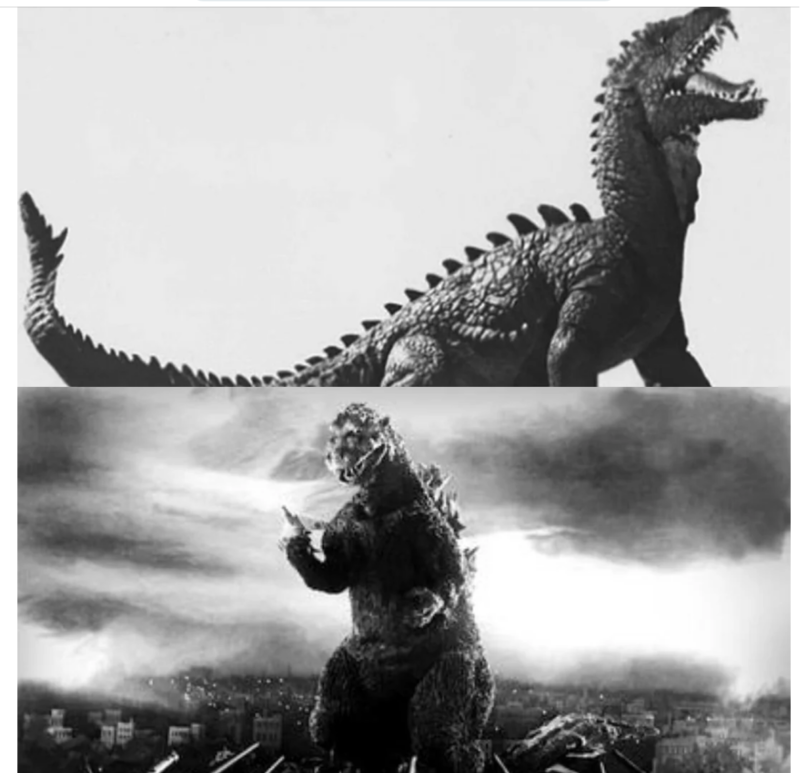
Today is Godzilla Day, which marks the anniversary of the original Godzilla opening in Japan on November 3, 1954. Every year around this date, the conversation tends to circle the same names: Ishirō Honda, Eiji Tsuburaya, and producer Tomoyuki Tanaka. Rightfully so. Of course, no monster is born in a vacuum, and one of the more interesting threads in Godzilla’s family tree runs back through an American short story about a very lonely sea creature and a lighthouse.
That story is Ray Bradbury’s “The Fog Horn.” It first appeared in The Saturday Evening Post on June 23, 1951, under the title “The Beast from 20,000 Fathoms,” before being retitled for Bradbury’s 1953 collection The Golden Apples of the Sun. It centers on a prehistoric creature drawn to the sound of a lighthouse’s foghorn. It is a sad, poetic little tale with very little in the way of rampaging, and that is exactly what makes what happened next so curious.
The producers Jack Dietz and Hal Chester were already developing an independent monster film called The Monster from Beneath the Sea, and its script included a sequence in which the creature destroys a lighthouse. Ray Harryhausen, a longtime friend of Bradbury’s, pointed out that his pal had published a story featuring a remarkably similar scene. The producers subsequently acquired the rights to Bradbury’s story, and the film was released under its original magazine title, The Beast from 20,000 Fathoms. It also received a credit reading “Suggested by the Saturday Evening Post Story by Ray Bradbury.” A price of around $2,000 is often repeated, although that figure comes from Harryhausen’s recollection, and accounts of how the deal came together are somewhat murky and conflicting. Bradbury himself later recalled being invited to read the screenplay before pointing out its similarities to his work. Either way, the finished film is only loosely connected to the original story, with the lighthouse sequence being its most recognizable link. It is widely credited as the first giant-monster film to feature a creature awakened by an atomic explosion, and Harryhausen’s Rhedosaurus was tearing through New York approximately sixteen months before Godzilla reached Japanese screens.
That timing matters. According to TCM, Tanaka read a synopsis of The Beast from 20,000 Fathoms in a trade magazine, and it helped inspire him to develop a Japanese giant-monster film. He was also looking for a replacement project after a planned Japanese-Indonesian co-production fell apart. Tanaka was additionally influenced by the Lucky Dragon No. 5 fishing boat incident, which brought renewed attention to the dangers of nuclear testing, as well as the 1952 theatrical re-release of King Kong. Writer Shigeru Kayama’s initial treatment for Godzilla drew from several monster-movie influences, including The Beast from 20,000 Fathoms, and even included a scene in which Godzilla attacked a lighthouse. That sequence would ultimately be removed during the film’s development. However, Toho’s production went somewhere very different from its American counterpart. Where The Beast from 20,000 Fathoms ultimately presents a creature that can be defeated through scientific intervention, Godzilla treats its monster more like an unstoppable natural disaster, with the destruction of Tokyo becoming a central part of the film’s identity. The original Japanese production also carried a much more pointed message about the consequences of nuclear weapons.
Now for the part I find the most fun. Bradbury’s story has a quieter afterlife among people who actually build Godzilla-style monsters. Japanese filmmaker Daisuke Sato and his crew from the Replica Co. production studio were working on costume and suitmation designs for Godzilla: Final Wars (2004) and Gamera the Brave (2006) when they decided to take on “The Fog Horn” themselves. The result was a roughly 20-minute experimental short completed in 2007. Sato described the project as a demonstration of the crew’s technical abilities, but copyright complications prevented it from being released to the public. For years, the only glimpse most people could get was through a trailer that eventually surfaced online.
Sato did not leave the story there. He returned to the material with Howl from Beyond the Fog, a crowdfunded short that he wrote and directed. The project emerged through a Kickstarter campaign in late 2017 and eventually premiered at the Atami Kaiju Film Festival on November 24, 2019. The creature, called Nebula, was brought to life using traditional Japanese practical effects techniques, with contributions from veteran monster maker Keizō Murase, whose credits include classic productions featuring Mothra, Varan, and Gamera. The film continued the spirit of the original project while giving Bradbury’s story another opportunity to reach audiences through the very filmmaking traditions that helped bring Godzilla to life. A home-media release followed, with SRS Cinema and MVD Entertainment bringing the film to North American audiences.
To be fair, Sato is the clearest example I have found of someone from the Godzilla and tokusatsu world carrying a torch for Bradbury’s original story. There is little evidence to suggest this is a wider tradition among Toho crews, so it is probably best viewed as an unusual passion project rather than an established connection. Still, it is a fitting little loop for Godzilla Day: a story about a monster that rises from the deep helped inspire a film, which helped inspire the King of the Monsters, and then a filmmaker who worked on Godzilla’s suits went back to adapt the story that helped set that chain in motion. So whether you spend today with the 1954 original or Harryhausen’s Rhedosaurus, spare a thought for Bradbury’s lonely sea creature and the lighthouse that helped set an entire genre in motion.