
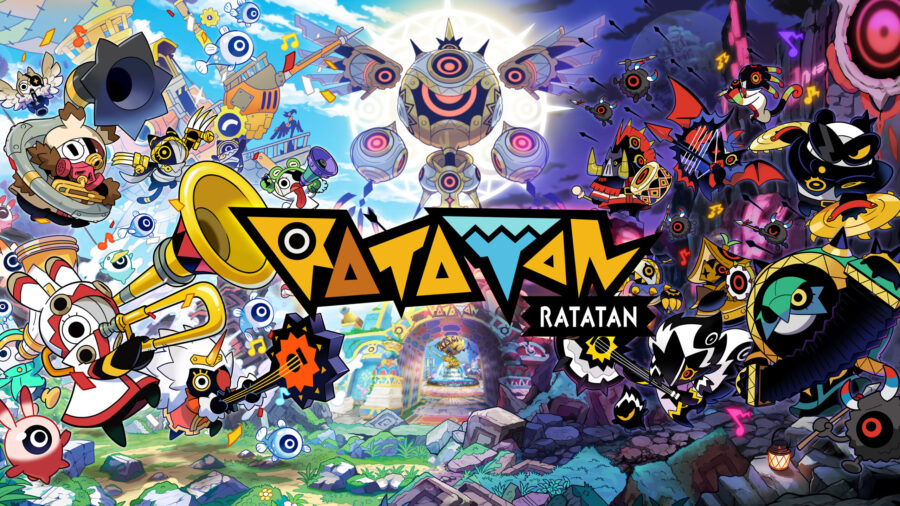
Rhythm is back! Well, to be fair, it never went away and rhythm games are a massive genre but the developers of one of the most unique rhythm games ever are back with a spiritual sequel. That’s right, Ratatan is here from developer Ratata Arts and publisher Game Source Entertainment. These are some of the famed developers that created the original Patapon trilogy as well, so you know things are going to get interestingly weird pretty fast.

Ratatan is a combat rhythm roguelike. Yes, that’s a mish-mash of gaming terminology but it suits the game. You play as a Ratatan (*gasp*), a weird creature who is able to imbue strength into their little compatriots called Cobuns with the power of your musical prowess. The entire game takes place on the very colorful Rataport Island and you’ll be dealing with Crow, a mysterious crow who gives you a skeletal story rundown and directs you for the first world or so and when things open up in Rataport. Then it’s time to dive right in with World 1!

Here’s where the rhythm and combat come in. You’ll choose one of the eight Ratatans to control and each Ratatan has two different types of Cobuns which hold different weapon combinations (and some crossover in Cobuns between Ratatans). It’s all a bit confusing and opaque at first and there are very few tutorial directions that are easy to accidentally bypass. Within the stage there’s a constant beat in the background and just like the Patapon games, you’ll have to hit combos of two or three buttons to trigger the Cobuns’ attacks, defense, and responses. Each possible move is conveniently displayed on the screen too, making it simple to string together combinations. Unlike the older series however, there are some significant differences. For starters, you’re in direct control of your Ratatan, which means that in addition to playing the rhythms, you’ll also have to dodge attacks. You’ll also have to choose which bonus cards you take, modifying the abilities of your Cobuns as you complete various stage segments.

Ratatan is described as a roguelike as well, but in many ways it doesn’t feel like one. The game is extremely linear with a set number of sections per World. This is a sidescrolling game, so you’ll be walking from left to right and at the end of each stage, and as you complete each portion, you choose one of two options for prizes from the next segment. These may be tokens to spend at the in-stage shops, new specialty Cobuns, or health boosts and other bonuses. Each new stage segment is randomized but the enemies are fairly standard, so they feel very similar regardless of which random segment you get.

You’ll also earn cards that you can slot in as attacks, skills, and bonuses but this is very poorly explained. The cards give your Cobuns additional abilities and attacks and the idea is to pick ones that are complementary to each other and your combat style. Cards can give damage bonuses, any combination of six different elemental attacks, and a variety of boosts that can massively upgrade your Cobuns’ damage and abilities. Choosing cards that work together makes levels a lot easier but it still takes some practice to get the hang of which cards to choose. You get one skill card, one attack card, and the rest are bonus cards, but choosing a new skill or attack card automatically replaces the current one.

If your Ratatan dies (and it definitely will…a lot), you’re returned to the main island area. Any items you found return with you and as you progress in the game, you’ll get better and better gear. You’ll also unlock the Blacksmith, who allows you to combine weapons found in the levels, making them more and more powerful. Some of the other characters also have additional upgrades activated by candy and doughnuts you find in stages that add permanent benefits. Eventually you’ll find rare and even legendary weapons which significantly boost your Cobuns’ stats. The idea is that each time you die, you get incrementally better and while yes, this is a standard roguelike formula, it feels particularly grindy. If you play something like Dead Cells for example, the gameplay loop is fun and variable enough that you don’t get bored quickly. In Ratatan, that’s noticeably different as the portions of each world feel particularly similar and the progress is very slow. Unlike Patapon, once you die, you don’t get to go directly back to the stage you died in either. Instead, you’ll play through all of the worlds one after another, and though they get progressively easier, grinding for gear and items becomes tedious very rapidly.

Enemy attacks and bosses get progressively more complex as you work your way through the worlds of Ratatan as well. Early on, you can mostly focus on the rhythm but as you move from world to world, you have to balance keeping your Ratatan alive with maintaining your rhythm. This makes it hard to keep a Fever going (when you get enough consistent correct patterns in a row) because you’re actively stopping the rhythm and losing your beat in order to control your Ratatan. This is frustrating because if you start to input a beat, the Ratatans just stop dead, often directly in the path of oncoming attacks. Your Cobuns do the same if you don’t have them follow you, guard, or jump, and even with guards up, you’ll all still take a bit of damage. Since this is a roguelike, there’s no guarantee you’ll get health back before the boss either, meaning that sometimes a run is a wash and there’s no help for it. That’s especially frustrating once you get to higher levels and have to play all the way to World 3 or 4 only to be stymied by some bad luck in terms of your bonus draws. Eventually you’ll unlock guaranteed health fountains for each stage, but it definitely takes a while.

Moving on to the visuals, Ratatan is a vibrant and stunning world to look at. Rataport Island, while small, is so busy and colorful that it’s hard to know where to look at all. Once you get used to the busy graphics of the game, there are really only a few locations going on, but the field depth of both the levels and the island are excellent and a lot of love has clearly gone into both character and level designs. Stages are equally beautiful to look at and the little Cobuns and vicious enemies alike are lovingly crafted. Bosses are particularly complex and interesting…it’s just a shame you don’t have time to admire them more as they’re slaughtering you. Sadly, while the game is outstanding to look at, there’s so much visual clutter most of the time that it’s hard to see what’s going on and combat becomes an absolute mess of explosions, weapons, clumped enemies, Cobuns, and Ratatans.

As for sound, this is a game based on music, so there’s plenty going on here. Lots of musical noise everywhere makes for a chaotic experience, and your rhythms, the enemy noise, the cheering Cobuns, and the background beat create a cacophony that is hard to muddle through. While the beats are good and the visual cues are excellent, there’s just as much going on with the audio as there is with the visuals and it can be a bit overwhelming at times. The Cobuns and all the yelling make it so you can barely hear the music sometimes, the same issue we noticed with the busy visuals. Each Ratatan has a different voice and plays a different instrument, which is neat, but the overall music and rhythms are a bit less compelling than you might hope…when you can hear them over the beat and the characters. The music in Rataport is particularly repetitive and after a while, every time we died, we cringed inside a bit and turned the sound down. For a music-based game, that’s a bit more disappointing than you might hope, and the music for Ratatan definitely isn’t going to be for everyone.

You might have surmised by now that Ratatan has a few design issues and you wouldn’t be wrong. That’s not to say it isn’t a good game, but there are some odd choices that limit its potential and fun factor. Maybe it’s a conscious decision to step a bit away from the Patapon fomula but Ratatan still feels like Patapon so much that this seems like a misstep. Being forced to grind the same worlds over and over, even though they get easier becomes tedious so rapidly that you start to dread the boss fights. Not because they’re incredibly hard, but instead because any death means working your way back through all the previous stages with a different random loadout that might not work as well. This works in other roguelikes but the lack of stage variety (new backgrounds and a few new enemies) makes it a slog instead of fun like Rogue Legacy or Dead Cells and the homogeneity of the combat exacerbates the issue.

In addition to the main loop being too repetitive, there are some other minor issues as well. There’s a skeleton of a plot here, which is fine but a little disappointing. After the beginning of the game, there’s almost no nod given to the plot. Some of the things you can do in town are extremely limited as well, so aside from unlocking the occasional permanent bonus or blacksmithing, you’re mostly just rushing back into the game to try and get a bit further. Having more to do to take a break from the loop might have been better here to separate the experience a bit so it doesn’t get stale. Once you beat all five worlds you unlock additional content including a new episode and some additional options to make the game harder but that will only appeal to a handful of players. Most people will switch to Welcome mode pretty quickly because it allows you to buff up your characters when you fail and if that’s the default mode for most players, the game’s balance is noticeably off.

As much as we’d love to recommend it, Ratatan is at best, a mixed bag. The colorful designs and visuals are neat, the overall concept is solid, and the variety of playable characters is fun. Blacksmithing is cool and the card based options are great, but the gameplay loop itself quickly becomes too routine, the visuals and sound are incredibly busy, and runs are very inconsistent, creating a lot of frustration. The initial portion of the game is very fun but it doesn’t take long for the design choices here to become stale and that’s not great. Unfortunately, there are simply better rhythm action games out there, including the recent re-release of the first two Patapon games, and even at only $35, not every player is going to get their money’s worth before the experience wears thin.

This review is based on a digital copy of Ratatan provided by the publisher. It was played on a Playstation 5 using a 55” 1080p TV and on the PS Portal where the game played equally well. Ratatan is also available on Xbox, Switch 2, and PC on Steam.

Nate Van Lindt has been a gamer since the days of yore (aka Commodore 64), and has played a bit of virtually everything out there. He's also an avid comic book collector, both vintage and current, and reads a fair amount of sci-fi and fantasy. On top of that, he watches a fair number of movies and TV shows as well. Oh, and he has a family, a full-time job, and lives somewhere in the urban wilds of Southwestern Ontario, Canada, foraging for old video cables and forgotten game soundtracks.