

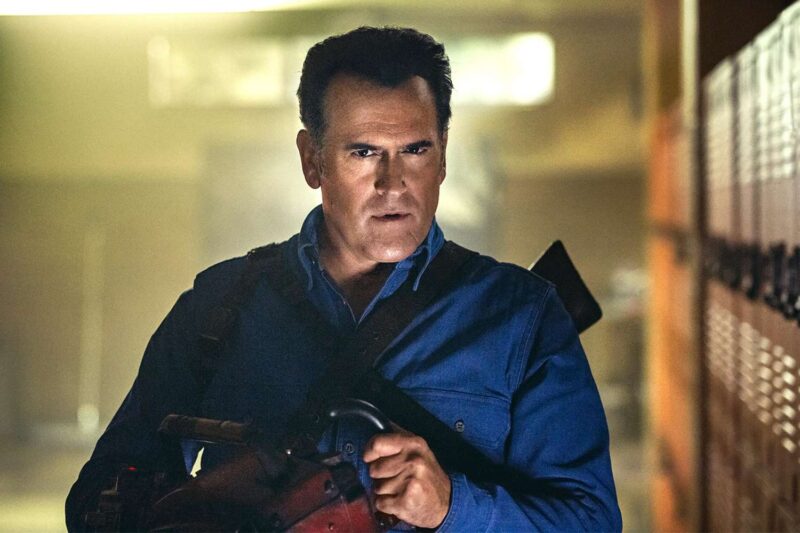
Every horror franchise eventually has to answer the same question: what happens when the face of the series walks away? A Nightmare on Elm Street has spent years dealing with the idea that Freddy Krueger and Robert Englund are one and the same, and the remake did little to argue otherwise. Evil Dead has faced a similar problem, but it has managed to handle it rather differently.
The numbers are certainly encouraging. The three Evil Dead films made without Ash Williams have pulled in roughly $300 million worldwide on a combined budget of just over $50 million, and all three have been well received critically. That is a healthy run for a franchise that has lost its most recognizable star. The question, however, is whether that success can continue, particularly when the series may have lost something more important than its leading man.
Evil Dead has always been a simple story attached to a complicated collection of movies. Each entry offers a different experience while recycling a handful of familiar ingredients, and that willingness to change direction is a big part of what makes the franchise one of the most consistently entertaining runs in horror.
The original Evil Dead sends a group of college students to a cabin in the woods, where they discover a tape recorder and the Necronomicon Ex-Mortis. They play the recording, the words are recited, and a demonic force starts taking people over. It is a bare-bones premise, but it does not need much more. The film helped establish the cabin-in-the-woods setup that would influence countless horror movies, from Cabin Fever to Tucker and Dale vs. Evil. It is also a decidedly amateur production, with crew members wandering into frame, focus slips, and hair that seems to change length between scenes. That said, these imperfections are part of its charm, and the older I get, the more I appreciate what Sam Raimi accomplished with so little.
It is also worth remembering that Ash was never supposed to be the entire brand. In the first film, Ashley Williams is just an ordinary guy, and honestly one of the least likely survivors in the cabin. Evil Dead 2 is where Raimi, Bruce Campbell, and Rob Tapert discovered the comedic potential of watching one man get tormented by the universe at every turn. Part sequel and part remake, it retells the first film in condensed form before becoming a one-man show in which Ash is slowly driven mad. If anyone can carry a movie while acting against props, it is Campbell. The possessed hand, the chainsaw, and the increasingly ridiculous slapstick transform him into the one-liner-spewing legend we know today.
Army of Darkness takes things further by retconning parts of the story, establishing Ash as an ordinary store clerk, and trading most of the horror for comedy. He swaps his chainsaw hand for a mechanical one, which is a downgrade if you ask me, before botching the magic words and raising an army of the dead. The franchise goes from horror to horror comedy to nearly pure comedy across the original trilogy, yet somehow it all fits together. Honestly, I still think it should have been called Medieval Dead.
But the tonal variety is only part of what makes Evil Dead different from its contemporaries. Think about Friday the 13th, A Nightmare on Elm Street, Halloween, and The Texas Chain Saw Massacre. When you picture those franchises, you picture the killers. Jason, Freddy, Michael, and Leatherface are the mascots, the faces on the posters and the Halloween costumes. The people they terrorize are often interchangeable, at least from one instalment to the next, because audiences are largely showing up to see what the monster will do.
Evil Dead flips that formula. The deadites are memorable enough, but the face of the franchise is the guy fighting them. Ash Williams is the character audiences come back to see, which gives the series a different dynamic. You are not simply waiting to discover who will be killed next. You are watching to see what happens to the poor soul caught in the middle of it all.
Of course, Ash is hardly a conventional hero. He is arrogant, petty, and frequently incompetent. He fumbles the magic words, grabs the wrong book, and raises an army of the dead because he cannot get a simple task right. Yet you still want him to survive. His flaws make him easier to root for, not harder, and the franchise’s combination of terror and slapstick depends on that connection. You are laughing at Ash and cheering for him at the same time, a very different experience from watching a masked killer work through a camp full of teenagers.
That distinction is important because it explains why the franchise could survive without Campbell while still feeling as though something was missing. When Evil Dead arrived in 2013, director Fede Alvarez made the right call by not attempting to recast Ash. You can replace the person under the hockey mask, but Campbell has become too closely associated with his character to be replaced in the same way. Campbell himself had no interest in simply carrying on as Ash, either. Instead, the film retained the Book of the Dead, demonic possession, and gruesome mutilation while dropping most of the humour, delivering something considerably meaner than its predecessors.
The Evil Dead spirit survived regardless, partly because the gore was so excessive that it occasionally circled back around into dark comedy. More importantly, the film gave us Mia, a woman recovering from addiction who was not simply Ash 2.0. She earned her place as a heroine by enduring an ordeal that was as emotionally punishing as it was physically gruesome. Evil Dead is one of the most underrated entries in the franchise precisely because it understands that a new lead does not have to replicate the old one. It is not trying to be the Evil Dead experience that came before it so much as offering another version of what the series can be. It is also the saddest entry, replacing much of the earlier films’ slapstick with genuine heartbreak. You do not need to have seen the previous movies to follow it, although familiarity with the franchise certainly helps.
Ash eventually returned in Ash vs Evil Dead, which restored the classic campy tone while giving us an older, wider, and still profoundly unwise version of the character. With Pablo and Kelly alongside him, the series also introduced two supporting characters who could stand on their own rather than simply serving as fodder for the deadites. By the end of the third season, Ash finally becomes the selfless hero he has always claimed to be, and the finale leaves him waking up in a far-flung future with another fight ahead of him. It is a fitting conclusion for a character who has spent his life stumbling from one disaster into another.
When the series was cancelled in 2018 and Campbell made it clear he was finished playing Ash, the franchise needed a new direction. Raimi found one by handing the keys to new filmmakers and letting them experiment with the formula. Lee Cronin’s Evil Dead Rise moved the evil out of the cabin and into a high-rise apartment, traded the tape recorder for a record player, and turned a family gathering into a nightmare. Beneath the bloodshed, it is also a story about motherhood, with the corruption of that relationship providing much of the film’s horror.
The franchise’s mythology has helped make these changes possible. Army of Darkness shows more than one Necronomicon, establishing that multiple copies of the Book of the Dead exist. That gives subsequent films room to tell their own stories without having to strain to fit every new possession into one rigid continuity. The evil remains familiar, but the people encountering it and the circumstances surrounding their encounters can change.
Evil Dead Burn continued that approach under director Sébastien Vaniček, who set out to make an especially nasty entry. The result features an already damaged family, abuse, and generational trauma, with the deadites turning those wounds into something even more horrific. The Kandarian dagger gives the story a more specific purpose for its supernatural violence, while references to Professor Knowby and the cabin fire from the 2013 film help tie it to the wider franchise.
It is a strong film and well worth another look, but its bleakness comes at a cost. Evil Dead has never been afraid to put its characters through the wringer, yet the series has traditionally balanced its cruelty with a sense of absurdity. Campbell, who stepped back from his executive producer duties early in the film’s development, has pointed out that horror can be scary without being grim. That is a distinction worth considering, especially when the newer films have increasingly favoured misery over the humour that once helped set Evil Dead apart.
This brings me to the franchise’s biggest problem. Because Evil Dead built its identity around a hero rather than a villain, losing that hero leaves a much bigger hole than it would in most horror franchises. Take the final girl out of a Friday the 13th film and Jason is still there, holding the whole thing together. Take Ash out of Evil Dead, however, and the deadites alone cannot carry the personality of the series, no matter how creative the kills become.
Mia and Beth were both viable leads, but Alice in Evil Dead Burn is given very little personality beyond her trauma, and the supporting cast is not much better. The film is far more interested in its deadites and set pieces than in the people audiences are supposed to care about. Even Ellie in Evil Dead Rise, easily the film’s most memorable character, is a deadite rather than the heroine. Ash was an idiot, but you wanted him to live. That feeling, the desire to see a flawed character make it through the nightmare, is what the post-Ash films have been missing. It is a big reason they can feel hollow beside the earlier entries, even when they succeed as horror films in their own right. Most horror franchises can get by without a compelling human lead. This one has a much harder time doing so.
Evil Dead Wrath, scheduled to arrive in 2028 from director Francis Galluppi, may help address that problem. Tapert has described the film as warm and tungsten-lit, with a 1972 setting and a more deliberate style, while teasing a return of some humour. Campbell has also spoken positively about Galluppi’s The Last Stop in Yuma County. Those details are encouraging, particularly if the next entry can recapture some of the tonal variety that made the original trilogy so memorable. But a different visual style and a few more laughs will only go so far if the characters themselves fail to leave an impression.
Fortunately, the franchise may already have the answer sitting in its own history. Campbell has retired from playing Ash, and I respect that decision. The series does not need to invent a new hero from scratch, though, because Ash vs Evil Dead already gave us a cast of characters who could carry the story forward.
Pablo and Kelly, the Ghostbeaters, are exactly the kind of characters the franchise needs more of. They were funny, loyal, and scrappy, and over three seasons they developed into legitimately capable monster hunters. Kelly, in particular, went from a coworker caught in a situation well beyond her control to a full-on badass. Pablo brought a different kind of appeal, offering warmth and sincerity that balanced Ash’s constant stream of bad decisions. Together, they helped recreate the camaraderie that made the show work even when the violence became ridiculous.
They would also give the franchise a way to bring back some of its humour without simply trying to manufacture another Ash. These are characters who have already proven themselves against the deadites, and their relationships have been developed over the course of the series. A film or new show centred on the Ghostbeaters would not need to spend its entire first act establishing why its leads matter. Audiences who watched Ash vs Evil Dead already know, while newcomers could still discover what makes them work.
Then there is Brandy, Ash’s daughter, who was introduced in the show’s third season. She offers a natural connection to the franchise’s past without requiring Campbell to return to the role. She has Ash’s blood and a personal stake in the fight, giving the series an opportunity to explore what happens when the next generation inherits a battle that never seems to end. Put Brandy front and centre, with Pablo and Kelly at her side, and you have a cast that can honour Ash’s legacy while developing an identity of its own.
There is no reason Evil Dead has to become a direct continuation of Ash vs Evil Dead, either. The franchise has earned the freedom to tell different kinds of stories, and new filmmakers should continue to have room to experiment. But experimentation should not mean abandoning the things that made audiences care about the characters in the first place. There is a difference between making a horror film in which everyone is miserable and making one in which you genuinely fear for the people being put through that misery.
Happy endings have never been promised in Evil Dead. You can beat the deadites, but you cannot beat the Evil Dead, which means there will always be another nightmare waiting around the corner. The franchise has already proved that it can survive without Ash Williams. The next step is to give audiences someone worth rooting for again, and the answer might be found among the people he left behind.