

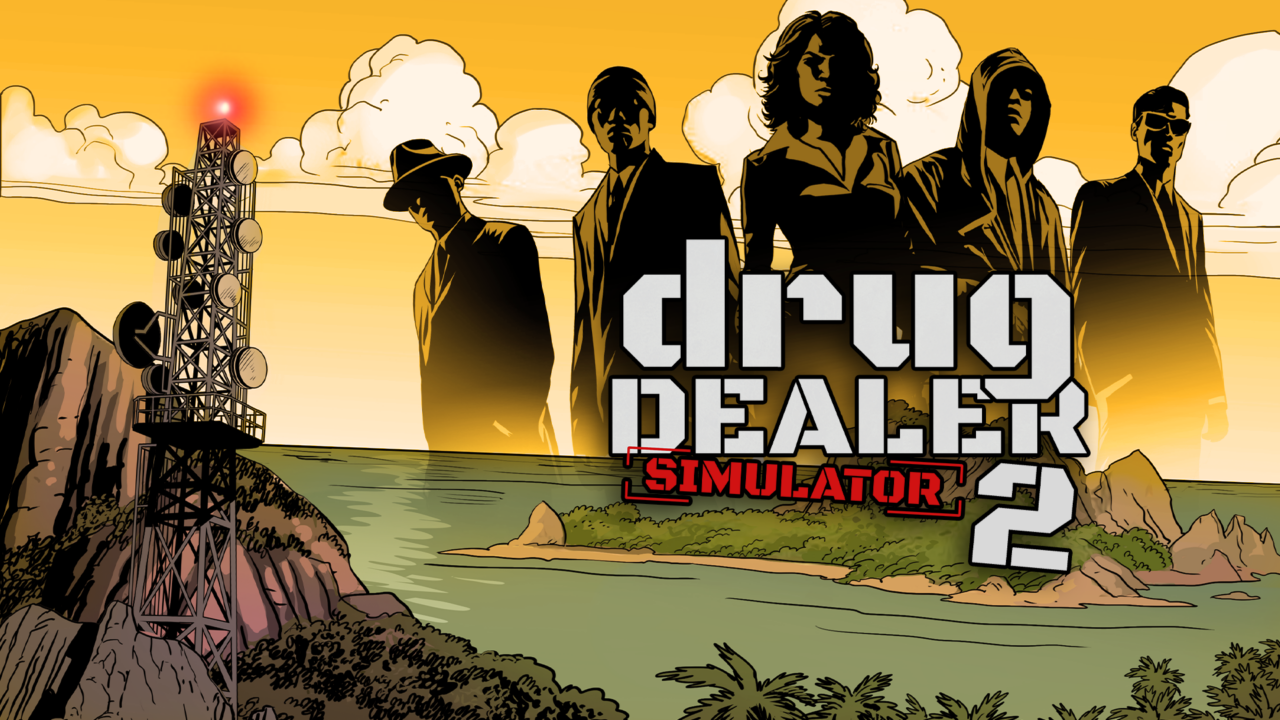
The story found in Drug Dealer Simulator 2 is one that’s been told before. You play as a silent protagonist that finds themselves on an island with nothing but a few bucks in their pocket. While you don’t have much money, you have a desire to make something of yourself. The overarching goal is simple on paper but incredibly complex in execution: evolve from an absolute nobody running street errands into an untouchable, multi island cartel lord.
The story primarily unfolds through interactions with colorful local factions, corrupt authorities, and rival gangs who control various territories across the island. Rather than offering a tightly scripted and cinematic narrative, the game positions its plot as a light framework designed to justify your expanding operations. You will frequently find yourself negotiating with eccentric contacts, navigating shifting political tensions within a fictional Caribbean dictatorship, and trying to outsmart a volatile local military group that acts as the primary systemic threat
While the premise of a self made kingpin is in itself compelling, the execution often leaves you wishing for a bit more narrative. The writing can be inconsistent, occasionally bouncing between dark, gritty realism and campy, internet humor-infused satire. It serves its purpose well as a motivational tool to push you into new zones, but otherwise lacks substance.

At its core, the gameplay loop is a multi-layered management simulation wrapped in a first-person sandbox. You start small by mixing basic recipes, manually packaging your product in ramshackle hideouts, and sprinting through backstreets to meet demanding local clients. As you generate capital, the game completely shifts gears into a full scale tycoon simulator where you purchase multiple safe houses, automate your supply lines, and hire low level street dealers and middle men to run the distribution network for you.
The depth of the crafting and distribution mechanics is the game’s strongest asset for the most part. These elements are so deep that you really have to pay careful attention to chemical purity, cutting agents, and regional market demand. Every decision made requires balancing risk vs reward. If you push too much product into one sector, this raises the local heat levels in the area. This in turn triggers active police patrols, hideout raids, and town wide lockdowns. On the other hand, not pushing product to raise your funds can cause your empire to come crashing down.
Unlike the first game where you relied on nothing but your feet, traveling plays more of a major role here. Due to the massive scale of Isla Sombra, you have quite a few modes of travel. You are able to obtain and drive a car, mopeds, a couple of different boats, and there is a fast travel system.
As ambitious as the open world of this game is, it’s occasionally dragged down by some of its mechanics. The parkour system feels heavy and clumsy, often causing you to get stuck on basic geometry or miss crucial jumps during high stakes escapes. Another element that has issues is the combat. It’s as equally unpolished as the parkour system. Basic melee strikes and firearms both feel floaty and imprecise. Because of this, physical confrontations are a frustrating chore rather than an exciting option.

Visually, the game presents a striking contrast between environmental ambition and poor asset quality. The archipelago of Isla Sombra features distinct and atmospheric zones, ranging from vibrant tropical beaches and dense jungles to derelict, graffiti covered shantytowns and eerie, abandoned docks. When the dynamic weather systems kick in, it feels like the islands come alive. The system can bath the landscape in a torrential downpour or the orange glow of a late-afternoon Caribbean sunset. As awesome of a weather system as this game offers, textures across the environment can appear incredibly muddy and low-resolution.
Character models are a particularly weak link, often sporting stiff animations, repetitive clothing assets, and vacant facial expressions that plunge straight into the uncanny valley during close up conversations.
Muddy low resolution textures and vacant NPCs are both things I would expect to see if this multi-platform release included low end PCs and the original Switch. But this game was released for mid to high end PCs, Playstation 5, Xbox Series X, and skipped the Switch ecosystem altogether. It would have been nice to see high resolution textures that are sharp and crisp looking. It would also have been neat to have character NPCs have more expression and be able to show more emotion during interactions.
The user interface is an element that suffers. The elements found here are clunky and very text heavy in their presentation. Feeling like they were lifted straight from a PC monitor without proper console optimization. Navigating through complex chemical formulas, employee management screens, and inventory bags on a controller is functional, but visually overwhelming. While it manages to capture a specific, gritty aesthetic that fits the early 2000s crime theme, it lacks the overall polish and refinement expected from modern console releases.
With as much depth as this game has, things should have been more streamlined to support consoles. It should have automated some elements to alleviate some of the menus. For instance, instead of having you grow and then dry products, there should have been just the selection to prepare the product. The preparation process would have you select the product and it would grow, dry on its own, and be made available to package. Changes like this could have made the game feel more streamlined and made for console instead of the rather clunky mess that we have here.

On the Xbox Series X, performance targets a smooth 60 frames per second, which thankfully feels like it hits consistently. For the majority of your time spent exploring the less populated islands or managing your labs, the frame rate holds up admirably, ensuring that running from the law feels fluid. The loading times are relatively quick when booting up the game or fast traveling between unlocked sectors.
Despite the targeted performance profile, the optimization is heavily inconsistent when the action heats up. In densely populated urban areas, during heavy downpours, or when multiple rival gang members and police officers spawn simultaneously during a hideout raid, the frame rate can take a noticeable dip. Screen tearing is another occasional nuisance when panning the camera rapidly across complex landscapes. This is an indication that the engine is struggling to keep pace with the asset streaming demands of a seamless world. Given the platforms this game is on, there should have been a lot more optimization done to combat this issues during development instead of forcing the player to deal with this unpolished experience.

The audio design is just as mixed as the graphics and presentation. Managing just enough to establish a tropical, high stakes atmosphere but then to struggle with consistency. The background soundtrack is a highlight, featuring a selection of relaxed, sunbaked beats and ambient Latin infused tracks. These tracks fit the island aesthetic perfectly while you brew batches in your lab. When your heat spikes and a chase ensues, the music seamlessly shifts into high tempo electronic rhythms that effectively amp up the tension.
Unfortunately, the environmental sound effects fail to match the quality of the musical score, frequently leaving the large world feeling oddly sterile and quiet. Footsteps can sound detached from the terrain, gunshots lack a satisfying, impactful punch, and ambient jungle noises often cut out abruptly or loop in a highly noticeable pattern. These hiccups in the soundscape constantly pull you out of the immersion, reminding you that the audio layer lacks the deep, systemic layering found in more polished open world titles.
Background tracks are good, environmental sounds are present, and the game features voice acting. Well it’s great that this game has voice acting, it’s yet another area where the game’s polish fluctuates. Interestingly this fluctuation happens from character to character, not just as a whole. A few of the primary story contacts deliver competent, entertaining performances that lean into the eccentric nature of the island’s criminal underworld. However, the vast majority of street clients, generic thugs, and random pedestrians suffer from flat, repetitive lines and highly inconsistent accents that make interacting with the local population a repetitive auditory experience.

Drug Dealer Simulator 2 is a textbook definition of a diamond in the rough. It takes the compelling, hyper detailed criminal economy of the original title and successfully expands it into a massive sandbox that offers dozens of hours of deep management gameplay. If you are a fan of complex manufacturing loops, resource management, and strategic empire-building, the satisfaction of turning a single shack into a fully automated cartel network is incredibly rewarding.
That being said, your enjoyment of the game hinges entirely on your tolerance for mechanical and technical issues. The weak narrative framework, clunky movement mechanics, lackluster combat, and frequent visual and performance bugs serve as constant reminders that the game needed a bit more time in the oven before launching on home consoles. It is a deeply flawed experience, but one that possesses a uniquely addictive charm that is almost impossible to find anywhere else on the market.
Ultimately, this is a niche title that knows exactly who its target audience is and caters to them aggressively without apologizing for its rough edges. It is a tough sell at a premium price point for casual players, but for those looking for a gritty, systems driven management sim, it delivers a genuinely engaging hustle. If you can look past the poor execution and embrace the grind, Isla Sombra offers a criminal playground that is well worth stepping into.
I really enjoyed this title a lot more than the first game. This sequel feels like what we should have gotten with the first game. Despite its issues (and there are a lot of them), this game is definitely one that I would recommend playing!
Disclaimer: A review key was provided

In addition to writing articles, Ryan Byers also creates content for his YouTube channel called "Obscure Games and Consoles", collects video games, and dabbles in video game development.