

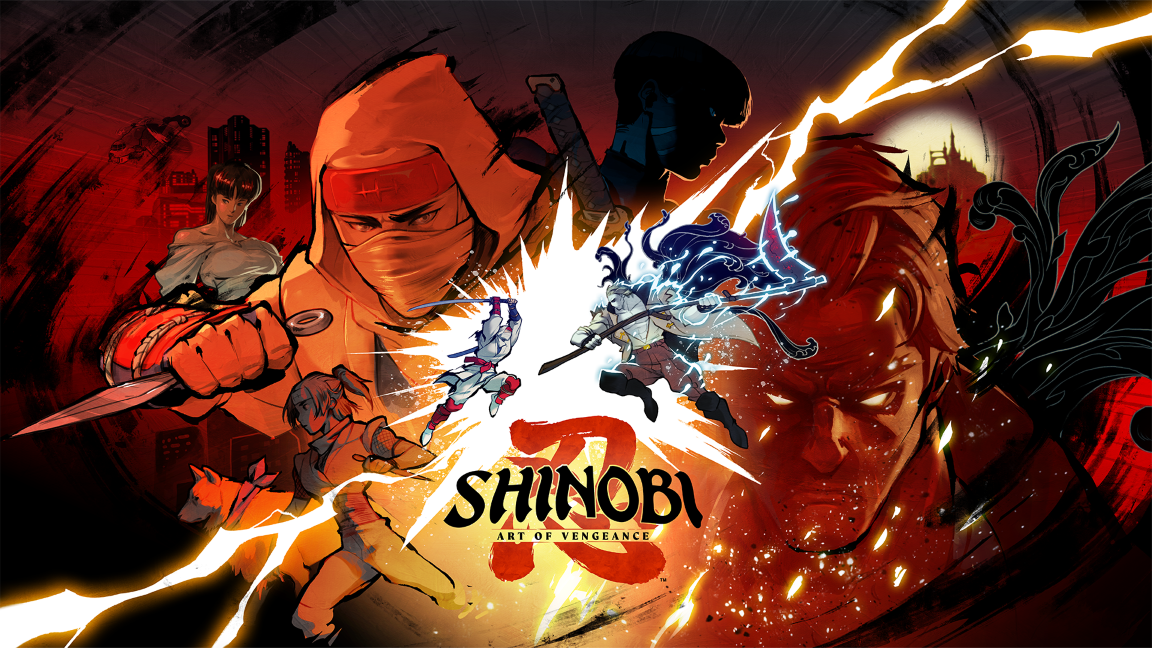
Lizardcube has built quite the reputation for reviving classic SEGA properties without simply repainting them in a modern coat of polish. After Wonder Boy: The Dragon’s Trap and Streets of Rage 4, the studio has now turned its attention to Joe Musashi, bringing the Shinobi series back after a long stretch on the sidelines. Shinobi: Art of Vengeance originally released in 2025, and with the game now available on Nintendo Switch 2, I finally had the chance to see whether Lizardcube could pull off the same trick a third time. The short answer is yes, and it does so while carving out its own identity rather than leaning entirely on nostalgia.
The story will not surprise anyone familiar with the series. Joe’s village has been destroyed, his clan turned to stone, and Lord Ruse sits at the centre of the plot as the man responsible for it all. There is nothing complicated going on here, and that is fine, because Shinobi: Art of Vengeance treats its narrative as little more than a reason to move Joe from one stage to the next. The gameplay and presentation are clearly where Lizardcube wanted the focus to be, and the game is better for not overcomplicating things on the story side.

Where Shinobi: Art of Vengeance really earns its keep is in the combat, and it took me longer than expected to appreciate just how deep that system actually goes. Joe’s sword is the obvious centrepiece, but treating it as the only tool in the kit is a mistake early players will likely make. Kunai, a growing set of ninja abilities and the option to chain attacks together all combine into something far more satisfying than simple button mashing. Once I started thinking about which ability suited a given situation rather than just charging forward, the combat opened up considerably. Staggering enemies, attacking from range before closing the distance and stringing together combos all create a rhythm that rewards patience as much as aggression.
That sense of progression carries through the whole game. The more comfortable you get with Joe’s tools, the more options start to reveal themselves in every fight, and the best encounters are the ones where everything clicks and Joe glides from enemy to enemy without missing a beat. The finishing moves help sell that power fantasy too, including one particularly striking attack that summons a dragon made of flame across the screen and wipes out everything in its path. These moments are not just visually impressive, they genuinely make Joe feel like the legendary shinobi the story insists he is, and the weight behind his attacks never comes at the cost of speed.

Of course, combat alone would not carry the game if the presentation did not match it, and this is another area where Lizardcube excelled. The hand-drawn art style is gorgeous throughout, with detailed backgrounds, expressive character animation and a real sense of energy behind every movement Joe makes. Watching him cut through a group of enemies feels closer to an animated sequence than a typical side-scrolling brawler, and the visual effects tied to combat abilities add real impact to the action without ever becoming cluttered or hard to read.
The variety across environments helps that presentation stand out even more. Joe’s journey takes him from Oboro Village to a submarine base, a neon-soaked city, a barren desert and several other distinct locations, and each one has its own visual identity. It would have been easy for a side-scrolling action game to settle into a repetitive look after a few stages, but Shinobi: Art of Vengeance keeps finding new scenery without ever losing the artistic thread that ties it all together.
This being said, the Switch 2 release specifically benefits from the extra hardware power in ways that matter for a game like this. It runs at a consistent 60fps, which is exactly what an action game built around fast reactions and precise timing needs. Handheld mode looks noticeably sharper and cleaner than it did on the original Switch, and the hand-drawn artwork stands out far more clearly as a result. Docked play sees a similar jump in image quality. This is not just a matter of the game looking prettier, either, since the added clarity makes it easier to actually appreciate the level of detail packed into the environments and animations.

Shinobi: Art of Vengeance also does a good job of avoiding the trap of straight-line stage design. There is a real emphasis on exploration built into the side-scrolling structure, and the game gives you plenty of reasons to look past the obvious path forward. As Joe picks up new equipment and abilities, areas that were previously out of reach open up, revealing optional sections and additional rewards. That balance works well, since you can push straight through a stage if you just want to reach the end, or slow down and dig around for hidden paths and collectibles. Returning to earlier stages after unlocking new abilities is worthwhile too, as those areas often hold rewards that were inaccessible on the first pass.
The map does a reasonable job of flagging some of these optional areas, including sections marked out in purple, though there are still moments where figuring out how to actually reach a location takes some trial and error. Some of the platforming can be surprisingly demanding as well. A single mistimed jump can undo an entire section’s progress, and there were stretches where I had to repeat an area simply because I had underestimated how precise the sequence needed to be. That said, the difficulty fits the tone of the game. Shinobi: Art of Vengeance is not trying to be a relaxing experience, and it expects players to learn its mechanics and grow more comfortable with Joe’s movement over time. Some encounters took several attempts to clear, but getting through them generally felt like the result of learning something rather than simply getting lucky, and that distinction matters when it comes to whether difficulty feels like part of the design or an obstacle for its own sake.
There is plenty of reason to keep returning to stages beyond the optional areas and collectibles as well. Each level hides members of the ENE Elite Squad, and tracking them down provides another layer of challenge for players who want to see everything a stage has to offer, with special amulets on offer as rewards. The result is a game that encourages full completion without ever making every last collectible feel mandatory.

That replayability helps make up for one of the weaker parts of the combat, which is enemy variety. New enemy types do get introduced as the game progresses, but plenty of the standard enemies become quite familiar by the midpoint, and fighting variations on the same foes repeatedly does take some of the shine off the later stages. The bosses land in a similarly mixed spot. They look the part, with large, visually distinct designs that sell the idea of a major threat, but a number of the boss encounters do not quite live up to the quality of the regular combat. More often than I expected, I found myself more engaged fighting a group of standard enemies than facing down one of the bigger battles, and while the bosses are not bad, they are not where the game is at its strongest either.
The voice acting deserves a mention too, and the Japanese track is the clear standout. It fits the setting and tone of the world far better than the alternative, giving the story sequences a feel that suits Joe’s world even if the narrative itself is not the main draw. What ultimately makes Shinobi: Art of Vengeance work is how well its individual pieces fit together. Lizardcube clearly studied what made the classic entries in this series enjoyable without simply trying to recreate them wholesale. The hand-drawn art gives the game a distinctly modern identity, the combat rewards experimentation without demanding it, and the exploration gives the stages more staying power than a purely arcade-style structure would have provided.

There is also something to be said for how fluid Joe feels to control once combat, platforming and movement all come together. It is not just that the animation looks good, since the controls let that fluidity translate directly into how the game feels to play, and that responsiveness becomes increasingly important as the difficulty ramps up. On Switch 2, the steady 60fps performance keeps that feeling intact throughout, and the hardware suits the game well as a result. During my time with this version, I did not run into performance hiccups that disrupted a fight or made a platforming section feel unreliable, and when a game demands quick reactions the way this one does, trusting the controls is essential.
None of this means Shinobi: Art of Vengeance is without rough edges. The story will not satisfy anyone looking for a narrative-heavy adventure, some of the standard enemies wear out their welcome, the bosses do not always match the quality of the regular combat, and certain platforming sections, particularly around optional areas, can be genuinely frustrating. These issues are noticeable, but they do not undercut what the game does well overall. Lizardcube has once again shown a strong understanding of how to bring back an older SEGA property without letting it feel like a relic, and just as Streets of Rage 4 successfully modernized the classic beat ’em up formula, Shinobi: Art of Vengeance expands on its predecessor’s side-scrolling action with a stronger emphasis on presentation, exploration and combat depth.

Shinobi: Art of Vengeance ultimately delivers a satisfying comeback for Joe Musashi. The hand-drawn artwork is excellent, the combat grows more rewarding the more of Joe’s arsenal you make use of, and the stages offer enough secrets and optional content to justify revisiting them. The Switch 2 version adds the performance and visual improvements that a fast-paced action game like this benefits from most, and whether returning to the series after years away or picking up Joe’s latest adventure for the first time, there is a great deal here worth enjoying.
Disclaimer: A review key was provided