

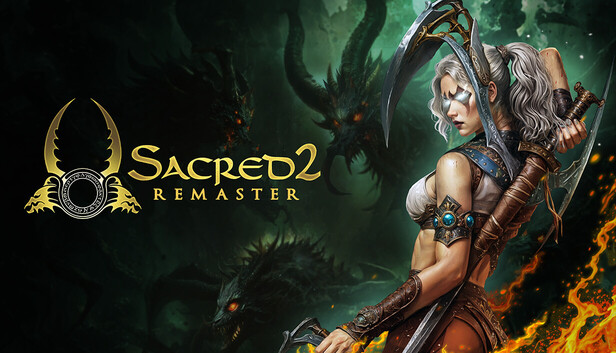
Sacred 2 Remaster arriving on Nintendo Switch makes a strange kind of sense. The original game belongs to a period when action RPGs still chased enormous worlds, tangled systems, and sheer volume of content over streamlining, and that spirit carries through fully intact here. Between its massive map, oddball character classes, loot-heavy progression, and off-kilter humour, Sacred 2 has a personality that a lot of current releases simply do not bother cultivating. That said, the years show almost right away, especially once movement, combat, menus, and exploration come into play.
Built by SparklingBit and put out by THQ Nordic, this remaster carries Ascaron’s sprawling action RPG onto current hardware following a launch that was, historically, plagued by technical troubles. The Switch edition turns out to be a reasonably solid way into the game, though expectations need to be kept realistic going in, especially given the console’s age relative to its rivals. Nothing here amounts to a ground-up reworking for the hardware. What is on offer is closer to the familiar classic experience, just packaged into something more stable and convenient than before.

Ancaria is still the main attraction. This is a genuinely huge world, packed with towns, ruins, dungeons, monsters, hidden secrets, and a side quest count that borders on absurd. Something always seems to be waiting over the next rise, and there is enough content stuffed into Ancaria to occupy players for dozens upon dozens of hours. Even after a long stretch of exploring, another quest or an unexplored corner of the map inevitably turns up.
The isometric camera translates surprisingly well to a handheld screen. Sacred 2’s varied biomes, vibrant environments, and moody night lighting keep the world feeling alive even now. It reads as dated next to newer open-world RPGs, no question, but the art direction papers over a fair share of the technical rough spots.

Running at 30 frames per second, the Switch build trims visual settings considerably relative to the PC and PlayStation 5 versions, with heavier fog, flatter shadows, softer textures, and other trade-offs baked in to keep things running on aging hardware. None of that undermines the core experience in a serious way. The occasional stutter can still crop up when entering a new area or when a screen suddenly floods with enemies, and these moments are a bit more noticeable in handheld mode, though the hiccups pass quickly. Worth noting as well is how the game holds up when played on Switch 2 through backward compatibility. The extra headroom on the newer console smooths out a good portion of the rough patches that show up on original Switch hardware, with quicker loading and steadier framerates during the busier moments, even though the game is still running the same base visual settings rather than anything upgraded for the newer system.
What is disappointing is how little the remaster does to work around the limits of the hardware. There is no way to trade visuals for a smoother frame rate, no mouse support, and nothing that feels tailored specifically to the console beyond getting the game running at all. It functions as a fairly straightforward port and not much beyond that, which feels like a missed opportunity given how much SparklingBit could likely have leaned into further optimization for a system this well understood at this point.

The larger concern is that Sacred 2’s core design has aged far less gracefully than its world has. Movement feels rigid, combat lacks the snap of newer action RPGs, and even routine tasks can turn cumbersome. Targeting enemies is not always intuitive, and both looting and navigating the map grow frustrating once the amount of information on screen starts competing for attention on a smaller display.
Menus are where the age gap is hardest to overlook. Handling gear, abilities, loot, and character progression is functional enough, but without pointer or mouse controls, everything takes longer than it should. This becomes especially noticeable when sifting through a heavy pile of loot or juggling a more elaborate build.

Fortunately, there is enough substance to justify tolerating those rough edges. Sacred 2 fields several distinct classes, each with a noticeably different approach to combat. The Combat Arts system leaves plenty of room to experiment, letting players tailor abilities and playstyle to their liking. Character building ends up being one of the most satisfying parts of the whole package as a result.
Each class also carries its own quest lines and alignment choices, which adds considerably more replay value than the size of the campaign alone would suggest. Decisions about how to handle certain situations can shift the tone of the story, and the gap between classes makes a second or third playthrough feel like something genuinely different rather than a repeat run.

This release also folds in the game’s post-launch fixes, inventory expansions, controller-friendly quick casting, and the Ice and Blood expansion, meaning there is an enormous amount of content available right out of the gate. Sacred 2 was already a sprawling game on its own, and having all the extra content and refinements bundled in makes this a substantial package for anyone hunting for a classic action RPG to lose serious time in, particularly on the go.
There is also a real charm running through Sacred 2 that helps smooth over its mechanical flaws. It takes its fantasy world seriously enough to build something huge and detailed, yet it is just as happy to poke fun at itself with strange humour and fourth-wall gags. That eccentric streak keeps it from ever feeling like just another generic loot-driven fantasy game.
On balance, Sacred 2 Remaster on Switch works better as something to admire than as something to actually play through start to finish. The mechanics feel awkward, the interface shows its age, and the hardware’s limits keep making themselves known throughout, even with the smoother experience available through Switch 2’s backward compatibility. Underneath all of that, though, sits a massive action RPG loaded with content, distinctive classes, deep customization, and a world that is still a genuine pleasure to wander, even in short handheld sessions.

This version will not modernize Sacred 2 the way some players might have wanted, but it does offer one of the more portable and convenient routes into this odd little classic, whether played on Switch or carried over to Switch 2. Players expecting the fluid combat and streamlined design of a modern action RPG will likely butt heads with its old-school sensibilities. For anyone prepared to work around those limits, though, there is a tremendous amount here worth digging into. Sacred 2 remains rough, occasionally clunky, and unmistakably dated, but its ambition and eccentric charm make it remarkably easy to disappear into all the same.
Disclaimer: A review key was provided