

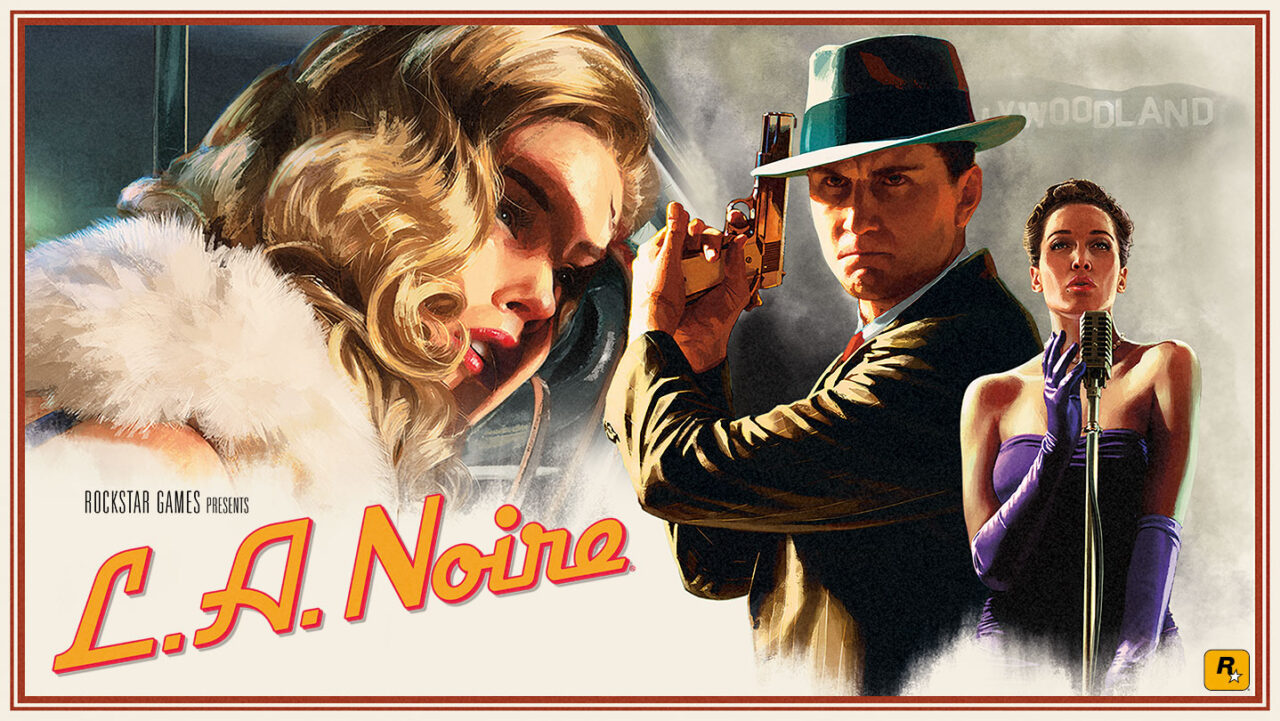
Los Angeles has always been a city of contradictions. It is a place where dreams are sold as easily as they are broken, where Hollywood glamour conceals exploitation, and where the promise of a better life can lead people into some of the darkest corners of American society. Few settings lend themselves to film noir quite as naturally, and that contradiction is central to what makes L.A. Noire such a fascinating video game. Rather than simply borrowing the visual language of classic crime cinema, Team Bondi’s detective adventure attempts to capture the moral uncertainty, institutional corruption, and personal tragedies that have long defined the genre.
Noirvember, the annual fan celebration devoted to revisiting classic film noir, offers a fitting opportunity to return to a game that draws so heavily from that tradition. Developed by Team Bondi and published by Rockstar Games, L.A. Noire arrived on May 17, 2011, in North America for the PlayStation 3 and Xbox 360, with European and Australian releases following on May 20. A Windows version arrived later that year. Set in 1947, it follows Cole Phelps, a decorated Marine veteran who joins the Los Angeles Police Department and works across several of its investigative desks. What initially resembles a police procedural develops into a much larger story involving organized crime, political corruption, murder, and the consequences of the protagonist’s own decisions.
Spoiler warning: This article discusses major story developments, including the game’s ending.
Postwar Los Angeles is one of the game’s greatest accomplishments. The city is presented as a place enjoying an expanding entertainment industry and a booming economy. Hollywood is thriving, automobiles fill the streets, and the promise of prosperity seems to be everywhere. Yet that outward confidence conceals a much uglier reality. Behind the storefronts, luxurious homes, and fashionable nightclubs are people struggling with addiction, desperation, greed, and violence. The police department, meanwhile, is hardly standing outside these problems as an impartial observer.

That contrast sits at the heart of film noir, a tradition fascinated by the distance between appearances and reality, and by characters who discover that the respectable institutions around them are far less virtuous than they first appeared. Writer and director Brendan McNamara has discussed the influence of films such as Chinatown, The Naked City, Out of the Past, and The Third Man, alongside the crime fiction of Raymond Chandler, Dashiell Hammett, and James Ellroy. The land-grab conspiracy at the centre of the game has much in common with the political and commercial corruption explored in Chinatown, while its compromised police force recalls the world of Ellroy’s L.A. Confidential. These influences help establish the kind of story the game wants to tell, but the setting gives them a distinct identity of its own.
Recreating Los Angeles required an extensive historical investigation. In an interview with Official PlayStation Magazine, McNamara described the first year and a half of development as a period devoted largely to research, with a small team travelling to Los Angeles, studying buildings, reading newspapers, and collecting photographs. Reports on the production put the photographic archive at approximately 180,000 images, with more than 1,000 newspapers also consulted. The team drew on aerial photography by Robert Spence to help reconstruct the city’s streets and buildings. The value of that work is apparent in the finished game. Its Los Angeles is not just a backdrop filled with period cars and familiar landmarks. It is a place shaped by its geography, its architecture, and the different lives unfolding across its neighbourhoods.
That sense of place is important because the city itself often feels like another character. The wide boulevards and grand buildings suggest opportunity, while the smaller businesses, residential streets, and neglected corners reveal the less glamorous lives that sustain the metropolis. Shadows stretch across alleyways, cigarette smoke hangs in dimly lit rooms, and conversations take place in offices, bars, and homes where nearly everyone seems to have something to hide. The game even includes an optional black-and-white mode for players who want a more traditional visual presentation, although its noir identity does not depend on removing the colour. Its atmosphere comes just as much from the people inhabiting these environments and the moral uncertainty surrounding their actions.
Cole Phelps provides an interesting way into this world. Unlike the cynical private investigators so closely associated with the genre, he begins as an idealistic police officer who appears to believe sincerely in the principles of justice. A decorated Marine veteran who served with the Sixth Marines in the Pacific, Phelps enters the LAPD with a strong sense of purpose. He wants to solve crimes, make a difference, and prove himself worthy of the badge. His ambition initially seems to distinguish him from the more compromised figures around him.

He is not the uncomplicated hero he first appears to be, however. His wartime experiences continue to trouble him, particularly a decision made during the fighting on Okinawa that returns to the story later. His personal choices also begin to undermine the respectable image he has carefully constructed. While working on the Vice desk, he begins an affair with Elsa Lichtmann, a German jazz singer. His partner, Roy Earle, exposes the relationship, destroying Phelps’s marriage, damaging his reputation, and contributing to his demotion to the Arson desk.
That career reversal is important because Phelps’s journey through the department is not a straightforward climb toward success. He advances through Patrol, Traffic, Homicide, and Vice before finding himself assigned to Arson. His fall reveals how little professional advancement necessarily has to do with doing the right thing. The institution he wants to serve is riddled with the same weaknesses and compromises he encounters on the streets, and his own failures make it increasingly difficult to maintain a clear distinction between the people he investigates and the department he represents.
The story consequently asks the player to examine Phelps as closely as the suspects he questions. He spends much of the game investigating other people’s crimes, but the narrative repeatedly returns to his own character and the consequences of his decisions. He is not a traditional hard-boiled detective, yet his growing disillusionment places him firmly within the genre’s tradition of morally compromised protagonists. His story also avoids the kind of uncomplicated resolution that might be expected from a conventional police drama. It ends in sacrifice, with McNamara having acknowledged the influence of Chinatown on the finale.
The partners Phelps encounters along the way offer different perspectives on the department and the work it does. Ralph Dunn is his original partner during the Patrol cases, while Stefan Bekowsky, his partner on Traffic, eventually becomes a friend. Rusty Galloway is a weary and cynical Homicide detective who frequently challenges Phelps’s theories. Roy Earle is sardonic, self-serving, and openly corrupt, making him an especially uncomfortable partner during the Vice cases. Herschel Biggs, a reclusive former Marine assigned to Arson, initially resents having a partner but slowly develops a measure of respect for Phelps. Jack Kelso, meanwhile, is not another LAPD partner. A fellow Marine who served alongside Phelps before becoming his rival, he becomes a second playable character for some of the final Arson cases.
Those Arson investigations finally give a name to the corruption that has been building throughout the story. The Suburban Redevelopment Fund presents itself as a program intended to provide affordable housing for returning veterans. In reality, it is a criminal enterprise built around land fraud. The syndicate acquires properties from owners willing to sell, then constructs cheaply built homes on the land to increase its value ahead of an anticipated government purchase for a new freeway. Owners who refuse to sell are another problem. The syndicate uses an arsonist to burn down their existing homes, forcing them out and clearing the way for the scheme to proceed. Real estate magnate Leland Monroe is at the centre of the operation, alongside psychiatrist Harlan Fontaine and other influential figures.

The conspiracy also connects to the stolen military morphine that Phelps investigates during his time on the Vice desk. The drug supply originates with members of his former Marine unit, while Earle’s betrayal proves to be more than a personal attempt to undermine a colleague. By exposing Phelps’s affair, Earle helps redirect attention away from a prostitution scandal involving prominent figures and earns himself a place in the redevelopment scheme. The police department is not simply failing to contain corruption. Some of its own officers are actively profiting from it.
The game’s investigative mechanics are another major part of its identity. Examining crime scenes, collecting evidence, questioning witnesses, and comparing statements form the foundation of the experience. Instead of relying entirely on gunfights and action sequences, L.A. Noire frequently asks players to slow down, observe their surroundings, and notice details that might otherwise be overlooked. It is an attempt to make the player feel like an investigator rather than someone merely controlling a character who happens to be one.
The interrogation system is the most ambitious expression of that idea. It uses MotionScan, a facial performance-capture technology developed by Depth Analysis, a sister company to Team Bondi that Brendan McNamara co-founded. Actors were recorded using 32 surrounding cameras, allowing their facial performances to be reproduced in remarkable detail. The intention was to make questioning suspects a matter of observing their expressions and deciding whether their responses were credible. The technology also influenced the casting process, since performers needed to communicate through their faces as much as their voices. Aaron Staton, best known for playing Ken Cosgrove in Mad Men, portrays Phelps, and the connection between the show’s casting firm and the game helps explain why several familiar television performers appear throughout the story.
The results are impressive, even if the underlying system does not always work as intended. Facial animation gives interrogations an unusual level of expressiveness, but recognizing that a suspect is uncomfortable or evasive does not necessarily make it clear which response the game expects. The original PlayStation 3, Xbox 360, and Windows releases presented players with Truth, Doubt, and Lie options. Choosing the wrong response can be frustrating, especially when an accusation seems reasonable but the game expects a specific piece of evidence that the player may not have considered. The 2017 console releases renamed these choices Good Cop, Bad Cop, and Accuse, an adjustment intended to make Phelps’s approach clearer. It helps communicate the tone of the available responses, although it does not entirely resolve the underlying problem.
Nevertheless, the technology gives the interrogations a quality that conventional dialogue systems rarely attempt. Suspects do not simply deliver lines while waiting for the player to select a response. Their performances become part of the evidence, even when the game does not always provide enough information to interpret them correctly. MotionScan is more than a technical curiosity here. It is central to the way L.A. Noire wants players to understand the people they are investigating.

Its relationship with real criminal history adds another layer to the experience. Elizabeth Short, a 22-year-old aspiring actress, was murdered in Los Angeles, and her body was discovered on January 15, 1947, according to the FBI’s account of the case. The brutality of the crime, the sensational attention it attracted, and the failure to identify her killer turned her into the Black Dahlia, one of the most infamous unsolved murder cases in American history. Her story became part of Los Angeles’s criminal mythology, making it a natural point of reference for a game so interested in the city’s darker history.
L.A. Noire does not attempt to recreate the actual investigation into Short’s murder. Rockstar’s account of the game’s real-crime influences explains that its cases are fictional stories drawing on details from historical crimes. The Black Dahlia investigation instead casts a shadow over the entire Homicide desk, where a series of murders appear to echo the original crime. One of the clearest examples is “The Red Lipstick Murder,” Phelps’s first Homicide case, which draws on the real killing of Jeanne French.
Rockstar’s account of the French case describes a 45-year-old former Army nurse found murdered in an isolated area known as The Moors in February 1947, just weeks after Short’s death. The letters “B.D.” had been written on French’s body in red lipstick, and her husband maintained that he was innocent. The game takes those details as a starting point, but the fictional case follows its own course. Its victim is Celine Henry, and the investigation becomes part of the larger series of murders that eventually leads Phelps and Galloway toward the truth.
The Homicide storyline ultimately gives the player an answer that real investigators never obtained. Phelps and Galloway track down Garrett Mason, the game’s fictional Black Dahlia killer, and he is killed during their confrontation. The resolution, however, is hardly a conventional victory. The department cannot publicly disclose Mason’s identity because he is related to a powerful government official. The men previously arrested for the murders are due to be released following a mistrial, leaving the case’s real perpetrator officially unacknowledged. The actual murder of Elizabeth Short, of course, remains unsolved.
This is an especially effective use of the game’s historical inspiration. The Black Dahlia case is not simply a familiar name attached to a fictional investigation. It gives the Homicide storyline a disturbing point of comparison between the public’s appetite for sensational crimes and the institutional interests that determine which truths can be acknowledged. Phelps and Galloway can identify the killer, but that achievement cannot undo the damage caused by the department’s earlier failures or guarantee that the truth will reach the public. The case becomes another example of how justice can be sacrificed to protect people with the right connections.
The history of L.A. Noire is itself a story of ambition, controversy, and an unusually difficult production. Team Bondi was founded in Sydney by Brendan McNamara in 2003, with development on the game beginning in 2004. Sony was initially involved as a publishing partner before Rockstar assumed that role in 2006. The project went through repeated delays and took roughly seven years to complete, with several Rockstar studios eventually contributing to the finished game.
The circumstances surrounding its development became a subject of public scrutiny after release. Reports from IGN included allegations from former employees about management practices, staff turnover, and extended periods of crunch. One anonymous developer claimed to have occasionally worked between 80 and 110 hours a week to meet milestones. McNamara disputed some of the accusations, including claims that overtime had gone unpaid, while other developers publicly defended the studio. A separate dispute concerned the game’s credits, after former employees created a website identifying more than 100 people they believed had been left out of the final credits roll.

The studio’s financial problems soon became clearer. Team Bondi entered administration in August 2011 and later went into liquidation. Reporting based on Australian government filings showed that the company owed more than A$1.4 million to creditors, including former employees owed unpaid wages and bonuses. Depth Analysis, the separate company responsible for MotionScan, was also listed as a creditor and was owed more than A$145,000. Team Bondi’s intellectual property and some of its assets were subsequently acquired by Kennedy Miller Mitchell.
Despite the difficult production, the game found a substantial audience. It shipped four million units during its first month and became the first video game selected for the Tribeca Film Festival, an unusual distinction that reflected the attention surrounding its cinematic approach to storytelling. Rockstar also supported the release with five downloadable cases, including “The Naked City,” “A Slip of the Tongue,” “Nicholson Electroplating,” “Reefer Madness,” and “The Consul’s Car.” The Windows version arrived in November 2011 as a Complete Edition containing the additional downloadable content.
The game returned in enhanced form on November 14, 2017, when versions for Nintendo Switch, PlayStation 4, and Xbox One were released. The new editions included the original game and its additional downloadable content, alongside platform-specific visual and control improvements. The Switch version added motion-based controls and touchscreen functionality, while the PlayStation 4 and Xbox One releases offered improved lighting, textures, and other graphical enhancements. L.A. Noire: The VR Case Files followed in December 2017, bringing seven selected cases to virtual reality through a version initially released for HTC Vive before later arriving on other platforms.
There are limitations to the experience, of course. Despite its open-world presentation, L.A. Noire is more structured than many players might expect from a Rockstar-published game. The city offers plenty of room to explore, but the investigations themselves follow relatively fixed paths. Visiting crime scenes, interviewing witnesses, and following leads can become repetitive, while some of the action sequences feel disconnected from the detective work that gives the game its identity. Individual cases also vary in quality, and the interrogation system does not always provide the clarity its central concept requires.
Even so, these shortcomings do little to diminish what makes the game distinctive. Its greatest achievement is not that it perfects the detective adventure, but that it understands what makes the stories and films that inspired it so enduring. Its setting, characters, visual presentation, and investigative structure reflect a genuine interest in the traditions of crime fiction instead of a superficial borrowing of their imagery.

More importantly, L.A. Noire recognizes that the greatest mysteries are not always about identifying a murderer. Sometimes they concern the way an entire city becomes complicit in the conditions that allow terrible things to happen. Its version of Los Angeles is populated by people chasing wealth, recognition, and personal happiness, often at someone else’s expense. The police are supposed to protect the public, yet members of the department perpetuate the very corruption they are meant to confront.
That is what makes L.A. Noire such a fitting addition to Noirvember. It takes familiar conventions of the detective story and uses them to explore a world where justice is rarely straightforward, appearances are deceptive, and even those who believe they are doing the right thing can become part of the problem. Its investigative mechanics do not always live up to their promise, but its understanding of noir makes it one of the most distinctive interpretations of the genre in video games. Los Angeles promises a better life to everyone who arrives, but in L.A. Noire, the closer people get to that dream, the more clearly its darkness comes into view.
Sources
-
L.A. Noire: How Team Bondi and Rockstar Games Re-created 1947 Los Angeles – Los Angeles Times
-
City at Night – USC Libraries
-
Interview: The Tech Designed To Give L.A. Noire’s Performances Life – Game Developer
-
IGDA to Investigate LA Noire’s Team Bondi – Shacknews
-
L.A. Noire Dev: $1.4M in Debt – GameSpot
-
Black Dahlia – FBI
-
4 New Versions of L.A. Noire Coming November 14 – Rockstar Games
-
Rockstar’s Open-World Crime Thriller LA Noire Comes to PS4 in November – PlayStation Blog
-
L.A. Noire Walkthrough – GameSpot
-
Brendan McNamara: L.A. Noire Is “Probably Too Big” – GameWatcher
-
L.A. Noire – Rockstar Games