

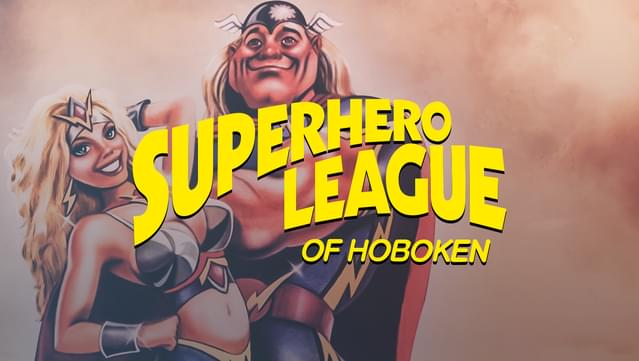
Superhero games have gone through a lot of transformations over the decades, and today the genre is largely defined by open-world spectacle, whether that means swinging between skyscrapers, tearing through waves of enemies, or wandering enormous cities filled with familiar faces and cinematic set pieces. Superhero League of Hoboken takes the opposite approach entirely. Originally released back in 1994, Steve Meretzky’s oddball creation blends a point-and-click adventure with a turn-based RPG, mixing exploration and item-based puzzle solving with party management, combat, and character growth. Even by the standards of its era, this was an unusual pairing of genres, and that strangeness is a big part of what still makes the game memorable.
The setup makes clear right away what kind of superhero story this is going to be. Set in a post-apocalyptic take on the northeastern United States, the game hands players control of a struggling superhero organization trying to build a reputation while contending with one absurd threat after another. These heroes are far from the type who would headline a summer blockbuster. Their powers are deliberately underwhelming or outright ridiculous, turning the usual power fantasy into something closer to an office comedy where everyone just happens to have abilities. That framing gives the game a strong comedic identity, and while some of the jokes have not aged gracefully, there is still real charm in how fully committed the whole thing is to its own premise.
A large portion of the experience is built around classic adventure-game structure. Players move between locations, examine their surroundings, talk to characters, and pick up items that eventually solve the various problems scattered throughout the world. Rather than laying out a clear sequence of objectives, the game frequently leaves players to piece together what needs to happen next, which gives the whole thing a distinctly old-school feel. The environments are rendered as static screens filled with text-heavy interactions rather than anything resembling a fully realized world, but that suits the low-key tone Meretzky was clearly going for. The appeal here has less to do with simply walking through these spaces and more to do with figuring out how the characters, objects, and situations all connect.

This is where the RPG side of the game becomes important, since combat is never treated as a minor distraction between adventure segments. The player’s superheroes form an actual party, each with their own stats and abilities, and battles unfold through a turn-based system that gives the game a second, equally significant layer of interaction. Characters gain experience, improve their stats, and pick up equipment as new powers get introduced over the course of the story. None of these systems are especially deep by modern standards, but there is enough progression here to make the League feel like a genuine team rather than a random assortment of characters tagging along for the ride.
Combat is also where the humour lands particularly well. Instead of trying to turn its cast into conventional action heroes, the game leans hard into the absurdity of their powers and treats its turn-based battles as another vehicle for comedy. Between the attacks, the enemy designs, and the flavour text, the whole thing feels much closer to a superhero parody than a traditional comic-book adventure. That said, there is a surprising amount of strategy hiding underneath the jokes, since party composition, positioning, and how individual abilities get used can make a real difference in the tougher fights. The presentation may be primitive, but the underlying mechanics hold up well enough that battles rarely feel like filler.

The way these two halves feed into each other is a big part of what gives Superhero League of Hoboken its identity. Completing missions and solving puzzles pushes the story forward, while combat and other activities help the League grow stronger over time. The organization’s reputation also expands gradually, with new characters and abilities unlocking as progress is made. It is a fairly straightforward structure on paper, but it gives the whole experience a nice sense of momentum. Players are never just solving one adventure puzzle after another in isolation, nor grinding through disconnected RPG encounters. The two systems continually reinforce each other, and the result feels distinct from either a standard adventure game or a conventional party-based RPG.
Unfortunately, the adventure half is also where the game’s age shows most clearly. There are genuinely clever puzzles scattered throughout, but the game is not always especially interested in signalling what counts as a reasonable solution. Items can have unexpected uses, important interactions are easy to miss entirely, and progress can occasionally boil down to testing every item in the inventory against every object on screen. That kind of design was common for adventure games of the period, but it can be a source of real frustration for anyone used to clearer objectives and more generous hinting. The satisfaction of cracking a puzzle is still there when it happens, though so is the occasional sense that the game simply expected its audience to read its mind.

The presentation reflects its 1994 origins just as clearly. Static environments, simple character artwork, and basic battle screens are obviously dated next to even modest modern RPGs, though the visuals still carry a certain charm that fits the material well. Superhero League of Hoboken was never trying to sell a grandiose superhero spectacle in the first place, so its modest look never feels out of place. If anything, the contrast between the bleak post-apocalyptic setting and the ridiculous cast of heroes reinforces the comedic tone throughout, since this is a world where the stakes can sound serious on paper only for the next character or situation to undercut them completely.
The writing is ultimately what holds everything together. Meretzky had already built a reputation for comedic adventure design by this point, and that sensibility runs through every corner of the game. Superhero conventions, pop culture, and the broader world all end up as targets for the humour, while the deliberately absurd abilities and personalities of the cast give the whole thing a tone closer to comic-book parody than straightforward RPG storytelling. Some of the jokes are clearly products of their era, but the central joke behind the whole concept still lands because the game never once takes its own superhero premise too seriously.

That commitment also explains why the hybrid structure works as well as it does. The point-and-click mechanics give players a reason to explore and investigate the world in detail, while the RPG systems make the party feel like something that is genuinely developing across the course of the adventure. Neither half is particularly sophisticated when viewed on its own, but together they create something that feels meaningfully different from most of what else was on shelves at the time. There are moments where the two genres do not blend seamlessly, but there is something refreshing about a game that was willing to attempt the combination in the first place.
Superhero League of Hoboken is not some forgotten masterpiece waiting decades to finally receive its due, and its old-school adventure logic can make revisiting it a genuine test of patience. The puzzles can be obscure, the presentation is unmistakably dated, and the humour will not land for every player. At the same time, writing it off as just another forgotten DOS title overlooks what makes it worth talking about. This is a genuinely unusual hybrid of point-and-click adventure and turn-based RPG, and the willingness to combine those two genres gives it a personality that plenty of more polished games never manage to find.

For anyone curious about the stranger corners of PC gaming history, Superhero League of Hoboken remains well worth seeking out. Its superhero satire gives the adventure segments plenty of personality, its RPG systems add meaningful weight to the exploration, and its turn-based combat provides a genuinely enjoyable counterpart to all the puzzle solving. Some patience with 1990s adventure-game conventions is required, but there is still plenty to appreciate in this oddball experiment. More than three decades on, the game remains a reminder that superhero stories did not always need to revolve around power fantasy and spectacle. Sometimes being a superhero simply meant wandering around a ruined New Jersey with a team of ridiculous characters, trying to work out exactly what bizarre solution the game had in mind next.