

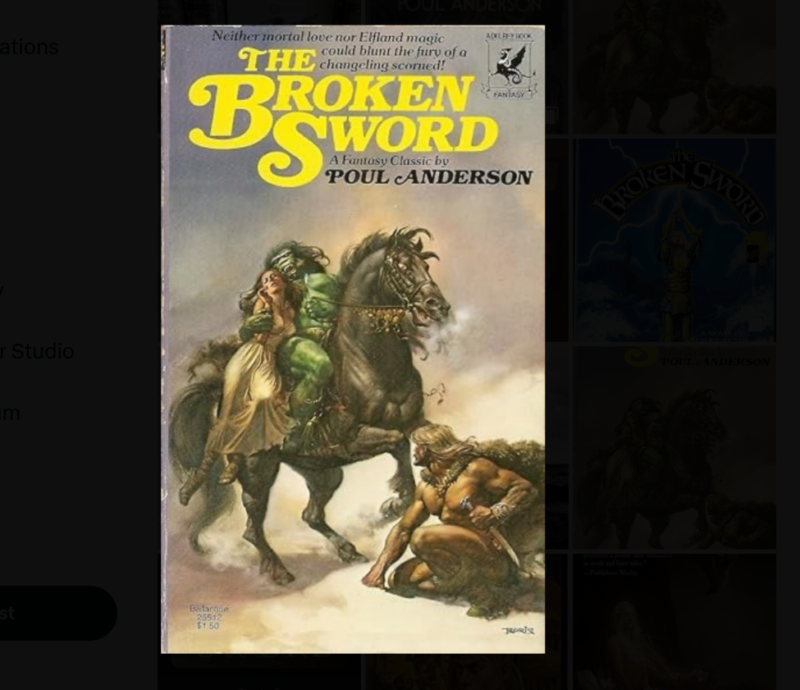
When discussing the fantasy novels that helped shape the genre, there are a few names that immediately come to mind, with J.R.R. Tolkien’s The Lord of the Rings, Robert E. Howard’s Conan stories, and Michael Moorcock’s Elric novels among the most recognizable. However, there is another author whose contributions deserve considerably more attention, particularly when discussing the darker side of fantasy fiction. Poul Anderson was one of the most influential fantasy and science fiction authors of the twentieth century, and while Three Hearts and Three Lions ( which we reviewed here) remains one of his most recognizable contributions to fantasy, The Broken Sword demonstrates another side of his writing that is every bit as remarkable.
Originally published in 1954, The Broken Sword is a dark fantasy novel heavily inspired by Norse mythology, European folklore, and the ancient traditions that helped shape stories of gods, monsters, and supernatural creatures. Published during the same year as the first volume of Tolkien’s The Lord of the Rings, Anderson’s novel takes a considerably different approach to fantasy, embracing the brutality, fatalism, and tragedy of the mythology that inspired it. This is a world where even the gods are dangerous, supernatural creatures are rarely benevolent, and the distinction between good and evil is considerably more complicated than readers might initially expect.
There is an interesting history behind the novel itself, as Anderson substantially revised The Broken Sword for its 1971 reissue. The original version, which is the subject of this review, has a particularly distinctive identity, preserving the author’s earlier approach to the story and its prose. Anderson subsequently made numerous changes, including alterations to the writing and certain aspects of the narrative. The revised edition is also notable for introducing the name Tyrfing for the enchanted sword, which is not identified by that name in the original text. While both editions are worth exploring, the 1954 version offers a fascinating glimpse into Anderson’s original vision and his willingness to embrace the harsher elements of the mythology inspiring his work.
The story follows Skafloc, a human child kidnapped from the household of Orm the Strong and raised by the elf lord Imric. In his place, the elves leave behind Valgard, a changeling born through magic from a captive troll mother. Although the two grow up looking identical, their personalities could hardly be more different. Skafloc becomes a courageous and loyal young man, developing friendships with the supernatural inhabitants of the world around him, while Valgard grows into a cruel and treacherous individual. Their respective upbringings eventually place them on opposite sides of a devastating war between the elves and trolls, with their shared origins adding another layer of tragedy to an already brutal conflict.
The elves desperately need the broken sword if they are to survive the war, and Skafloc is tasked with seeking out Bolverk, a mighty ice giant capable of reforging the weapon. What follows is a journey involving the gods, ancient prophecies, supernatural politics, revenge, and increasingly complicated relationships between the different inhabitants of this world. Anderson wastes little time establishing the conflict, and despite the relatively short length of the novel, there is an extraordinary amount happening throughout its pages.
One of the most fascinating aspects of The Broken Sword is its approach to mythology and folklore. Anderson brings together Norse gods, elves, trolls, dwarves, goblins, brownies, giants, and numerous other supernatural beings, creating a world that feels as though it belongs to an ancient collection of European legends. Odin, Thor, Loki, and the Valkyries are all part of this setting, but the author does not limit himself to a single mythology. Different supernatural traditions coexist, with their inhabitants interacting, competing, and occasionally interfering with the affairs of humanity. Celtic and Greek mythological figures also make appearances, adding to the sense that this is an entire supernatural world rather than simply a collection of Norse legends.
What makes this particularly interesting is the way Anderson distinguishes between the ordinary human world and Faerie, the supernatural realm that exists alongside it. Magical creatures inhabit the same general geography as mortals, but remain hidden from human eyes except under particular circumstances. The result is a setting where the familiar world is only part of what exists, with ancient powers and supernatural conflicts unfolding beyond the understanding of most ordinary people. Anderson makes excellent use of this idea, giving the novel an atmosphere that feels considerably older and stranger than the conventional fantasy kingdoms that would become so familiar in later decades.
There is also an interesting religious dimension to the story, particularly through the spread of Christianity and the growing influence of the White Christ. The old gods and supernatural creatures are increasingly confronted with a divine power that threatens the established order of their world. Unlike the gods of the older traditions, the White Christ offers mercy and protection to his followers, creating complications for supernatural beings accustomed to operating through ancient pacts, oaths, and agreements. The spread of Christianity gradually weakens Faerie, and there is a genuine sense that an entire supernatural order is approaching its decline. Anderson makes this transition feel like an actual historical and mythological upheaval rather than simply another conflict between competing magical factions.
What makes Anderson’s interpretation particularly effective is that he does not romanticize the supernatural creatures inhabiting his world. The elves may initially appear to be the more sympathetic faction, but they are hardly innocent, and their actions are frequently driven by selfishness, vengeance, and their own ambitions. The trolls are terrifying adversaries, but the conflict is not simply a matter of good versus evil. Even the gods have their own interests, and their involvement in the affairs of mortals often makes an already dangerous situation considerably worse. There are few traditional heroes here, and even fewer characters who can be trusted to act out of entirely selfless intentions.
The relationship between Skafloc and Freda introduces another tragic dimension to the story. Their growing affection is complicated by circumstances neither initially understands, and their relationship becomes one of the novel’s most devastating elements. Anderson is particularly effective at incorporating personal tragedy into a conflict that already involves gods, supernatural creatures, and the fate of entire realms. The characters are not simply pieces being moved around a mythological battlefield. Their desires, relationships, and personal decisions contribute to the tragedy unfolding around them, even when they have little understanding of the forces manipulating their lives.
The Broken Sword is also an excellent example of Anderson’s ability to tell an expansive story without allowing it to become unnecessarily bloated. His prose has the quality of an ancient saga being recounted by a storyteller, with events unfolding at a remarkable pace. There is little unnecessary exposition, and the author trusts readers to follow the mythology and supernatural politics without constantly stopping to explain every detail. This gives the novel a distinctive identity, particularly when compared with the more elaborate worldbuilding associated with much of modern fantasy literature.
Anderson’s writing is remarkably vivid, particularly when describing the supernatural world and its inhabitants. The battles are brutal, the monsters are genuinely frightening, and the violence carries an intensity that suits the mythology inspiring the story. There is a sense of danger throughout the novel that makes its fantastical elements feel considerably more threatening than the creatures found in many conventional fantasy adventures. Anderson understands that the world of ancient mythology was not necessarily a place of wonder and adventure for those forced to inhabit it. It was frequently cruel, unpredictable, and governed by forces that ordinary mortals could never fully understand or control.
I also particularly appreciate the attention Anderson gives to the physicality of combat and the atmosphere surrounding his battles. Weapons have weight, swordplay feels dangerous, and the descriptions of fighting convey an appreciation for the realities of armed combat. His use of poetry and the traditions of the skalds further reinforces the impression that the story is being recounted as an ancient saga. There is a rhythm to the storytelling that makes the novel feel distinct from much of the fantasy literature that followed, and Anderson’s ability to create such an immersive atmosphere without spending hundreds of pages describing every landscape and building is impressive.
This is also what makes The Broken Sword such an interesting companion to Three Hearts and Three Lions. Both novels demonstrate Anderson’s fascination with mythology, folklore, and the supernatural traditions of Europe, but they approach these subjects from very different perspectives. Three Hearts and Three Lions explores the conflict between Law and Chaos through a more adventurous fantasy narrative, while The Broken Sword embraces the harsher traditions of Norse mythology and the tragedy of a world governed by fate. The former would become particularly influential on fantasy role-playing games, while the latter demonstrates Anderson’s ability to explore the darker possibilities of the genre. Together, they offer an excellent illustration of just how versatile he was as a fantasy author.
The novel’s influence can also be appreciated through its willingness to embrace violence, tragedy, and morally complicated characters. Anderson was exploring many of the ideas that would become increasingly associated with darker fantasy long before grimdark became a recognizable category of fiction. His influence on Michael Moorcock is particularly noteworthy, with Moorcock acknowledging Anderson’s importance to the development of his Elric stories, including the concept of a powerful, cursed sword. Considering how influential Elric and Stormbringer would become, this is another reason why The Broken Sword deserves considerably more recognition among fantasy readers.
What ultimately makes The Broken Sword so effective, however, is its refusal to offer the sort of comfortable resolution readers might expect from a traditional fantasy adventure. This is a story shaped by fate, revenge, and the consequences of decisions that cannot simply be undone. Courage does not guarantee survival, love does not necessarily provide salvation, and defeating an enemy does not mean everything will suddenly be right with the world. Anderson understands the darker implications of the mythology that inspires his work and remains remarkably faithful to its spirit. The result is an emotionally powerful story that can be as tragic as it is exhilarating, with an ending that feels entirely appropriate for the world he has created.
The Broken Sword is one of those fantasy novels that deserves to be discussed alongside the genre’s most influential works. It is a remarkably imaginative story that brings together mythology, folklore, supernatural conflict, and tragedy without requiring several volumes to accomplish what it sets out to do. Anderson’s writing remains engaging, the worldbuilding is fascinating, and the story’s willingness to embrace the harsher elements of its inspirations gives it an identity that still stands out today. While it may not enjoy the same level of recognition as Tolkien’s work, it is every bit as deserving of attention from readers interested in the foundations of modern fantasy.
For anyone interested in Norse mythology, European folklore, or darker fantasy fiction, The Broken Sword is absolutely worth reading. It is also an excellent next step for those who have already experienced Three Hearts and Three Lions and want to explore another side of Anderson’s writing. The two novels demonstrate just how much he contributed to fantasy literature, and why his work deserves to be rediscovered by readers who may only be familiar with the authors he helped inspire.