

Los Angeles has always had a complicated relationship with its own image. It is a city that sells dreams, manufactures celebrities, and promises opportunity to anyone willing to chase the California sunshine. Yet beneath Hollywood’s glamour exists another version of the city, one shaped by exploitation, organized crime, political influence, and corruption. Few films capture these contradictions quite as effectively as Curtis Hanson’s L.A. Confidential, a neo-noir crime thriller that uncovers an ugly reality hiding behind the carefully maintained image of postwar prosperity.
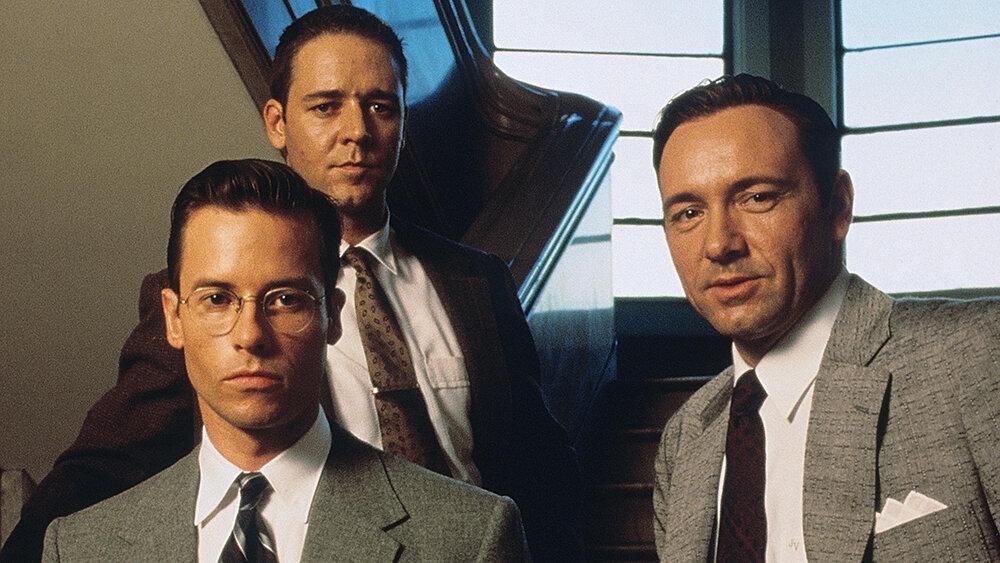
Released in 1997 and adapted from James Ellroy’s 1990 novel, L.A. Confidential takes audiences into early 1950s Los Angeles, where a seemingly straightforward investigation into a brutal multiple murder gradually exposes a much larger network of corruption. At the centre of the story are three police officers whose personalities, ambitions, and approaches to law enforcement could hardly be more different. Ed Exley (Guy Pearce) is an ambitious officer promoted to detective lieutenant following the Bloody Christmas scandal, whose willingness to testify against fellow officers earns him the resentment of his colleagues. The real-life incident involved LAPD officers beating several detainees on Christmas Eve 1951, exposing serious problems with police brutality and accountability within the department. Officer Bud White (Russell Crowe) is a physically imposing cop whose violent temper is matched by a personal code that compels him to protect women from abusive men. Meanwhile, Sergeant Jack Vincennes (Kevin Spacey) has become something of a celebrity through his involvement with the entertainment industry and a tabloid publication that profits from police scandals.
Each character represents a different relationship with the institution they serve, and none begins the story with particularly clean hands. Exley is willing to manipulate situations to advance his career, White frequently relies on brutality to achieve his objectives, and Vincennes has grown comfortable providing confidential police information to a publication in exchange for money and recognition. Their methods may differ, but all three have compromised their principles in pursuit of something they believe they want. What makes the film so compelling is how their individual motivations gradually become entangled with a conspiracy that challenges their understanding of the department, their colleagues, and themselves.
The contrast between Exley and White is particularly effective. Exley believes that following procedure and maintaining a respectable public image are essential to becoming a successful police officer, while White operates according to a much more personal understanding of justice. Neither approach is entirely satisfactory, however, and their disagreements expose the limitations of both men. Exley’s ambition can make him dangerously calculating, while White’s instinctive response to injustice often places him on the wrong side of the law himself. Their relationship provides much of the film’s dramatic tension, especially as the investigation forces them to recognize that their differences may be less important than the corruption surrounding them.
Vincennes offers another perspective on this world. His involvement with Sid Hudgens (Danny DeVito), the editor of the scandal-focused Hush-Hush magazine, demonstrates how closely the police and entertainment industries have become connected. The film’s fictional publication draws inspiration from real-life scandal sheets, particularly Confidential, a notorious magazine that exposed the private lives of Hollywood celebrities throughout the 1950s. Rather than simply reporting on criminal activity, Hush-Hush actively participates in manufacturing stories and exploiting the reputations of people who can be turned into profitable headlines. Vincennes initially treats this arrangement as another convenient way to advance his own interests, but the consequences eventually force him to confront the difference between being associated with justice and actually pursuing it.
This relationship between law enforcement and the entertainment industry is among the film’s most interesting ideas. Hollywood is not merely a backdrop for the investigation. It is part of the machinery that helps sustain the city’s carefully maintained public image. Celebrities become commodities, scandals become entertainment, and even police officers can be transformed into recognizable personalities. The distinction between public service and performance becomes increasingly difficult to identify when everyone involved seems more concerned with appearances than accountability.
Kim Basinger’s Lynn Bracken adds another important dimension to this examination of appearances. A woman working for wealthy businessman Pierce Patchett (David Strathairn), Bracken participates in an operation that employs women resembling famous Hollywood actresses. Her resemblance to Veronica Lake is particularly significant, as it connects the film directly to the visual history of classic film noir. One of Bracken’s earliest scenes presents her through an image of Lake and Alan Ladd in This Gun for Hire, a 1942 crime film, before the camera reveals Basinger in the room. The sequence establishes the relationship between the artificial image Bracken is expected to embody and the person she actually is. She is simultaneously an individual with her own vulnerabilities and someone whose appearance has become a product to be sold.
It is an especially fitting introduction for a film so concerned with the difference between public identities and private realities. Almost everyone in L.A. Confidential is performing some version of themselves, whether for professional advancement, financial gain, or personal survival. The people who appear respectable may be deeply corrupt, while those who seem irredeemable may still possess the capacity to recognize their own wrongdoing. The film understands that appearances are not simply misleading, but can actively become weapons used by those with enough influence to control them.
That idea extends into the film’s depiction of the Los Angeles Police Department. The investigation gradually reveals a department where corruption is not restricted to a handful of bad officers operating independently. Instead, it is woven into a larger structure in which authority, political influence, and personal ambition reinforce one another. Captain Dudley Smith (James Cromwell) embodies the danger of this arrangement. His position and reputation give him an appearance of legitimacy, but the investigation reveals how easily institutional authority can be used to conceal criminal activity. The distinction between the people responsible for maintaining order and those who profit from disorder becomes increasingly difficult to defend.
This is also where the film’s treatment of violence becomes important. L.A. Confidential does not romanticize police brutality simply because it takes place within a period crime story. White’s violent behaviour is often presented as an extension of his personal convictions, but the consequences are difficult to ignore. The film also examines how police misconduct can be excused, repackaged, or deliberately concealed when it serves the interests of the department. The public may be presented with a reassuring version of events, but the truth is considerably less flattering.
Hanson’s direction is particularly effective because he avoids treating the film as a straightforward recreation of classic Hollywood noir. Although the story contains many familiar genre elements, including compromised detectives, dangerous relationships, betrayal, and a city filled with hidden motives, its visual approach is considerably more naturalistic than the heavily stylized cinematography associated with many earlier noir productions. Working with cinematographer Dante Spinotti, Hanson sought to recreate the period faithfully without making the film feel like an exercise in nostalgia. In an interview with American Cinematographer, Hanson discussed the desire to avoid filtering the story through nostalgia or simply recreating the visual conventions of earlier films. The production also drew inspiration from the documentary photography of Robert Frank, whose work helped establish the film’s more naturalistic visual language. The result is a Los Angeles that feels lived in rather than artificially constructed, with its bright streets, fashionable establishments, and impressive architecture providing an effective contrast to the darkness of the story.
That decision makes the film’s noir identity particularly interesting. Traditional film noir frequently used shadows, confined spaces, and stark visual contrasts to communicate the psychological and moral uncertainty of its characters. L.A. Confidential certainly incorporates elements of that visual language, but it does not depend on them. Its darkness is found just as often in the institutions, relationships, and personal compromises that shape the narrative. Even in a city filled with sunshine, nobody seems particularly capable of escaping the shadows.
The film’s adaptation of Ellroy’s novel deserves considerable credit as well. The original book contains an enormous number of characters, interconnected storylines, and historical references, making it a challenging property to translate into a conventional feature film. Hanson and screenwriter Brian Helgeland significantly streamlined and restructured the material, concentrating the narrative around the three detectives while retaining the larger themes of corruption, ambition, and institutional decay. Some of the film’s most memorable elements were developed specifically for the adaptation, including Rollo Tomasi, a name absent from Ellroy’s novel. The name becomes a personal shorthand for a killer who escapes justice, representing Exley’s determination that someone who commits such a crime should not simply get away with it. Rather than attempting to reproduce every aspect of Ellroy’s sprawling novel, the filmmakers understood which relationships and ideas needed to remain at the centre of the story.
There is also something particularly appropriate about L.A. Confidential arriving in the 1990s. Although its events take place in the early 1950s, its concerns are not confined to that period. The relationship between police departments and the media, the commercialization of celebrity culture, the manipulation of public perception, and the protection of powerful individuals are all subjects that remain relevant well beyond the film’s setting. Its historical backdrop gives these ideas a distinctive atmosphere, but the underlying questions are much more universal.
What ultimately makes L.A. Confidential such an effective neo-noir is that it understands the genre as something more substantial than a collection of visual conventions. Its detectives are not simply hard-boiled investigators navigating a dangerous city, nor are its criminals isolated figures operating outside an otherwise respectable society. The corruption reaches into the very institutions that claim to protect that society, leaving its central characters to decide whether their personal ambitions and carefully maintained reputations are worth preserving at any cost.
Los Angeles may promise a world of glamour, opportunity, and reinvention, but Hanson presents a city where almost everyone is selling something, including themselves. Its police officers become celebrities, its celebrities become commodities, and its institutions become businesses concerned with protecting their own interests. L.A. Confidential ultimately finds its noir identity not simply in the crimes being investigated, but in the realization that the people entrusted with maintaining order can be just as compromised as those they pursue. Beneath the polished surface, the city’s carefully constructed mythology conceals a world where justice is negotiable, reputations are manufactured, and the truth is often the most dangerous thing to uncover.