

Few films occupy quite the same unusual place in cinema as Charles Laughton’s The Night of the Hunter. Released in 1955, this adaptation of Davis Grubb’s 1953 novel, with a screenplay credited to James Agee, combines the criminal undercurrents and visual language of film noir with Southern Gothic horror and the unsettling imagery of a dark fairy tale. The result is a film that feels unlike almost anything else from its era, transforming an otherwise straightforward story of murder, stolen money and a desperate escape into an extraordinary cinematic nightmare.
At the centre of the story is Harry Powell, played by Robert Mitchum, a self-proclaimed preacher who travels through the American countryside while hiding a murderous nature beneath his religious persona. Jailed for thirty days after stealing a car, Powell shares a cell with Ben Harper, a condemned man who killed two people during a bank robbery and hid the $10,000 he stole. Harper goes to the gallows without revealing where the money is, but Powell learns that Harper’s two children, John and Pearl, know the secret. Once released, Powell travels to the family’s hometown, ingratiates himself with Harper’s widow, Willa (Shelley Winters), and marries her in the hope of finding the money. However, John knows the secret his father entrusted to him, and Powell’s growing obsession turns the household into a terrifying place for the children.
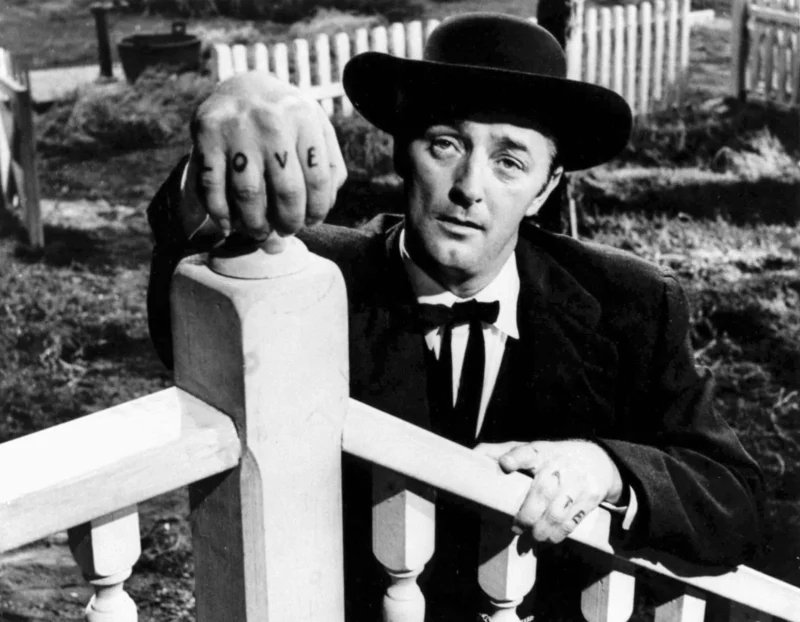
Mitchum’s performance is arguably one of the greatest villain portrayals of the period, with Harry Powell becoming frightening precisely because he rarely behaves like the monster he actually is. His religious convictions become both a convenient disguise and a justification for his murderous behaviour, allowing him to exploit people who mistake his preaching for genuine morality. Powell appears to believe that his actions are sanctioned by a higher power, making his particular brand of religious fanaticism all the more disturbing. The LOVE and HATE tattoos across his knuckles provide an immediately recognizable visual representation of the conflict he claims to understand, although Powell himself is entirely consumed by the latter. Mitchum brings a remarkable sense of menace to the character without relying on constant displays of aggression. His calm delivery, unsettling smile and occasional bursts of violence make him an especially disturbing presence, while his ability to switch between charming and threatening gives the character an unpredictability that remains effective throughout the film.
What makes Powell particularly frightening is that he doesn’t need to hide from society. He is welcomed into homes, treated with respect and given opportunities to exploit the very people who should be able to recognize his intentions. Laughton uses this contradiction to explore the dangers of religious hypocrisy and the ease with which respectable appearances can conceal something profoundly evil. The film’s horror is rooted in a recognizable human threat, one that can exploit faith, authority and the willingness of ordinary people to believe the best about someone presenting himself as a man of God.
This also makes The Night of the Hunter an especially interesting film when considering the overlap between film noir and horror. Productions such as Cat People and The Seventh Victim had already demonstrated how noir’s expressionistic lighting, psychological tension and atmosphere of dread could complement horror filmmaking. These earlier films are now frequently discussed as examples of the growing overlap between the genres, rather than straightforward attempts to establish a distinct horror noir tradition. The Night of the Hunter takes that relationship in a particularly distinctive direction, combining the fatalism and criminal undercurrents of noir with the imagery and narrative structure of a Southern Gothic nightmare. Rather than simply using horror elements to make a crime story more unsettling, Laughton creates a world in which the visual language of noir becomes part of the film’s broader exploration of fear, evil and innocence. It is not the beginning of horror noir, but it stands as one of the most memorable examples of these traditions coming together.
Much of the film’s lasting power comes from Laughton’s extraordinary direction. Although The Night of the Hunter would remain the only feature film Charles Laughton directed, it demonstrates an unusually confident understanding of visual storytelling. Working with cinematographer Stanley Cortez, Laughton creates compositions that frequently resemble illustrations from a sinister children’s story. Deep shadows, exaggerated silhouettes, carefully arranged lighting and deliberately artificial-looking environments give the film a dreamlike quality that separates it from more conventional crime pictures. There is a strong influence from German Expressionism and silent cinema, with the visual presentation frequently communicating the characters’ emotions and circumstances more effectively than dialogue could.
The sequence in which Powell’s shadow looms across the wall of the children’s bedroom is particularly effective, transforming an ordinary domestic environment into something resembling a haunted house. Other images are even more striking, including the unforgettable sight of Willa’s body beneath the water, which turns an otherwise horrific discovery into an almost surreal composition. Laughton understands that horror doesn’t always require showing something directly, and the film repeatedly uses silhouettes, distance and unusual framing to make Powell seem like an inescapable presence.
The children’s escape down the river provides perhaps the strongest demonstration of this approach. As John and Pearl travel through the countryside, the film temporarily abandons the familiar rhythms of its crime narrative and becomes something closer to a dark fairy tale. The landscape appears almost enchanted, with animals, vegetation and distant silhouettes creating an environment that feels detached from ordinary reality. Walter Schumann’s score adds considerably to this atmosphere, helping transform the children’s journey into something both beautiful and unsettling. Yet this beauty never entirely removes the sense of danger. Powell remains in pursuit, and the seemingly peaceful countryside becomes another part of the nightmare. The contrast between the children’s vulnerability and the strange beauty of their surroundings gives these sequences a particularly memorable quality.
The film’s perspective is also important. Although Powell drives much of the narrative, the emotional centre of the story belongs to John and Pearl. Their understanding of the world is limited by their age, and the adults around them are frequently unreliable, easily manipulated or incapable of protecting them. Their journey therefore becomes more than an attempt to escape a murderer. It is also a frightening encounter with a world in which the distinction between safety and danger is not always immediately apparent. Laughton’s fairy-tale approach makes this particularly effective, presenting the countryside as a place of both wonder and terror.
Lillian Gish provides an essential counterpoint to Mitchum as Rachel Cooper, the older woman who eventually takes the children into her care. Her performance brings a different kind of authority to the film, with Rachel representing the genuine compassion and faith that Powell merely pretends to possess. The casting is especially fitting given Gish’s place in the history of silent cinema. Her presence reinforces the film’s connection to an earlier filmmaking tradition, while her character provides a reassuring contrast to the corruption and hypocrisy that dominate much of the story. The confrontation between Rachel and Powell is ultimately a battle between two opposing interpretations of faith, one rooted in compassion and the other used to justify cruelty.
The Night of the Hunter received a mixed critical reception upon its release and failed commercially, and Laughton never directed another feature film. That makes the extraordinary confidence of its visual storytelling all the more remarkable. Rather than feeling like an unsuccessful experiment from a filmmaker unfamiliar with directing, it plays like the work of someone with a remarkably clear vision of the film he wanted to create. Its mixture of noir, horror, Southern Gothic and fairy-tale imagery might have been difficult to categorize when it first appeared, but that refusal to fit comfortably into one genre is now among its greatest strengths.
The Night of the Hunter remains a remarkable achievement, not simply because of Mitchum’s unforgettable performance or Laughton’s striking direction, but because of how effectively it brings together different cinematic traditions. Its use of noir imagery helps establish an atmosphere of suspicion and moral corruption, while its horror elements transform a story about a murderous criminal into something far more unsettling. Like the darkest fairy tales, it understands that the most frightening monsters are not necessarily supernatural creatures hiding in the wilderness. Sometimes they are the people who have already been welcomed into our homes.