

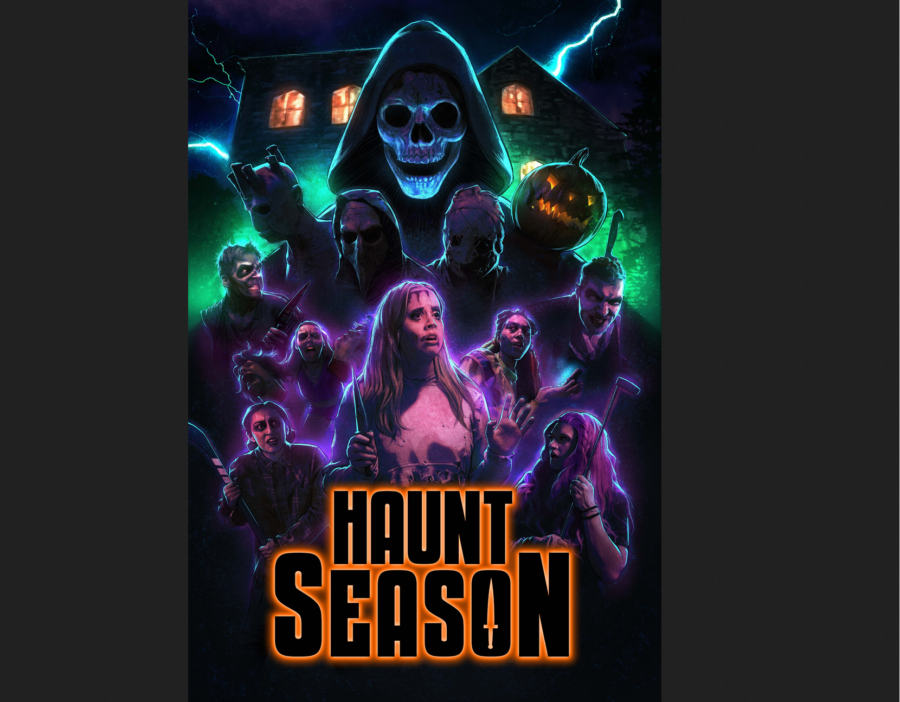
There is a piece of writing advice often attributed to Dorothy J. Heydt that I have always found particularly useful: the Eight Deadly Words, “I don’t care what happens to these people.” It is difficult for a story to recover when its audience has no reason to care about the characters, regardless of how elaborate the plot becomes or how spectacular its set pieces might be. What is less often discussed is the opposite problem, when a film makes its characters so engaging that the plot begins to feel like an unwelcome interruption. That is the unusual position I found myself in while watching Haunt Season, the 2024 independent horror film written and directed by Jake Dary. Rather than struggling to make me care about its characters, the film succeeded so thoroughly that I sometimes wished it would stop trying to kill them.
The premise is hardly unfamiliar territory for horror fans. Killers hiding among costumed performers at a haunted attraction have provided the backdrop for films such as Hell House LLC, Hell Fest, Haunt, The Houses October Built, The Funhouse Massacre, The Bates Haunting and Blood Fest. There are only so many ways to turn a haunted house into a real-life nightmare before the concept begins to feel repetitive, and Haunt Season does not necessarily reinvent the formula. What distinguishes it is its interest in the people who make these attractions possible, giving the employees, their friendships and their shared enthusiasm for frightening strangers considerably more attention than the typical slasher would.
A haunted attraction is ultimately a business, but it can also be a gathering place for people whose interests and creative ambitions might not fit comfortably elsewhere. Documentaries such as Haunters: The Art of the Scare and The American Scream have explored the dedication and community behind Halloween entertainment, and Haunt Season draws on similar ideas to establish its fictional workplace. Its employees are an eccentric bunch, but they are not simply a collection of quirky personalities assembled to provide colourful victims. They have routines, inside jokes, petty disagreements and relationships that suggest they have spent enough time together to develop their own little world. The result is a surprisingly convincing portrayal of a workplace where people have found somewhere they belong, even if their idea of a good time involves spending their evenings covered in fake blood and terrifying paying customers.
The production benefits considerably from its setting, too. Filming took place at the actual Realm of Terror haunted attraction in Round Lake Beach, Illinois, just north of Chicago, while the surrounding entertainment centre provided additional locations, including an arcade, bowling alley and mini golf course. These spaces give the film a tangible sense of place that would have been difficult to replicate with a collection of inexpensive sets. There is a lived-in quality to the environments, and the attraction feels like somewhere that could exist beyond the boundaries of the movie. For an independent production working with limited resources, finding a location that already has so much character can make a considerable difference, particularly when the setting is supposed to feel like a functioning business rather than a stage built exclusively for the next murder.
The story introduces us to Matilda, played by Sarah Elizabeth, a recent theatre graduate who auditions for a position at the attraction. Her ability to scream convincingly earns her a job involving a particularly gruesome effect, in which she is chained up while another performer appears to slice the top of her head off. When the first guests come through and react with the expected horror, Matilda discovers that she genuinely enjoys the experience of frightening people. It is a simple introduction, but it captures something that many horror films overlook: the satisfaction performers can get from seeing an audience react to something they have worked to create. For Matilda, the attraction is not merely a temporary job or an opportunity to indulge her interest in Halloween. It offers a chance to put her theatrical training to use while discovering what she wants to do next.
That uncertainty gives Matilda a relatable quality beyond her enthusiasm for the macabre. Having finished school, she finds herself at a crossroads, unsure whether to move back in with her parents or attempt to make a living independently while pursuing her acting ambitions. It is the sort of dilemma that anyone who has completed their education without a clear path forward can understand, and it provides a welcome grounding for a character who could otherwise have been defined entirely by her participation in a horror attraction. Elizabeth plays her with an appealing combination of laid-back curiosity and quiet confidence, making Matilda someone who observes the world around her rather than simply accepting its conventions.
One of the film’s more amusing exchanges comes when Matilda questions why women in horror movies are so often the ones being chased, tortured and killed, asking why the men cannot take their place for a change. When she is told that this is simply how things have always been done, she encourages her colleagues to stop being classic and start being original. The joke works because it acknowledges the genre’s familiar habits without turning the scene into a lecture about them. Haunt Season understands that horror can be affectionate towards its influences while still recognizing how predictable some of its traditions have become. It is a small moment, but it establishes Matilda as someone who is willing to question the familiar and suggests that the film itself might be interested in doing the same.
Elizabeth is also supported by a cast that makes the attraction’s community feel genuine. The performances are generally naturalistic, with conversations that sound more like exchanges between coworkers who have spent countless hours together than dialogue written to make every character stand out. Nobody seems particularly desperate to steal a scene, and that restraint ultimately makes the ensemble more appealing. Their personalities emerge through their interactions, and the film gives them enough room to develop a sense of familiarity that makes their relationships feel important in their own right. These are people who presumably have lives beyond the attraction, and while the film does not explore every aspect of them, it establishes enough personality to make their time together enjoyable.
There are occasional diversions into social media and the ways people seek attention or present themselves to others. One character shares revealing photographs of herself posing with pumpkins, while another seems perfectly comfortable wandering around naked. These details do not develop into particularly substantial observations about modern life, and the film could have done more with its interest in how people construct their identities for an audience. Nevertheless, they contribute to the impression that the employees have individual habits and personalities rather than existing solely to fulfil familiar horror movie archetypes. Even when these elements feel underdeveloped, they help make the group feel less artificial.
The film’s affection for Halloween also gives it an identity that extends beyond its central premise. There are moments spent among farms, pumpkin patches and the surrounding countryside, accompanied by softer music that creates a mood quite different from the tension associated with the haunted attraction itself. Haunt Season understands that Halloween is not just about monsters, costumes and frightening people. There is also something bittersweet about the final stretch of October, when the holiday you have been anticipating for weeks is nearly over and the decorations will soon be packed away for another year. That sense of seasonal nostalgia lends the film a warmth that I appreciated, particularly because it makes the world outside the attraction feel just as important as the scares taking place within it. Even as the story grows darker, there is an underlying affection for the people and traditions that make the season special.
Unfortunately, the slasher elements are not nearly as consistently effective as the character work. The kills have a deliberately campy quality, with the murderer making use of garden tools, a chainsaw and whatever else happens to be available. One particularly memorable sequence involves a victim’s face being shoved into a watermill on the mini golf course, demonstrating that the film is willing to get creative with its surroundings. These moments offer the sort of gruesome entertainment that fans of independent slashers will appreciate, but the violence does not always sit comfortably alongside the more grounded drama. The film spends so much time making its characters likeable and establishing the appeal of their little community that the sudden shift into conventional slasher territory can feel less like a natural escalation and more like an interruption.
That may sound like an odd criticism of a horror film built around a series of murders, but it speaks to the strength of what Dary establishes before the bloodshed takes over. I became so invested in the employees and their relationships that I sometimes found myself wishing the movie would return to their everyday lives instead of advancing the central mystery. Their conversations, disagreements and shared enthusiasm for their work were often more entertaining than the scenes in which they were being hunted. Rather than eagerly anticipating the next kill, I wanted to spend more time with the people who had made the attraction feel like a genuine community. The violence is an essential part of the premise, but Haunt Season occasionally struggles to reconcile the appeal of its characters with the demands of the slasher formula.
The mystery surrounding the killer is another area where the film falls short of its potential. The employees regularly change costumes and apply elaborate makeup as part of their work, which creates an opportunity for confusion and deception, but it can also make it difficult to keep track of who is who. When the eventual reveal establishes that the murderer is someone we have been following, the explanation raises questions about how the killings could have taken place without attracting more suspicion. The motivation behind the murders also feels forced, lacking the credibility needed to make the reveal as satisfying as it should be. A more carefully developed mystery could have made better use of the attraction’s unusual working environment, particularly given how easily costumes and disguises could complicate the search for a killer.
Even so, the finale makes for an entertaining send-off. The bowling alley provides an effective setting for the film’s final stretch, allowing the production to take advantage of another location that feels distinct from the haunted attraction itself. It is a memorable sequence that brings some welcome energy to the conclusion, even if the revelations leading up to it never entirely come together. The film is more successful at creating an appealing group of characters than it is at constructing a convincing whodunit, and the ending does little to change that balance. Still, there is enough enjoyment to be found in the final confrontation that the weaker aspects of the mystery do not entirely undermine the experience.
What I appreciate most about Haunt Season is how effectively it makes a familiar horror premise feel personal. The film has its share of gruesome kills, genre references and mystery elements, but its greatest strength is its affection for the people working behind the scenes of a haunted attraction. They are not particularly extraordinary individuals, nor do they need to be. Their appeal comes from the sense that they have found a place where they can be themselves, surrounded by others who share their interests and understand their enthusiasm. That simple idea gives the film a warmth that many slashers lack, and it makes the moments spent with the ensemble considerably more engaging than the mechanics of the murder plot.
Haunt Season is not without its shortcomings, particularly when it comes to the killer’s identity, the motivation behind the murders and the uneven balance between character drama and slasher violence. Nevertheless, those flaws are easier to forgive when the film gets so much right about the people at its centre. Its cast is likeable, its setting gives the production a convincing sense of place, and its affection for Halloween extends beyond the usual assortment of spooky decorations and grisly set pieces. I came away from the film wanting to spend more time with its characters, which is a considerably better problem to have than feeling indifferent to them. For an independent horror film working with a well-worn premise, Haunt Season finds something worthwhile in the community surrounding the scares, and that is what makes it stand out.