

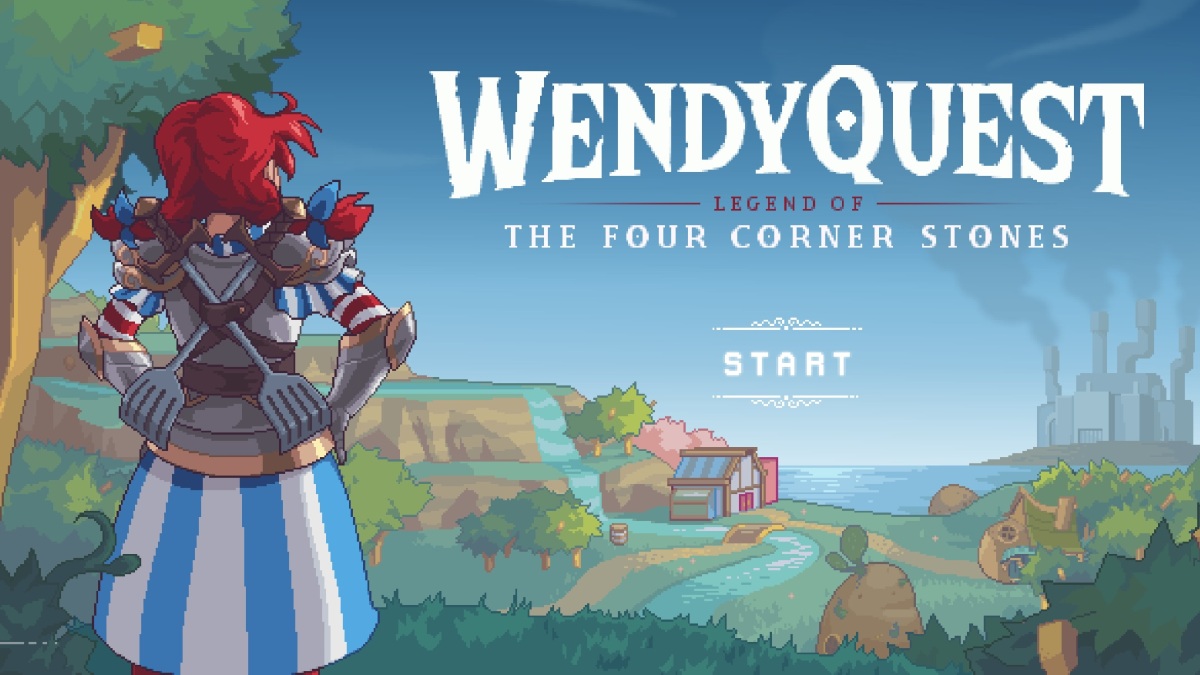
There was a time when companies seemed perfectly happy to turn practically anything into a video game advertisement. Cereal mascots, fast food restaurants, soft drinks, and all sorts of other recognizable brands found themselves starring in their own digital adventures, particularly throughout the 1990s and early 2000s. Some were little more than forgettable promotional curiosities, while others, such as Chex Quest, managed to develop reputations that outlived the products they were originally designed to promote. It is a strange corner of gaming history that has become considerably less common, which makes the existence of WendyQuest: Legend of the Four Corner Stones in 2026 all the more amusing. A Wendy’s RPG sounds like the sort of idea that would have been pitched as a joke, but 81monkeys has somehow turned this bizarre marketing experiment into a genuinely enjoyable adventure.
WendyQuest takes the familiar personality of Wendy’s advertising and builds an entire fantasy RPG around it. This isn’t some collection of promotional minigames or an interactive advertisement that barely qualifies as a video game. It is a proper role-playing adventure with an original world, a colourful cast, turn-based combat, exploration, secrets, and plenty of ridiculous jokes. Naturally, Wendy’s branding is practically impossible to escape, but there is enough genuine creativity here that even someone with absolutely no interest in the restaurant can find something worthwhile.

The adventure begins when Wendy is transported to Savoria, a fantastical land where practically everything revolves around fast food. Following a prophecy involving the legendary Dave Thomas, she is tasked with recovering the Four Corner Stones of flavour and stopping the MechBorg Corporation from taking over the kingdom. Its villainous scientist and his army of factory-produced enemies are spreading blandness throughout the land, replacing fresh ingredients with frozen beef, soggy fries, and melted ice cream. The whole thing is an unmistakable jab at McDonald’s, right down to the villain’s appearance and the game’s constant references to the differences between the competing restaurants. Subtlety clearly wasn’t on the menu, but that is hardly the point.
Savoria is easily one of the game’s most impressive accomplishments. Its various regions are built around different menu items and food-related concepts, with environments that go considerably further than simply putting giant hamburgers in the background. Nuggedor features enormous chicken nuggets and sauce-inspired landscapes, while the Breakfast Isles incorporate breakfast foods into their architecture and surroundings. Potatoes become lumber, fries appear in trees, and salt replaces ordinary sand. Even the smaller environmental details receive attention, with books scattered throughout the world offering information about its inhabitants, history, transportation, and various peculiarities.

It is a surprisingly thorough approach to world-building for something that exists primarily to advertise a fast food restaurant. There is an obvious amount of enthusiasm behind the idea of imagining how an entire civilization might function in a world constructed from food, and the developers seem determined to squeeze as much creativity out of the premise as possible. Savoria could easily have been a disposable backdrop for a collection of product references, but instead it becomes a genuinely entertaining setting worth exploring.
Of course, WendyQuest never forgets who paid for the adventure. Your companions include Frygor, Frostyna, Sir Chicken, and Baconator, while enemies range from Golden Archers to OrEggGami creatures and other food-inspired monstrosities. Equipment includes golden spatulas and armour made from familiar menu items, while attacks feature names such as Nugget Strike and Crispy Blast. There is hardly a corner of the experience that doesn’t contain some reference to Wendy’s, and the product placement is about as subtle as a billboard on the side of a building. Yet there is something genuinely endearing about how completely the game commits to its ridiculous premise.
The humour follows much the same approach. Wendy carries the sarcastic attitude associated with the restaurant’s online marketing, regularly breaking the fourth wall and making observations about the absurdity of the situations around her. There are jokes about familiar RPG conventions, development budgets, and the expectations players have of the genre. Some of the dialogue is deliberately stupid, but the writing understands that the entire adventure is built around an inherently ridiculous concept. The supporting cast also has enough personality to keep things interesting, with their own relationships and occasional moments of genuine drama giving the journey a little more substance than an endless parade of fast food jokes.

The biggest surprise, however, is that WendyQuest is actually quite enjoyable to play. Its turn-based combat incorporates timing mechanics that make attacks considerably more involved than simply selecting an option from a menu. Rather than relying entirely on conventional damage calculations, attacks use moving meters that require carefully timed button presses to maximize their effectiveness. Landing particularly accurate attacks produces critical hits, and maintaining a successful streak increases their damage potential. It is a straightforward concept, but one that gives battles a welcome degree of interaction.
Wendy is the central character in combat, accompanied by one party member at a time. You can switch between companions depending on the situation, with each offering different abilities and limited special resources to manage. The system reminded me quite a bit of Mario & Luigi: Superstar Saga, particularly with its emphasis on timed attacks and the relationship between the main character and their companion. It isn’t nearly as elaborate, but the similarities are immediately recognizable, and the simplified approach works well for a game of this scale.
The presentation also does an excellent job of reinforcing the experience. Its colourful pixel art brings Savoria and its inhabitants to life, while the soundtrack feels right at home alongside the retro RPGs that inspired it. Each region has its own musical identity, and the compositions are considerably more memorable than they have any obligation to be. Caffeine Caverns is a particular highlight, with a wonderfully fitting theme that makes exploring the area even more enjoyable. Between the visuals, music, and overall presentation, WendyQuest manages to capture the appeal of an older RPG without feeling like a particularly lazy imitation.

Unfortunately, the combat isn’t quite as charming once enemies start taking advantage of the game’s status effects. Opponents can hit surprisingly hard, even during the earlier portions of the adventure, and certain conditions interfere directly with the timing mechanics. Sogginess, for example, restricts how far the attack meter can progress, while other effects make its movement considerably less predictable. These are clever ideas that tie the game’s environmental themes into its mechanics, but they can become downright irritating when multiple enemies repeatedly inflict them.
Some encounters feel less like meaningful challenges and more like exercises in patience, particularly when enemies are capable of strengthening their allies or repeatedly disrupting your attacks. The timing window for critical hits can also be unforgiving, making it frustrating when an otherwise successful battle turns into a drawn-out exchange of missed opportunities and healing. An amulet obtained relatively early provides an optional way to make the experience considerably easier, but even then, certain fights can become exhausting.
The economy doesn’t help matters much either. Healing and removing negative conditions often requires purchasing food from Wendy’s restaurants, which makes sense within the context of the game but becomes inconvenient when money is limited. There isn’t much of an equipment economy to exploit, and the inability to sell unwanted weapons means earning additional cash can be a slow process. Thankfully, there are no random encounters, and defeated enemies stay defeated. This makes backtracking considerably less tedious and gives players the opportunity to retreat, recover, and approach difficult encounters again without having to fight through the same groups of enemies.

There is also more to discover than the main storyline initially suggests. Hidden idols provide additional rewards and abilities for companions, while side quests and optional areas give players reasons to explore beyond the obvious path. Later in the adventure, an airship opens up additional opportunities to travel around Savoria and collect remaining treasures. There is even a hidden ending, although discovering how to unlock it is rather obscure and requires some unconventional progression. The adventure itself takes approximately seven to ten hours to complete, depending on how much optional content is explored, which feels like a comfortable length for this sort of experience. It gives the game enough room to develop its world and mechanics before delivering an appropriately extravagant RPG finale against MechBorg’s forces.
Then there are the rewards that exist outside the game itself. Defeating bosses provides special items containing codes for free Wendy’s food through the restaurant’s mobile app. These include a medium fries, a small Classic Frosty, a 10-piece chicken nuggets, a breakfast biscuit or croissant, and a Dave’s Single burger. The offers require an eligible purchase, and the codes are limited, but it is still an amusing incentive for completing a video game. It also reinforces the nostalgic appeal of promotional games from an era when companies occasionally came up with much stranger ways to advertise their products.

Perhaps the most remarkable thing about WendyQuest is that it is completely free, with no paid downloadable content or microtransactions. Its commercial purpose is obvious, but 81monkeys clearly had enough creative freedom to make something that functions as an actual game rather than an extended advertisement. It is available on Steam, including support for Steam Deck, making it an especially easy recommendation for anyone curious about this unusual project.
WendyQuest: Legend of the Four Corner Stones isn’t going to redefine the RPG genre, and its combat occasionally makes the adventure more frustrating than it needs to be. Nevertheless, there is a surprising amount to appreciate here. The colourful environments, memorable soundtrack, self-aware humour, and entertaining interpretation of familiar RPG mechanics combine to create something considerably more memorable than its premise suggests. More importantly, 81monkeys has demonstrated that even a promotional game built around a fast food restaurant can have a personality of its own when the developers are given the opportunity to do something interesting.
There is something refreshing about seeing a company take such an unusual approach to marketing, especially when so many modern promotional collaborations amount to little more than cosmetic additions, temporary events, or advertisements dressed up as partnerships. WendyQuest feels like a throwback to a time when companies were willing to experiment with entirely original games, sometimes producing something far more interesting than anyone anticipated. It might be a bizarre way to promote hamburgers, but the developers have managed to create an adventure that stands on its own merits.

For fans of retro-inspired RPGs, unusual indie projects, or the strange history of promotional video games, WendyQuest is absolutely worth experiencing. You don’t need to care about Wendy’s, enjoy its food, or even have any particular interest in fast food to appreciate what 81monkeys has accomplished. It is a charming, occasionally frustrating, and consistently entertaining adventure that has absolutely no business being this good. Apparently, there’s still some life left in the old advergame, and this time around, it comes with a side of fries.