

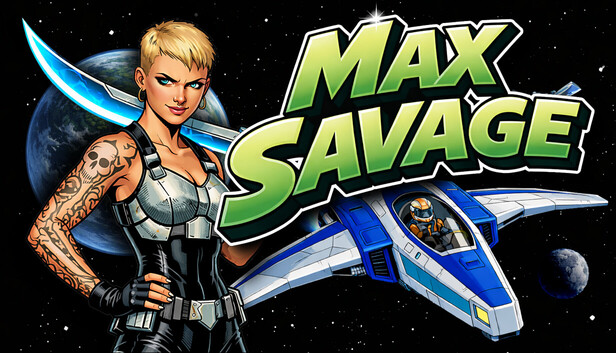
When Wing Commander launched in 1990, it helped establish a template for space combat games that developers continue to revisit today. Origin’s series combined arcade-style dogfighting with a cast of characters who gave its interstellar conflicts a personal dimension, while Wing Commander: Privateer took things in a different direction by letting players abandon military service in favour of mercenary work. Freelancer would later expand on the appeal of making a living among the stars, giving players another memorable take on the genre. Max Savage, developed by Tim Rachor, draws inspiration from these classics while adding an unexpected twist by combining space combat with Zelda-style action-adventure exploration. Its cockpit interface, retro visuals and arcade dogfights immediately establish its influences, but this is not an expansive sandbox filled with a galaxy to explore. Instead, it is a narrative-driven, level-based adventure that borrows elements from several genres to create something a little different, even if the execution does not always live up to its ambitions.
Max Savage follows a Federation pilot who finds herself stranded in the Kir system after refusing an order to execute Lara, a wounded pirate. Her decision costs her rank and leaves her far from home, forcing her to take mercenary contracts as she works towards earning passage off-world. Along the way, she must also protect the future she has begun building with the woman she chose to save. This personal motivation gives the story a different foundation from the usual space opera in which the fate of an entire civilization rests on the protagonist’s shoulders. The relationship between Max and Lara provides a reason to care about what happens beyond the next dogfight, although the narrative does not always deliver its developments with the clarity or impact they need. Some story sequences feel as though pieces of dialogue or exposition are missing, making it difficult to determine whether certain developments are poorly explained or whether dialogue triggers are failing to activate properly. The voice acting is a pleasant surprise for a project of this scale, helping give the characters more personality, but uneven storytelling and interruptions to the gameplay prevent the narrative from being as effective as it could be.

Space combat is the main attraction, with Max Savage favouring accessible arcade action over the complexity of the games that inspired it. Dogfights are generally entertaining, and the straightforward controls make it easy to get into the action without spending too much time learning the ropes. Players take contracts, hunt pirate crews and assist local inhabitants throughout the Kir system, with the missions providing a steady stream of activities as Max attempts to rebuild her reputation. The battles capture some of the immediate appeal of classic space combat games, particularly when the action gets moving, but the combat lacks the depth and variety needed to remain compelling over longer stretches. Weapon effects could also use more impact, making some encounters feel less satisfying than they should. Missiles are a particularly disappointing part of the arsenal, as maintaining a lock requires keeping the reticule and range steady for an unnecessarily long period. By the time a lock is secured, the target may already have been destroyed with lasers, turning what should be a useful alternative into an inconvenient option that is difficult to justify using.
Between missions, a space station serves as a central hub where Max can meet characters, accept contracts and upgrade her ship. This structure provides a natural place to prepare for the next mission, although the game’s pacing can make these activities more frustrating than they need to be. Story progression sometimes interrupts whatever the player is doing, including outfitting a ship or working through other activities, forcing them to abandon their current plans to advance the narrative. Such interruptions would be easier to accept if the story consistently conveyed a sense of urgency, but important developments do not always have enough impact to justify disrupting the player’s routine. The result is a progression system that can feel more restrictive than necessary, particularly when the appeal of games such as Privateer and Freelancer comes partly from the freedom to decide how to spend time between major story events.

The mercenary structure offers additional work beyond the main narrative, but the organization of side missions into reputation brackets limits how much variety players experience at any given stage. Advancing often means repeating the same handful of assignments until enough reputation has been earned to unlock the next tier. Although the selection of missions provides some variety across the full campaign, that variety is less apparent when progression requires completing similar jobs multiple times. The lack of meaningful rewards, score-based challenges or substantial penalties for failure further reduces the incentive to approach these activities differently. Rather than making the pursuit of a higher reputation an engaging long-term goal, the system can turn it into a grind that interrupts the forward momentum of the adventure. This is particularly disappointing because the mercenary premise is a natural fit for a game inspired by classic space sims, where taking jobs and gradually building a career should be among the most appealing parts of the experience.
Max Savage attempts to distinguish itself from more conventional space combat games through its planetary exploration, which shifts the action away from the cockpit and towards on-foot missions. These sections resemble a basic action RPG, with 2D adventure maps connecting areas where players can fight enemies, speak with characters and search for secrets. They also provide a separate progression system through upgrades for Max herself, giving players another way to improve their capabilities as the adventure unfolds. The change of pace is welcome, and combining ground-based exploration with space combat gives the game a more distinctive identity than it would have if it focused exclusively on dogfighting. Unfortunately, the planetary sections are relatively simple, and their occasionally difficult-to-read visuals can make them less engaging than the space battles. There is not enough depth to make the action-adventure gameplay particularly memorable on its own, so its success largely depends on whether players appreciate the additional variety. The idea of combining these genres remains appealing, but the ground missions do not always feel developed enough to stand alongside the cockpit action as an equally compelling part of the experience.

Ship and equipment progression should provide another reason to keep taking contracts, with a selection of modules available for customizing spacecraft and entirely new vessels unlocking as players advance. There is some satisfaction in improving a ship and preparing for subsequent missions, but the differences between vessels are too modest to encourage substantially different approaches to combat. Higher-tier ships generally represent improvements over their predecessors, leaving little incentive to choose one for its agility and another for its durability or firepower when the next available upgrade is usually the obvious choice. Equipment offers some variation, but its effects are not pronounced enough to make loadout decisions particularly meaningful. For a game inspired by space sims known for their ships and customization, this lack of mechanical depth is disappointing. The planetary upgrades give character progression a separate purpose, but they do not entirely compensate for the limited impact of the ship-building systems.
The presentation is one of Max Savage’s more consistent strengths, combining pixel art, comic-style illustrations and flat-shaded low-poly 3D environments to evoke the look of older PC games. The contrasting styles give the game a recognizable visual identity, and its retro science-fiction aesthetic feels appropriate for an adventure inspired by the likes of Wing Commander and Privateer. Environmental artwork generally captures the atmosphere the game is aiming for, although some character portraits are less convincing and can distract from otherwise solid presentation. The audio has room for improvement as well, particularly during combat, where more substantial weapon effects could make battles feel more forceful. The voice acting fares better, giving the dialogue-heavy narrative a degree of personality even when the writing itself falters. Support for mouse and keyboard, gamepads and dedicated flightsticks is also appreciated, particularly for players who prefer a more traditional space simulator setup. Four difficulty levels, including a story mode, make the game approachable for newcomers, although accessibility cannot entirely compensate for the repetition and mechanical limitations that become more noticeable as the campaign progresses.

The overall length depends on how much players want to accomplish, with a playthrough on normal difficulty taking roughly eight to twelve hours and higher difficulties, additional runs and secret hunting potentially extending that to twenty hours or more. For a game at its price point, this offers a reasonably compact adventure, but the repetitive mission structure does little to encourage returning once the story is complete. Max Savage is an earnest attempt to recapture the appeal of classic space combat games without demanding a major time commitment or a substantial financial investment. Its accessible dogfights, nostalgic presentation, voice acting and combination of space and ground missions give it a personality of its own, even when several of its systems feel underdeveloped. Repetitive side missions, limited ship progression, awkward missile mechanics and uneven pacing prevent it from reaching the heights of its inspirations, while the relatively shallow planetary sections make its unusual genre combination less successful than it could have been. Nevertheless, there is uncomplicated fun to be found in taking contracts, improving a spacecraft and heading back into space for another fight. For players looking for an inexpensive dose of retro space combat, Max Savage is worth considering, provided they are not expecting the depth, freedom or scale of a full-fledged space simulation.
Disclaimer: A review key was provided for this review.