

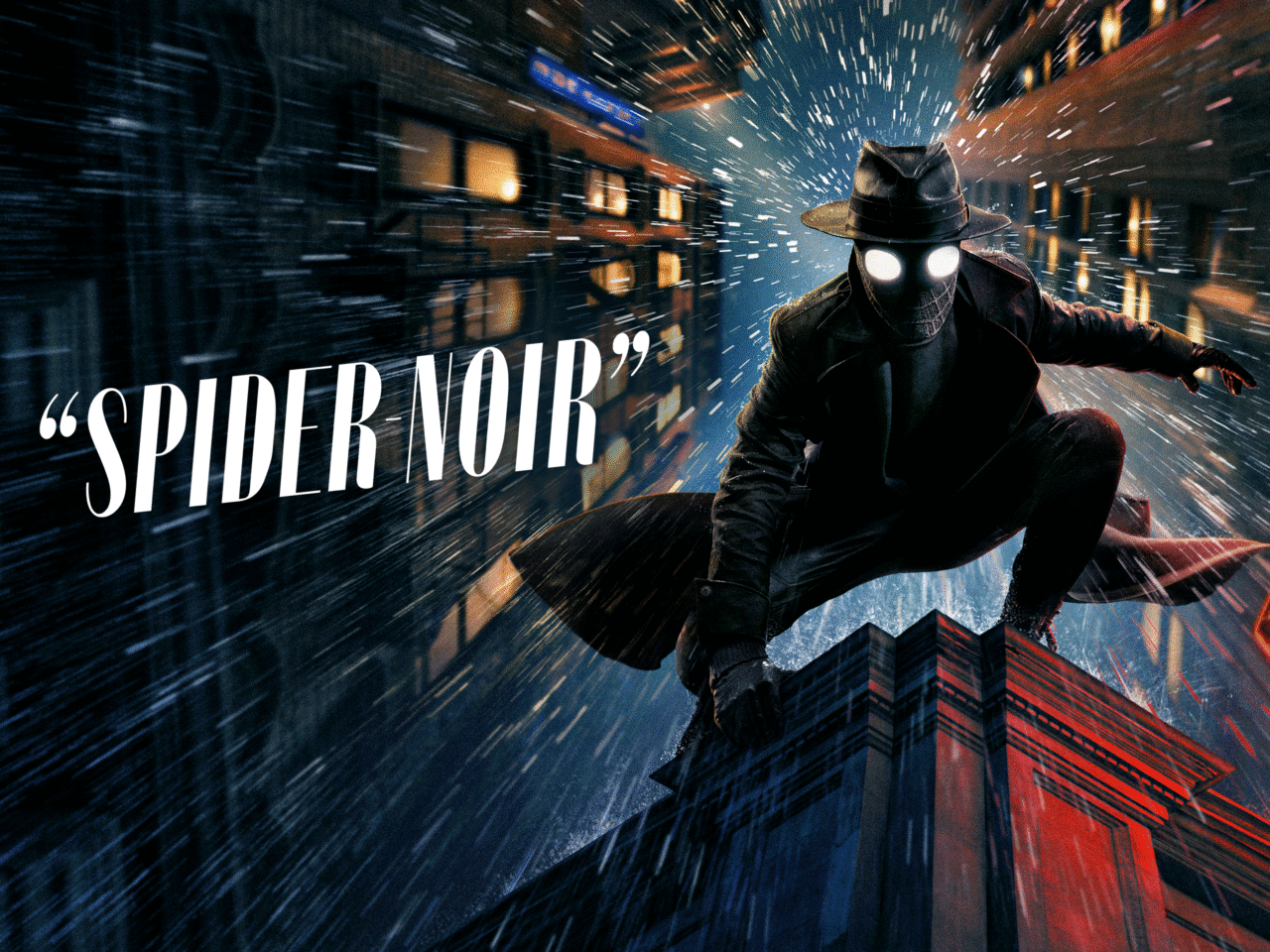
There are plenty of ways to reinvent a familiar superhero, but few are quite as interesting as dropping one of comics’ most recognizable characters into the middle of a classic noir mystery. Spider-Man has traditionally been associated with colourful adventures, wisecracking villains, and the familiar streets of New York City, but Spider-Man Noir offers something considerably different. Inspired by pulp fiction, hard-boiled detective stories, and the shadowy atmosphere of film noir, this alternate version of the wall-crawler trades much of the usual superhero spectacle for organized crime, corruption, and a world where doing the right thing does not always come with a happy ending. However, the character’s history is more varied than a simple change of decade suggests, spanning several creative teams, a jump from the Depression to the eve of the Second World War, and even a change of identity along the way.
For Noirvember, Spider-Man Noir is an especially worthwhile character to revisit. He is far from the only hero to be pulled into the world of crime fiction, but his origins draw directly from the pulp vigilantes who helped establish the genre, a lineage explored in our retrospective on The Shadow. The Shadow helped establish the popularity of the pulp hero, inspiring competitors such as The Spider, whose first magazine appeared in October 1933. Fittingly, this is also the year in which the original Spider-Man Noir comic takes place, creating an unexpected historical connection between Marvel’s alternate superhero and the pulp fiction that helped inspire him.
Spider-Man Noir debuted in the four-issue Spider-Man Noir miniseries, which carried cover dates from February to May 2009. Its first issue actually went on sale on December 17, 2008, explaining why some publication listings associate the series with that year despite its 2009 cover dates. It was part of Marvel’s wider Noir line, which also included books such as X-Men Noir and Punisher Noir. The original concept came from Fabrice Sapolsky, who developed the idea of a 1930s pulp interpretation of Spider-Man with writer David Hine. The two subsequently worked together on the series, with Carmine Di Giandomenico handling the artwork and Marko Djurdjević designing the costume.
The story takes place in 1933, where the Great Depression has left New York struggling and criminal organizations have found ways to profit from widespread desperation. Norman Osborn, better known as the Green Goblin in the mainstream Marvel universe, is a powerful crime boss who goes by the Goblin and keeps his grip on the city through a collection of dangerous associates. Those associates include the Enforcers, Kraven, the Chameleon, and a version of the Vulture who is a sideshow attraction with a particularly disturbing taste for human flesh. Rather than a costumed supervillain threatening the city with elaborate schemes, this version of Osborn is something considerably more grounded in the traditions of crime fiction.
Peter Parker’s circumstances are just as different. He is raised by Aunt May and Uncle Ben, a First World War pilot who made an enemy of Osborn by organizing workers against him. Ben’s murder is far more gruesome than anything the mainstream books would show, and Peter eventually finds himself under the wing of photojournalist Ben Urich, whose own relationship with Osborn proves to be more complicated than it first appears. After encountering a mysterious spider with a decidedly supernatural connection, Peter builds his costume from pieces of his uncle’s old airman uniform and sets out to take the Goblin down. This is not quite the friendly neighbourhood hero audiences know, as his approach to fighting crime is considerably more brutal and his willingness to use lethal force makes him a much more morally complicated protagonist. When the Vulture is sent after Aunt May, for example, Peter shoots him to save her.

That distinction is particularly important because it changes the way Spider-Man’s familiar sense of responsibility is presented. The traditional Peter Parker understands that having great power means accepting responsibility for how it is used, but the Noir incarnation operates in a world where conventional justice has largely failed. The people responsible for maintaining order are often just as corrupt as the criminals they are supposed to stop, and the line between a vigilante and the people he hunts can become uncomfortably thin. This does not make him an entirely different character, but it does offer a compelling look at what Spider-Man might become if he were raised in a society where violence and corruption were everyday realities.
The original miniseries also makes effective use of familiar Marvel characters by reimagining them through the conventions of pulp crime fiction. Felicia Hardy, for instance, becomes the owner of the Black Cat nightclub, Urich’s former lover, and a complicated ally in Peter’s war against Osborn’s criminal syndicate. The result is a world that remains recognizably connected to Spider-Man while drawing heavily from the crime stories that helped establish the foundations of the superhero genre. Di Giandomenico’s artwork is another important part of the experience, giving the series a suitably grim atmosphere that complements its Depression-era setting.
The story continued with Spider-Man Noir: Eyes Without a Face, another four-issue miniseries from Hine, Sapolsky, and Di Giandomenico. Its first issue went on sale in December 2009, while the final issue arrived on March 3, 2010, despite the series carrying cover dates from February to May 2010. Set roughly eight months after the original story, in September 1933, it expanded the world by introducing the Crime Master, Sandman, and Doctors Otto Octavius and Curt Connors, who are involved in disturbing experiments on kidnapped victims. Robbie Robertson also receives a larger role as a struggling reporter, and Peter’s relationship with Felicia Hardy continues to develop. The two miniseries make for a particularly worthwhile starting point for anyone interested in seeing how Marvel first approached the concept. Both are collected alongside additional material in Spider-Man Noir: Hard-Boiled Origins, which also includes the character’s return in Edge of Spider-Verse and a Spider-Geddon-related story.
The character received another comic book adventure in 2020 with a five-issue Spider-Man Noir series, later collected as Spider-Man Noir: Twilight in Babylon. Written by Margaret Stohl with artwork by Juan Ferreyra, it jumps ahead to 1939, where Peter, now working as a reporter, is pulled into the murder of a waitress at the Black Cat nightclub. The trail leads overseas and into a globe-trotting adventure involving Nazi agents and an ancient evil unearthed on the other side of the world. Of course, this moves well beyond the more localized crime fiction of the original stories, but it retains the alternate universe’s pulp influences and its interest in placing familiar Marvel characters into a different historical setting. Ferreyra also keeps much of the artwork in grey tones with occasional splashes of colour, which suits the late 1930s atmosphere nicely.
More recently, Erik Larsen and artist Andrea Broccardo revisited the character with a five-issue Spider-Man Noir series that began on October 1, 2025, with Marika Cresta also contributing artwork. Larsen, who made his name on Amazing Spider-Man in the early 1990s before leaving to co-found Image Comics and launch Savage Dragon, returned to Spider-Man with his own take on the Noir version of Peter Parker. This time, Peter works as a private investigator by day and takes to the rooftops as Spider-Man by night. When Gwen Stacy walks into his office asking him to find out who killed her father, police captain George Stacy, Peter finds himself in a case that draws in gangsters, a Nazi plot, and the people closest to him. Collected in June 2026 as Spider-Man Noir: The Gwen Stacy Affair, the story brings the character even closer to traditional hard-boiled detective fiction. Making Peter a private investigator is a particularly natural fit, giving the series an opportunity to embrace familiar mystery conventions while maintaining the darker superhero elements that distinguish this incarnation from the mainstream Spider-Man.

Spider-Man Noir’s popularity eventually extended beyond the comics, most notably through his appearance in 2018’s Spider-Man: Into the Spider-Verse. Voiced by Nicolas Cage, this version of the character became one of the film’s more memorable alternate Spider-people, combining the exaggerated seriousness of classic detective protagonists with an appropriately unusual sense of humour. His screen time was relatively limited, but the performance helped introduce Spider-Man Noir to an audience that might never have encountered the original comics. It also gave the character a recognizable face beyond the comic book readership. Cage’s take demonstrated that the character could be entertaining without abandoning the visual language and personality that made him distinctive in the first place.
That popularity eventually led to Spider-Noir, a live-action series starring Cage that debuted on MGM+ on May 25, 2026, before arriving on Prime Video on May 27. Created by Oren Uziel, with Uziel and Steve Lightfoot serving as co-showrunners, the eight-episode series is not a straight adaptation of the Peter Parker comics and takes place in its own continuity rather than following the same version of the character seen in Into the Spider-Verse. It also marks Cage’s first lead role in a television series. Cage plays Ben Reilly, a down-on-his-luck private investigator in 1930s New York who spent years as the city’s only superhero, known as the Spider, before stepping away following personal tragedy. Comic fans will recognize Ben Reilly as the name of Peter Parker’s clone, but the television series uses it for a different interpretation of the character rather than adapting his familiar comic-book history. The creative team felt that Peter Parker was too closely associated with a younger, more boyish interpretation of the superhero, whereas Ben Reilly offered an opportunity to explore someone older and considerably more disillusioned. The series also calls him the Spider, a name the creators have tied to early crime fighters like the Spirit and the Shadow, and one that happens to match the pulp hero who debuted in 1933, further connecting the adaptation to the crime-fiction traditions that inspired the original comics.
The private investigator premise gives the series plenty of opportunities to draw from classic noir. Ben is a considerably older and more disillusioned protagonist than the young Peter Parker of the original comics, and his circumstances allow the show to explore familiar themes of regret, personal tragedy, and the difficulty of escaping one’s past. While Larsen’s comic reimagines Peter as an investigator who continues to operate as Spider-Man, the television series takes a different approach by making Ben a former superhero who must confront the life he left behind. Cage has described his approach as roughly 70 percent Humphrey Bogart and 30 percent Bugs Bunny, which gives a clear sense of the tone. The supporting cast fills out the world nicely, with Lamorne Morris as Robbie Robertson, Ben’s friend and a freelance journalist chasing riskier stories, Li Jun Li as nightclub singer Cat Hardy, the series’ take on Black Cat, and Karen Rodriguez as Janet Ruiz, Ben’s secretary and fellow investigator. On the other side of the law, Brendan Gleeson plays mob boss Finn Byrne, better known as Silvermane, Jack Huston plays Flint Marko, who becomes Sandman, and Abraham Popoola plays Lonnie Lincoln, better known to comic fans as Tombstone.
Cage is particularly well suited to this interpretation. His performance in Into the Spider-Verse already established an affection for the exaggerated language and atmosphere of old detective stories, and the television series gives him considerably more room to explore those influences. There is something inherently entertaining about watching a superhero character operate within the conventions of a hard-boiled detective story, particularly when the protagonist is as unconventional as this version of Ben Reilly. That being said, the series also has a more serious side, using its setting and central mystery to explore the consequences of a life spent fighting crime.
One of the more notable decisions surrounding Spider-Noir is that viewers can experience the series in two different presentations, marketed as Authentic Black & White and True-Hue Full Color. The black-and-white presentation is an obvious nod to classic film noir, immediately evoking the shadows, stark contrasts, and visual language associated with the genre. The colour version, meanwhile, offers another way to experience the same story without abandoning its period atmosphere. This is more than just a novelty, as it raises a fair question about what actually makes something noir, a topic covered in our look at what film noir is and why it still matters. A monochromatic image can certainly help establish the atmosphere, but noir has never been defined exclusively by its visual presentation. Its characters, moral uncertainty, storytelling, and treatment of corruption are just as important.
That distinction is particularly relevant when considering Spider-Man Noir as a whole. The original comics use the conventions of pulp fiction and film noir to reinterpret a familiar superhero, while the television adaptation moves closer to the private investigator stories that helped define the genre. Neither approach needs to abandon the superhero elements entirely, but both demonstrate that the character works particularly well when placed in a world where justice is difficult to find and the people responsible for maintaining order cannot necessarily be trusted.

Unfortunately, Spider-Noir will not continue beyond its first season. Prime Video and MGM+ confirmed the cancellation on September 4, 2026, without announcing an official reason, despite strong reviews and 11 Emmy nominations, the most of any Prime Video series that year. Just two days later, the series won five Creative Arts Emmys, taking home awards for stunt coordination, sound editing, title design, visual effects, and cinematography. The recognition makes the cancellation particularly disappointing, especially when the creative team had already considered where Ben Reilly’s story might go next. Co-showrunner Oren Uziel had discussed how a possible second season might have taken Ben Reilly to another location, with the story eventually moving towards the increasingly turbulent events leading up to the Second World War. Uziel also described the first season as a self-contained story, meaning its cancellation does not necessarily leave viewers with an unfinished central mystery. Nevertheless, there were plenty of possibilities left to explore, and the cancellation means many of them will likely remain untold.
Spider-Man Noir is a particularly strong example of how flexible the conventions of noir can be. The character began as an alternate interpretation of a familiar superhero, but his enduring appeal comes from how naturally he fits into the traditions of pulp crime fiction and hard-boiled detective stories. Whether it is Peter Parker fighting organized crime during the Great Depression or Ben Reilly investigating the darker corners of 1930s New York, these stories demonstrate that a superhero does not necessarily need a colourful costume, an extraordinary enemy, or a world-saving adventure to make for an engaging protagonist. Sometimes, all that is needed is a troubled detective, a corrupt city, and a mystery that refuses to stay buried.


