

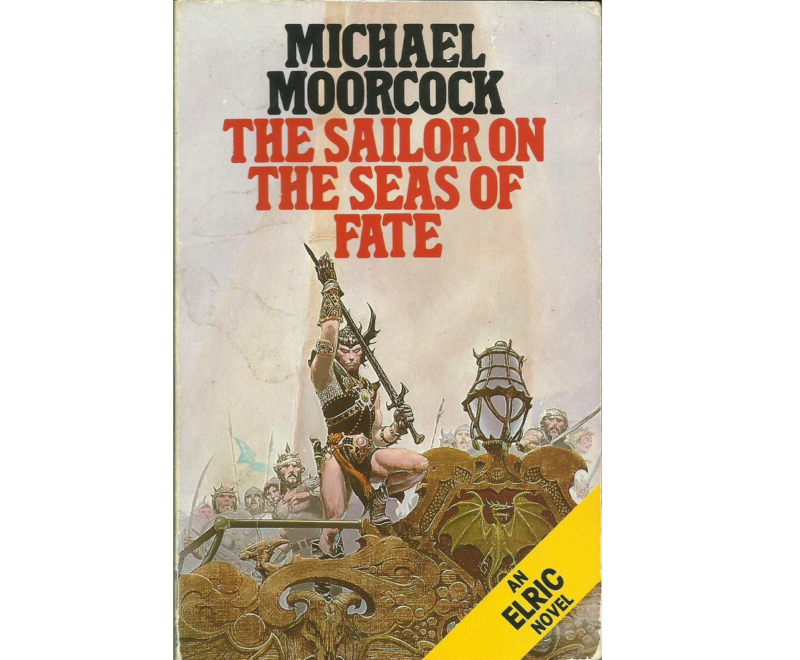
When discussing the authors who helped shape sword and sorcery, Robert E. Howard’s Conan stories are often the starting point, but Michael Moorcock took the genre in a very different direction. Rather than creating another barbarian defined by physical strength and survival, Moorcock introduced Elric of Melniboné, an albino emperor whose fragile body, troubled conscience, and dependence on a soul-devouring sword make him a very different kind of fantasy protagonist. Elric of Melniboné (which we reviewed here) introduced readers to this doomed figure, but The Sailor on the Seas of Fate expands the boundaries of his adventures considerably, taking him beyond the familiar kingdoms and into a much stranger mythology.
Originally published in 1976, The Sailor on the Seas of Fate first appeared in Britain through Quartet Books before its American release as a DAW paperback in December of that year. The American edition featured cover art by Michael Whelan. The book consists of three connected novellas, “Sailing to the Future,” “Sailing to the Present,” and “Sailing to the Past.” The final story was adapted from Moorcock’s earlier 1973 work The Jade Man’s Eyes, while the collection’s placement in Elric’s life is also worth noting. The later novel The Fortress of the Pearl takes place between Elric of Melniboné and this book, placing The Sailor on the Seas of Fate after Elric’s earlier adventures in the saga’s internal chronology.
Having abandoned Melniboné, Elric continues wandering the Young Kingdoms in search of an understanding of the human civilizations his people once dominated. His departure was partly motivated by his disgust with Melnibonéan decadence, but leaving his homeland has hardly made him welcome elsewhere. When the story opens, Elric is fleeing hunters along the desolate coast of Pikarayd after escaping imprisonment. With the sea ahead and his pursuers closing in, his prospects appear bleak until a mysterious vessel emerges from the mist and offers him an unexpected escape.
The ship’s blind captain has brought together four warriors from different worlds: Elric, Erekosë, Dorian Hawkmoon, and Prince Corum. The captain reveals that they are different incarnations of the Eternal Champion, a being repeatedly drawn into the conflict between Law and Chaos. Their task is to confront the sorcerers Agak and Gagak, whose ambitions threaten the existence of the worlds themselves. The ensuing adventure takes the Champions into an extraordinary landscape where their identities and bodies merge, eventually transforming them into a single eight-armed warrior capable of confronting the creatures hidden within an enormous living structure.
The Eternal Champion was already familiar to Moorcock’s readers through Erekosë, Hawkmoon, and Corum, whose adventures had begun appearing in their own stories, but this is where Elric becomes more firmly connected to the author’s wider fantasy universe. The idea is fascinating, although the execution is uneven. Moorcock moves so quickly through the premise, characters, and mythology that the story can be difficult to fully absorb. Its dreamlike quality works in its favour, particularly when the memories of the adventure begin to fade, but readers unfamiliar with the other Champions may struggle to distinguish them beyond their names and origins. The final confrontation is visually imaginative in concept, yet the battle itself feels surprisingly modest compared with the enormity of the threat the story establishes.
The philosophical conflict between Law and Chaos that underpins Moorcock’s mythology also has earlier roots in fantasy literature. Poul Anderson’s Three Hearts and Three Lions (which we reviewed here) explored a similar opposition, and Moorcock developed the concept in his own direction, turning it into a much broader cosmology. Neither force represents an uncomplicated form of good or evil, as an absolute commitment to either can become destructive. The Eternal Champion is therefore caught in a struggle that offers no easy resolution, with the survival of existence dependent on preventing either side from gaining complete dominance.
After the cosmic upheaval of the opening novella, “Sailing to the Present” brings Elric into a more familiar sword and sorcery adventure. Cast onto another world with little recollection of his previous journey, he encounters Count Smiorgan Baldhead of the Purple Towns, a sailor and nobleman whose pragmatic outlook provides a contrast to Elric’s introspection and fatalism. Their friendship develops quickly, but the pairing works because Smiorgan approaches life with an enthusiasm and practicality that Elric often lacks. He also gives the story a more traditional sword and sorcery foundation following the abstract and unusual events of the first novella.
Their adventure soon draws them into the affairs of Saxif D’Aan, a Melnibonéan nobleman who has established himself as a ruler in this unfamiliar world. Saxif carries the burden of a terrible history involving Gratyesha, a half-human woman promised to Prince Carolak whom he abducted and imprisoned. His jealousy and cruelty eventually led him to subject her to horrific torture, killing her in the process. Only afterward did he discover that she had loved him as well, a revelation that left him consumed by guilt. When he encounters Vassliss of Jharkor, a woman who bears a striking resemblance to Gratyesha, he becomes convinced that his former love has returned and attempts to reclaim her.
Saxif is among the more interesting figures in the collection because his remorse does not erase the cruelty that brought him to this point. His tragedy is rooted in his inability to accept the consequences of his own actions, and the centuries he spends seeking another chance do little to redeem what he did. There is an uncomfortable parallel between Saxif and Elric, both of whom are products of Melnibonéan culture and struggle with the legacy of their people, although Elric’s efforts to question that legacy offer a stark contrast to Saxif’s inability to escape his own destructive impulses.
The final novella, “Sailing to the Past,” is arguably the strongest of the three. Elric and Smiorgan find themselves rescued at sea by the explorer Duke Avan Astran, who is searching for R’lin K’ren A’a, the ancestral homeland of the Melnibonéans. The expedition is also seeking the two jewels believed to be the eyes of a massive jade statue associated with Arioch. The journey becomes an exploration of a forgotten civilization, filled with hostile creatures, ancient ruins, and unsettling discoveries that challenge Elric’s understanding of his own race. Moorcock gives this story a stronger sense of discovery, allowing the landscape and the history buried within it to become as compelling as the adventure itself.
Among the revelations is the presence of J’osui C’reln Reyr, the Creature Doomed to Live, a man who has survived for roughly ten thousand years and possesses knowledge of the ancient ruins. Through him, Elric begins to uncover the origins of Melniboné and the events that led his ancestors to abandon their original homeland. Readers familiar with The Jade Man’s Eyes will also notice the changes Moorcock made when incorporating the earlier story into the Elric saga, including Smiorgan’s role in place of Elric’s former companion Moonglum.
Stormbringer also becomes increasingly important in this story, not simply as the source of Elric’s strength but as a presence that cannot be trusted to obey its wielder. The sword sustains Elric’s frail body by consuming the souls of those it kills, but its appetite and supernatural will make it far more than an ordinary weapon. It can act in ways Elric neither intends nor desires, leaving him increasingly uncertain about whether he is controlling the sword or being controlled by it. This relationship is central to what makes Elric such a compelling fantasy protagonist, as even his victories can leave him morally compromised and powerless over the consequences. Moorcock’s interest in the cursed and sentient sword also recalls Poul Anderson’s The Broken Sword (which we reviewed here), an important influence on the dark fantasy elements that would help distinguish Elric from more traditional heroic figures.
The collection is not without its shortcomings. The transition from the relatively personal story of Elric of Melniboné to a multiversal adventure involving several of Moorcock’s other heroes is abrupt, and the three novellas do not always feel like parts of a cohesive novel. Some of the concepts are introduced with little time to develop, and the first story in particular struggles to make the scale of its mythology translate into an equally satisfying adventure. Yet the differences between the three stories also give the book its appeal. “Sailing to the Future” is the most ambitious, “Sailing to the Present” offers a tragic and personal story, while “Sailing to the Past” combines exploration, ancient history, and supernatural horror more effectively. Taken together, they also make Melniboné feel like a civilization with a history far more complex than Elric’s own people have come to understand.
The Sailor on the Seas of Fate is an important entry in the Elric saga, particularly for readers interested in the development of Moorcock’s Eternal Champion mythology. Rather than remaining within the confines of traditional sword and sorcery, Moorcock uses Elric to explore a much larger universe shaped by competing forces, recurring identities, and a destiny that cannot easily be escaped. The collection is uneven, but its ideas help establish the foundations for much of what follows in Elric’s story, while its exploration of the character’s dependence on Stormbringer makes his struggle with power and identity even more compelling.
For readers interested in the history of sword and sorcery, dark fantasy, or the Eternal Champion, The Sailor on the Seas of Fate remains a worthwhile read, particularly after Elric of Melniboné. Its unusual shift in scale is easier to appreciate with some familiarity with Elric’s origins, and those willing to follow Moorcock into stranger territory will find a story that opens up a much larger world around him. Readers looking for another way to experience the adventure can also seek out the Roy Thomas and Michael T. Gilbert comic adaptation, originally published as a seven-issue series by First Comics between 1985 and 1986, and later collected by Titan Comics as part of The Michael Moorcock Library.