

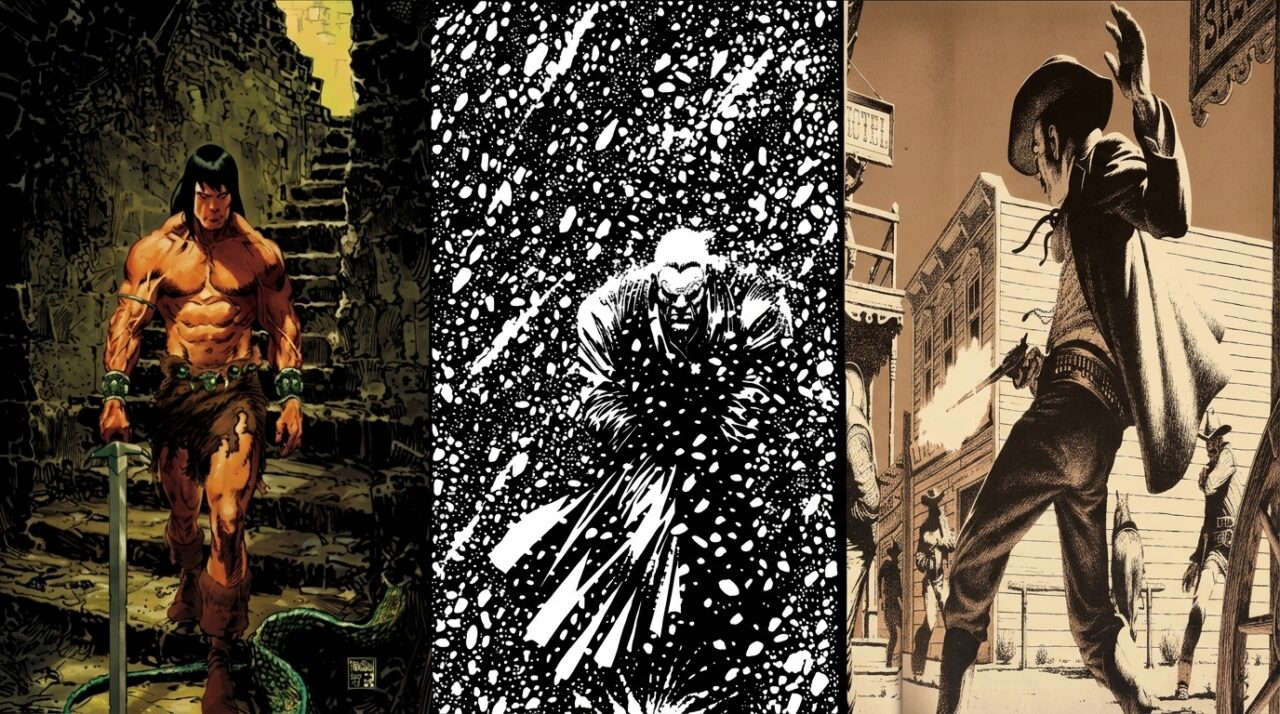
Having just revisited L.A. Confidential, with its portrayal of police corruption, criminal conspiracies, and the moral compromises of those supposedly responsible for upholding the law, it is worth looking beyond traditional crime fiction to consider how these same ideas appear in some rather different genres. Noir, the Western, and sword and sorcery might seem to occupy separate corners of fiction, but they share a surprising number of themes, particularly their fascination with outsiders who move through violent worlds where the established rules offer little protection.
One of the clearest examples can be found in Frank Miller’s Sin City, specifically its opening story, “The Hard Goodbye.” Marv is an unusual noir protagonist. He has the trenchcoat, the hardboiled outlook, and the willingness to follow a trail of violence wherever it leads, but he is hardly the typical private detective. He is closer to a force of nature, an almost unstoppable figure who solves problems with his fists rather than careful deductions. There is a reason for that. In a 2026 interview with Den of Geek, Miller explained that he initially approached Marv with Mickey Spillane’s Mike Hammer in mind before settling on the phrase “Conan in a trenchcoat” as the idea that defined the character. It is a remarkably concise description, and one that reveals just how naturally the worlds of noir and sword and sorcery can overlap.
Marv feels like a barbarian who has wandered into a crime story. He is physically imposing, distrustful of authority, and guided by a personal code that has little to do with the institutions surrounding him. His world is corrupt, its powerful figures are often protected by money and influence, and conventional justice is largely an illusion. Rather than accept that arrangement, Marv takes matters into his own hands. Replace the streets of Basin City with a fantasy kingdom full of treacherous nobles, corrupt officials, and dangerous criminals, and the character would not feel particularly out of place.
The connection becomes even more interesting when considering the work of Robert E. Howard, whose fiction helped establish sword and sorcery as a distinct fantasy tradition. Howard was not confined to tales of ancient kingdoms and barbarian heroes. He wrote Westerns, detective stories, boxing fiction, horror, and historical adventures, often drawing on similar character types and conflicts across these different settings. His stories repeatedly return to men who exist on the margins of society, individuals whose strength, resourcefulness, and willingness to act separate them from the supposedly respectable world around them.
Conan is perhaps the best example. Although he belongs to an imagined prehistoric age, much of his characterization feels closer to that of a Western gunslinger than a conventional fantasy hero. He travels from place to place, takes work when it suits him, becomes involved in conflicts that are often larger than himself, and rarely shows much loyalty to the authorities who claim to govern the lands he visits. He can be a thief, a mercenary, a soldier, or a king, but none of those positions entirely define him. Even when he eventually takes the throne of Aquilonia in The Hour of the Dragon, he remains a man whose instincts were shaped beyond the walls of civilization.
Howard himself offered an unusually direct explanation for the character’s origins in a July 23, 1935, letter to fellow writer Clark Ashton Smith. He described Conan as an amalgamation of people he had encountered, including “prize-fighters, gunmen, bootleggers, oil field bullies, gamblers, and honest workmen.” That list sounds less like the inhabitants of an imaginary ancient world and more like the cast of a hardboiled crime story or a Western. It is a useful reminder that Conan was not simply assembled from historical warriors and mythological heroes. Howard also drew from the rough characters and working lives he knew from contemporary America.
Few Conan stories make the Western connection as apparent as “Beyond the Black River,” first published in Weird Tales in 1935. Rather than relying on lost cities, ancient temples, or the decadent kingdoms that appear in many of Conan’s adventures, Howard places the story in a frontier environment of forests, rivers, log cabins, settlers, and outposts. The conflict between the frontier settlements and the Picts draws heavily on the conventions of American frontier fiction, particularly the familiar conflict between settlers and Indigenous peoples. The Picts are fictional inhabitants of Howard’s invented past, not a direct representation of any one real people, but the story nevertheless carries the colonial assumptions and violence associated with the frontier narratives that influenced it.
The result is effectively a frontier Western recast in Howard’s imagined prehistory. Conan’s role as a scout and fighter for a frontier garrison could easily be adapted into a story about a gunslinger hired to defend a settlement from an advancing enemy. Yet Howard does not give the reader a comfortable celebration of frontier expansion. The story ends with one of its characters delivering the famous declaration that “barbarism must always ultimately triumph,” leaving the conflict with a bleak conclusion that questions the permanence and supposed superiority of civilization. The wilderness is not simply an obstacle waiting to be conquered, and the institutions attempting to impose order are not necessarily destined to survive.
This is where the Western’s wandering gunslinger and the noir drifter begin to resemble Conan even more closely. All three are figures who exist outside the security of settled society, even when they temporarily work for it. The gunslinger may be hired to protect a town, but he is rarely accepted as one of its respectable citizens. The private detective operates within the city but remains separate from its institutions, often discovering that the police, politicians, and wealthy residents are just as compromised as the criminals he investigates. Conan can serve a king or command an army, but his independence remains central to his identity. Their circumstances differ, yet each character is defined by a tension between personal freedom and the systems that attempt to control the world around them.
Howard’s detective fiction offers another particularly interesting bridge between these traditions. His Steve Harrison stories are private-eye adventures, but Harrison is hardly the restrained, cerebral investigator often associated with hardboiled fiction. The Robert E. Howard Foundation’s introduction to Steve Harrison’s Casebook highlights the character’s unusual physicality and his tendency to meet danger with weapons and violence. Harrison is an investigator whose temperament and approach to conflict have much in common with Howard’s fantasy heroes. The comparison is revealing because it shows that Howard did not need to move between entirely separate creative worlds to explore these characters. He could take the same basic kind of protagonist and place him in a modern city, a Western setting, or a fantasy landscape.
There is also a shared fatalism running through all three genres. Noir is often concerned with people trapped by their past decisions, circumstances, and the corruption of the world around them. Westerns frequently portray a changing frontier where the gunslinger belongs to an increasingly obsolete way of life. Sword and sorcery, meanwhile, often places its heroes in worlds where civilization is fragile, power is temporary, and survival depends more on individual ability than on the promises of kings and governments. None of these genres necessarily believes that the world can be made orderly simply by enforcing its rules. Their protagonists survive because they understand how dangerous the world can be, not because they believe it is fair.
The frontier itself is an important part of this connection. In the Western, it is the physical boundary between established society and the wilderness beyond it. In sword and sorcery, it might be the border of a kingdom, the ruins of an ancient civilization, or a distant land beyond the reach of familiar laws. In noir, the frontier becomes urban rather than geographical. The city is crowded and supposedly civilized, but its streets and back alleys conceal their own forms of lawlessness. The difference is largely one of setting. Each genre uses its environment to explore what happens when the structures people depend upon become unreliable.
This is also why the influence of these traditions continues to appear in modern storytelling. Fantasy does not always need to be about grand prophecies, royal bloodlines, and world-ending conflicts. Sometimes its most compelling stories are about dangerous individuals navigating a corrupt society, much like the protagonists of classic noir. Likewise, Westerns can borrow the moral ambiguity and fatalism of crime fiction, while noir can adopt the mythic scale and physical brutality of sword and sorcery. These genres are not interchangeable, but their shared storytelling traditions give creators plenty of room to move between them.
Returning to Marv, it is easy to see why Miller’s description of him as “Conan in a trenchcoat” works so well. Marv is not simply a parody of a barbarian transplanted into a crime comic. He demonstrates how naturally the two archetypes can coexist. His quest in “The Hard Goodbye” has the structure of a hardboiled investigation, but his approach to the world is closer to that of a sword-and-sorcery hero. He is a solitary figure moving through a corrupt landscape, confronting powerful enemies, and relying on his own strength when the institutions around him have failed.
The detective, the gunslinger, and the barbarian are often treated as products of very different storytelling traditions. Yet each can be understood as a variation on the same enduring figure: the outsider who refuses to accept the world as it is, even when he has little chance of changing it. Sometimes that outsider carries a sword, sometimes a revolver, and sometimes a detective’s badge. In Marv’s case, he simply wears a trenchcoat.
Sources referenced
- Frank Miller interview: “Frank Miller: Inside the Mind That Changed Batman, Daredevil and Comics Forever” – Den of Geek.
- Robert E. Howard’s letter to Clark Ashton Smith, July 23, 1935 – REH Writings.
- “Robert E. Howard, the American Frontier, and Borderlands in the Stories of Conan the Barbarian” – Jared Van Duinen.
- Steve Harrison’s Casebook – Robert E. Howard Foundation Press.
- The Collected Letters of Robert E. Howard, Volume Three – REH Writings.
- Robert E. Howard, “Beyond the Black River”, first published in Weird Tales in May and June 1935.