

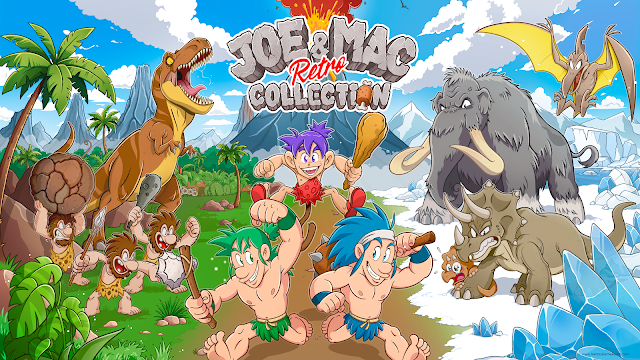
There’s always something exciting about seeing another retro collection arrive on modern hardware, particularly when it brings back a series that helped define a particular era of gaming. Joe & Mac has always been one of those wonderfully ridiculous franchises that feels inseparable from the ’90s, with its oversized cavemen, prehistoric creatures, and uncomplicated approach to action. While preserving games like these for a new generation is always welcome, the best retro collections offer more than just a convenient way to play something old. Joe & Mac Retro Collection brings together three of Data East’s Super Nintendo adventures, and while there’s plenty of prehistoric fun to be found here, the package itself feels like it could have gone a little further.
The collection includes Joe & Mac: Caveman Ninja, Congo’s Caper, and Joe & Mac 2: Lost in the Tropics, which was known as Joe & Mac 3 in Europe. Each game takes a slightly different approach to prehistoric platforming, ranging from straightforward arcade action to more involved adventures with exploration, collectables, and light RPG elements. While the original Joe & Mac: Caveman Ninja remains a charming slice of early ’90s action, it’s actually the two sequels that leave the strongest impression. Together, these games offer an interesting look at how Data East experimented with the series, even if the collection’s relatively limited selection and the fact that all three games are already available through Nintendo Switch Online in North America make this a harder recommendation for everyone.

Joe & Mac: Caveman Ninja is the most straightforward of the three. Players control the titular cavemen as they journey through prehistoric environments, bashing dinosaurs and rival cavemen with their clubs while collecting different weapons to help them along the way. The objective is simple enough, with the duo setting out to rescue the women of their village, who have been kidnapped by a rival tribe of Neanderthals. The real appeal comes from the colourful environments, ridiculous enemy designs, and chaotic action. There’s a lot of charm in watching dinosaurs react to being hit, and the exaggerated animations give the game a personality that remains enjoyable today.
The original is also the most obviously dated of the three games. Its movement can feel awkward, particularly when jumping, and the weapon hitboxes are not always as reliable as they should be. Enemies can be surprisingly aggressive, and the combination of sudden attacks, respawning enemies, and limited opportunities to recover can make certain sections more frustrating than necessary. It’s still an entertaining arcade platformer, but there’s a learning curve involved in getting comfortable with its controls and combat. The game is at its best when played cooperatively, where having another caveman alongside you makes the adventure considerably more enjoyable. The Super Game mode also allows players to hit one another, which can turn an already chaotic experience into an absolute mess, but that’s part of the appeal.
Congo’s Caper takes the series in a different direction, introducing a new protagonist who can transform into a monkey after taking damage. It’s a more traditional console platformer, with greater emphasis on exploration, hidden areas, and collectables. Congo moves faster and jumps higher than Joe & Mac, while collecting red jewels restores his human form and, when accumulated, powers him into Super Congo. This enhanced state improves his abilities and allows him to take more damage before reverting to his normal form. The game also features a few interesting mechanics, including climbable vines, hidden rooms, and a slot machine system that can provide additional rewards/

Congo’s Caper is an interesting departure from the original, although its combat and boss encounters are less satisfying. The faster movement and different approach to platforming can make the game feel more demanding in certain sections, and Congo’s abilities do not always provide the tools needed to deal with the challenges ahead. The transformation mechanic is a neat idea, but losing enhanced abilities after taking a hit can be frustrating, especially when enemies are positioned in ways that make avoiding damage difficult. Still, there’s a lot to appreciate here, particularly when it comes to the level design and the additional freedom afforded to players. It’s a more involved platformer than the original, and its willingness to experiment helps make it an interesting part of the collection.
Joe & Mac 2: Lost in the Tropics is where the series really comes together. Returning to the original duo, the third game improves on the controls, visuals, and overall presentation while introducing a more open-ended adventure. Players can explore a world map, choose which stages to tackle, and visit villages where they can interact with the inhabitants. There are also some light RPG elements, including the ability to build a camp and woo cave women by spending collected stone wheels on gifts. The story is still delightfully ridiculous, involving an evil villain named Gork who has stolen a magical crown, but the additional mechanics give the adventure a much stronger sense of progression.
The gameplay feels considerably more polished, with Joe and Mac moving with greater agility while retaining a satisfying sense of weight. The stages are more varied, the enemies are more interesting, and the additional exploration makes the experience feel much larger than the original. There’s also a greater sense of humour throughout, with the exaggerated animations and silly situations feeling like a deliberate extension of the series’ personality. It’s the strongest game in the collection, and it’s easy to see why it remains such a memorable entry in the franchise. While the original Joe & Mac might be the game that most players remember, Lost in the Tropics offers the most satisfying experience overall.

One of the best aspects of having all three games together is seeing how Data East gradually developed the series. The original establishes the basic formula, Congo’s Caper experiments with more traditional platforming and exploration, and Lost in the Tropics combines those ideas into a more substantial adventure. There’s a clear progression between the games, and even their shortcomings become interesting when viewed in the context of the series as a whole. The bright, chunky pixel art remains appealing, with the dinosaurs, cavemen, and bosses all displaying a level of personality that makes the games enjoyable to revisit. The music is also a highlight, with each game featuring a memorable soundtrack that complements the colourful prehistoric setting.
Red Art Games has included a number of welcome features to make the collection more convenient to play on modern hardware. Save states and rewind functionality are particularly useful for these older platformers, allowing players to recover from mistakes without having to replay entire sections. There are also optional CRT filters, different aspect ratios, and a selection of display frames that help recreate the original presentation. The collection includes both the Western and Japanese releases, including the uncensored Japanese version of Caveman Ninja. This is a particularly welcome inclusion for anyone interested in seeing how the original game differed from its Western release.
The additional preservation features are where the collection really shines. Players can virtually unbox the original games, examining their cartridges, boxes, and manuals from different regions. It’s a lovely addition that captures some of the excitement of opening a new game in the ’90s, and being able to flip through the original manuals is a particularly nice touch. There’s also a gallery featuring concept art and character sketches, alongside a music player that allows players to listen to the soundtracks from all three games.

The Boss Rush mode is another welcome addition, offering a chance to take on bosses from the three games without having to replay their entire campaigns. It’s a fun way to appreciate the enemy designs, particularly in Lost in the Tropics, where some of the bosses are introduced with memorable sequences that make their encounters feel more dramatic. The collection also includes a selection of additional presentation options, making it easier to tailor the experience to individual preferences.
However, while the collection does a good job of preserving the three Super Nintendo games, there’s still a sense that it could have offered considerably more. The arcade versions of Joe & Mac: Caveman Ninja and Joe & Mac Returns are notably absent, and their inclusion would have made this a much more comprehensive collection. The arcade original is a different experience from the Super Nintendo version, while Joe & Mac Returns offers a particularly entertaining take on the series with its single-screen cooperative action. Additional console versions, such as the NES and Game Boy releases, would have also been interesting to include. The Sega Genesis version is particularly notable, as it is generally regarded as one of the home versions that comes closest to the arcade experience.

The collection could also have benefited from more historical material. While the concept art and virtual packaging are appreciated, developer interviews or additional information about the games’ creation would have made the package more interesting for anyone curious about Data East’s work. There’s a fascinating story to be told about how the series evolved from an arcade conversion into a more involved console platformer, and additional insight into the people responsible for these games would have made the collection even more worthwhile. The included artwork offers a glimpse into the development process, but it feels like an opportunity for a more substantial preservation effort was missed.
It’s also worth noting that all three games included in Joe & Mac Retro Collection are available through Nintendo Switch Online’s Super Nintendo library in North America. While having them in a standalone collection means players can continue playing without relying on a subscription, it makes the package a harder sell for anyone who already has access to Nintendo’s classic game library. The additional preservation features and virtual packaging are appreciated, but they may not be enough to justify purchasing the collection when the games themselves are already available elsewhere. For longtime fans who want to own these adventures outright, there’s still value in having them together, but newcomers and existing Nintendo Switch Online subscribers may find that the collection doesn’t offer enough to warrant another purchase.
That consideration is primarily relevant to Nintendo hardware, however. On PlayStation 5, Xbox Series X|S, and PC, Joe & Mac Retro Collection is the only legitimate way to play these Super Nintendo versions, making it a considerably more appealing purchase for players on those platforms. The collection may not be as comprehensive as it could have been, but having these games available outside of Nintendo’s subscription service gives it a stronger reason to exist.

Despite these shortcomings, Joe & Mac Retro Collection is a worthwhile collection of colourful, entertaining platformers that deserve to remain accessible on modern hardware. The original Joe & Mac: Caveman Ninja is still a charming piece of gaming history, even if its age is apparent, while Congo’s Caper and Lost in the Tropics offer some interesting ideas that make them more than simple follow-ups. The additional preservation features are appreciated, particularly the virtual unboxing and original manuals, and the modern conveniences make it easier to enjoy these games without having to deal with all their original frustrations.
A more comprehensive collection, particularly one featuring the arcade versions and additional historical material, would have been preferable, but there’s still a lot to enjoy here. With all three games already available through Nintendo Switch Online in North America, this collection is not necessarily an essential purchase for everyone. Longtime fans who want to own these games outright will find plenty to appreciate, while newcomers may be better served by trying them through Nintendo’s subscription service first. For those playing on other platforms, however, there’s a much stronger reason to pick it up. The cavemen may not have conquered the world, but their adventures remain entertaining enough to warrant another trip through the prehistoric era.
Disclaimer: A review key was provided.