

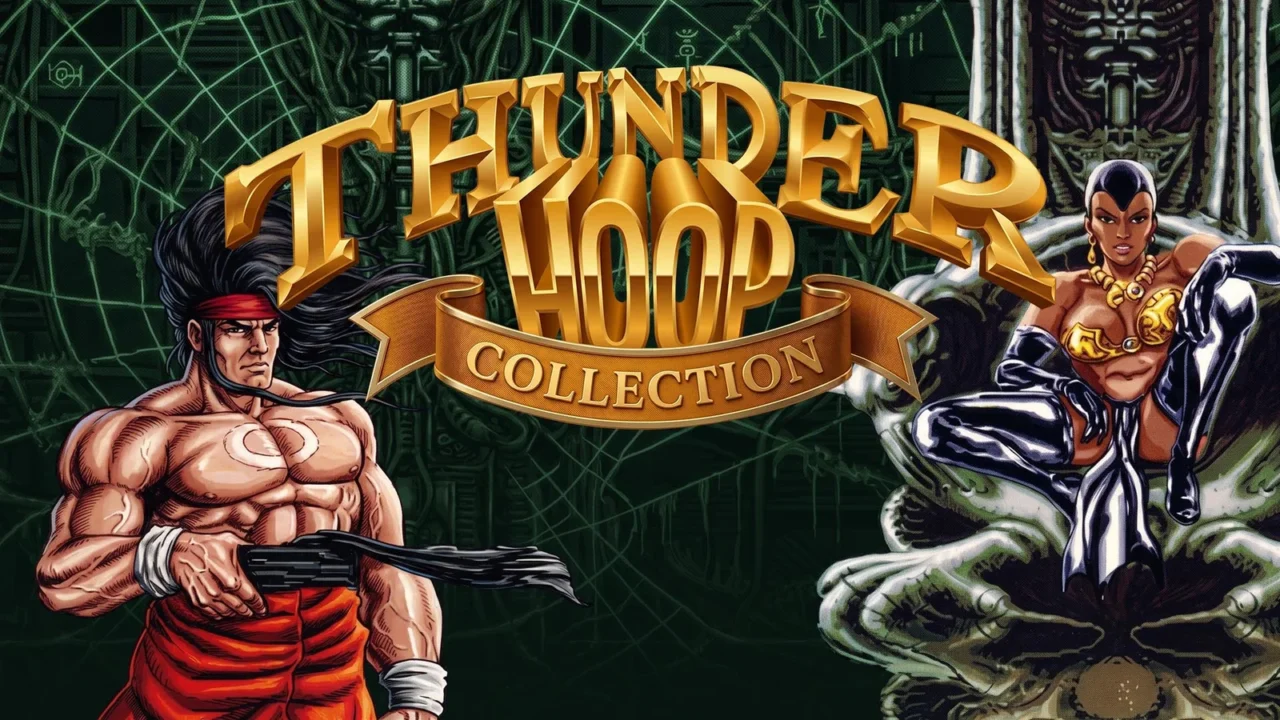
There’s something particularly exciting about discovering an obscure arcade game that has largely slipped under the radar, especially when it turns out to be considerably more interesting than expected. Thunder Hoop was one of those titles that first caught attention through Run ‘n’ Gun: A History of On-Foot Shooters from Bitmap Books. Both games looked promising on the page, but seeing them in motion is another matter entirely. Thunder Hoop Collection brings together two arcade releases from Spanish developer Gaelco. The original is an enjoyable enough run-and-gun platformer, yet its sequel improves so markedly that it almost feels like a different series.

Originally released in 1992, Thunder Hoop follows a genetically engineered hero created to protect his DNA from the sinister Professor Genbreak and his army of dangerous biological experiments. The premise is simple, as are the mechanics. Players run, jump, and shoot anything that gets in the way. Its visual style carries a distinctly early ’90s arcade flavour, and the hero’s resemblance to a certain famous anime martial artist is hard to miss. The game is essentially a fairly straightforward action platformer spread across five stages, with plenty of enemies and challenging boss encounters along the way. It has an almost DOS-era run-and-gun platformer quality, which is not necessarily a drawback. Still, the relatively straightforward level design and limited combat options leave it feeling somewhat dated even by the standards of its contemporaries.
The real surprise arrives with TH Strikes Back. Released in 1994, the sequel takes place ten years after the original, with an older and considerably more capable Thunder Hoop facing Genbreak’s creations once again. The difference between the two games is immediately apparent, and it is remarkable how much Gaelco achieved in just two years. The action is faster, the combat more engaging, and the visuals considerably more detailed. Where the original feels like a relatively simple platforming adventure, TH Strikes Back fully embraces its run-and-gun identity. Movement is more fluid, the level design is improved, and the emphasis stays firmly on keeping the action moving. It also introduces simultaneous two-player cooperative play, making it considerably more enjoyable with a partner. This is a particularly welcome addition compared with the original’s alternating-turn multiplayer. Playing the pair back to back only makes the sequel’s advances more apparent, and it quickly becomes the collection’s highlight.

Both games retain the unforgiving difficulty typical of arcade releases from the era. Enemies can appear unexpectedly, tricky jumps demand precise timing, and bosses punish even relatively minor mistakes. Plenty of power-ups alter the type of projectile fired, including chain, firebolt, bubble, and molecule shots in the original, along with laser and phoenix shots in the sequel. TH Strikes Back also introduces a limited-use super attack that damages every enemy on screen, a welcome option when the action becomes especially crowded. The basic controls are easy to grasp. Movement uses the directional buttons or left analogue stick, jumping is mapped to B, and shooting is assigned to Y. Holding the shoot button produces continuous fire, which proves particularly useful during tougher encounters.
As arcade titles, both games were originally built around a credit system, and this collection preserves that functionality by letting players insert virtual coins with ZR. The accessibility options, however, make the experience considerably more approachable than it would have been in a real arcade. Rewind is especially helpful, allowing mistakes to be corrected without having to replay entire sections, while save states let players preserve their progress and return later. These features are welcome, particularly given how punishing certain stretches can be, although their presence also raises questions about how the collection approaches arcade preservation. The original arcade settings and the collection’s default configurations do not necessarily provide the same experience, and it would have been appreciated if the collection had offered clearer encouragement to explore the games with their original difficulty and life settings. There is nothing inherently wrong with making these games more accessible, but a little more emphasis on learning enemy patterns and improving through repeated attempts would have been welcome.

On Nintendo Switch, the collection runs well, with responsive controls and no noticeable emulation or input lag to disrupt the action. Several display options are available, including CRT filters for those who want the appearance of an old arcade monitor. The presentation is otherwise fairly modest, although there are a few worthwhile extras. These include the original arcade operator manuals and access to each game’s soundtrack. An in-game achievement system also supplies a handful of additional objectives, rewarding players for defeating bosses, dying for the first time in Thunder Hoop, collecting the various weapon power-ups, and using the sequel’s special attack.
Unfortunately, the achievements also represent a missed opportunity to give players a stronger reason to master these games. Most unlock simply by working through the two releases, offering relatively little incentive to improve beyond completing their basic objectives. Challenges for finishing a game on a single credit, defeating bosses without dying, playing on higher difficulty settings, or completing a run without rewind and save states would have added considerably more replay value. TH Strikes Back is particularly well suited to such tests. Its faster pace and refined mechanics make it the kind of arcade game that could easily reward repeated attempts at a cleaner run. Instead, the achievement list feels more like a basic checklist than a genuine invitation to explore what makes these titles worth revisiting.

Thunder Hoop Collection is a worthwhile little piece of arcade history, especially for anyone interested in lesser-known releases from the ’90s. The original Thunder Hoop is a fairly basic yet enjoyable run-and-gun platformer, while TH Strikes Back offers a much more substantial experience that demonstrates just how dramatically Gaelco refined the formula. The collection itself could do more to encourage players to explore its games beyond simply completing them, and the achievements feel like a missed opportunity to add meaningful challenges. Nevertheless, the solid emulation, supplementary material, and inclusion of rewind and save states make both games considerably easier to revisit. It is especially satisfying to see an obscure European arcade series receive a proper release on modern hardware. TH Strikes Back alone makes this collection worth checking out for fans of classic run-and-gun action.
Disclaimer: A review key was provided