

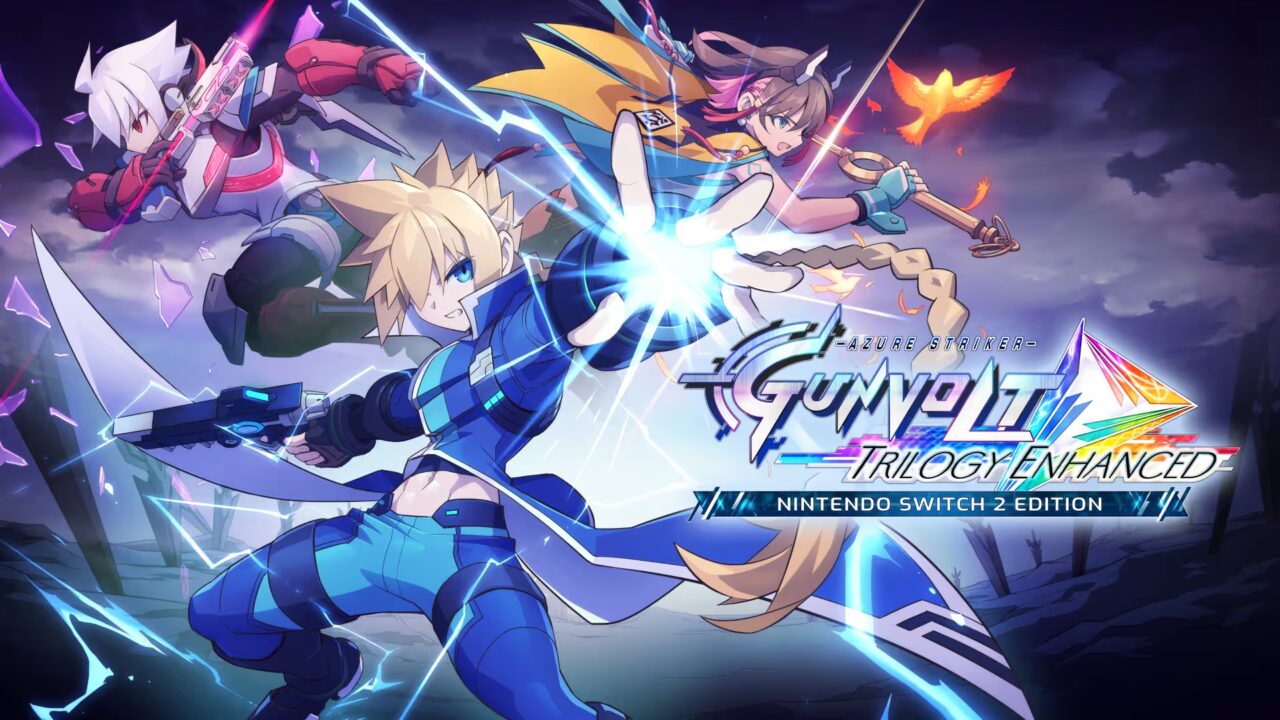
Azure Striker Gunvolt Trilogy Enhanced Nintendo Switch 2 Edition brings together three excellent action-platformers from Inti Creates, combining the complete original trilogy with every piece of DLC, additional audio content, gameplay adjustments, and a substantial new campaign. Originally released on Switch in 2024, the collection returns with improved performance and resolution, but its biggest selling point is Gunvolt GX, a new story mode that finally brings Gunvolt and Copen together as playable partners throughout an entire campaign. While the additions will be more appealing to newcomers and dedicated fans than those who already own the original collection elsewhere, this remains an excellent showcase for Inti Creates’ ability to build on the foundations of classic action-platformers.
The Azure Striker Gunvolt series takes place in a science-fiction world where individuals known as Adepts wield supernatural abilities called Septima. Gunvolt, the titular hero, commands electricity and initially finds himself caught between his former obligations and his desire to protect Joule, a girl whose ability to manifest the Muse Lumen makes her central to the schemes of the Sumeragi Group. Azure Striker Gunvolt 2 expands the conflict while introducing Copen as a second playable protagonist, complete with his own supporting cast and distinct abilities. Azure Striker Gunvolt 3 then shifts the spotlight to Kirin, an Adept capable of sealing the powers of others, taking the series in a new direction that does not always fit comfortably with what came before.

Storytelling has never been the trilogy’s strongest asset. Plot developments can feel rushed, supporting characters often disappear when they could use more attention, and the third entry struggles to maintain a coherent direction for the overarching narrative. Nevertheless, the cast remains likeable, and the conversations available through each game’s hub menu give the characters considerably more personality than the main campaigns alone might suggest. The inclusion of the previously Japan-exclusive audio drama CDs is particularly welcome, providing additional conversations and character interactions that make the collection feel more complete. These extras will mean little to players who are not invested in the series’ lore, but fans who have followed the characters across all three games will find plenty to enjoy.
At its core, Azure Striker Gunvolt follows the familiar structure of a classic Mega Man-style action-platformer, with linear stages, themed bosses, and relatively short campaigns. Most levels can be completed in around five to ten minutes, making the games well suited to quick sessions rather than lengthy stretches of play. The relatively small number of stages in each entry is offset by the amount of depth packed into their design, particularly for anyone interested in mastering the combat systems, improving their rankings, and completing optional challenges. Although the trilogy does not radically reinvent the genre, it understands how to make a familiar formula engaging through carefully constructed encounters and mechanics that reward experimentation.
Each protagonist also brings a distinct approach to combat. Gunvolt marks enemies with projectiles before discharging electricity to hit multiple targets simultaneously, while a protective field helps him negate incoming projectiles during his attacks. The number of enemies he can tag depends on his equipped gun, which can be crafted using materials collected throughout the stages. Copen, meanwhile, favours a more aggressive approach, dashing directly into enemies to mark them before following up with his own attacks. His impressive aerial mobility and the abilities acquired from defeated bosses make him particularly satisfying to control. Kirin combines ranged attacks with swordplay, throwing projectiles to mark targets before cutting through them and using her diagonal throws to launch herself off enemies and certain surfaces. She takes longer to master than the other two, but her mechanics become equally rewarding once everything falls into place.
Azure Striker Gunvolt 3 further expands the possibilities through Image Pulses, which summon manifestations of Gunvolt’s memories to provide different forms of support. With more than 100 available, they offer an impressive amount of customization and give players additional reasons to experiment with their preferred builds. Across the trilogy, the variety between the protagonists helps prevent the shared stage structure from becoming too repetitive, even when revisiting familiar types of enemies and environments.

The scoring system is arguably the series’ most compelling feature, encouraging players to return to completed stages rather than treating them as disposable obstacles between boss fights. Performance is measured through Kudos, which can be earned by avoiding damage, finishing quickly, and chaining together multipliers through different combat techniques. Taking out several enemies at once is especially valuable, rewarding players who learn how to exploit the layout of each stage instead of simply rushing towards the exit. Checkpoints provide opportunities to cash in accumulated Kudos or continue with a multiplier for the chance to earn a higher score, introducing a welcome risk-and-reward element that can make even familiar encounters tense.
Difficulty settings also influence how much of that progress can be preserved, with the highest setting removing Kudos after a single hit. The vocal tracks performed by Lumen and the other Muses add another distinctive element, activating at certain Kudos thresholds or under specific circumstances to provide offensive and defensive benefits. These songs can become a little overwhelming alongside the colourful combat effects, but they also give the series a memorable identity. The Manor stage in Azure Striker Gunvolt 2 is a particularly strong example of the design philosophy at work, with its atmosphere, enemy placement, and encounters encouraging players to think carefully about how they approach each fight.
Unfortunately, the trilogy retains several frustrating design decisions. Optional missions must be generated before they can be completed, meaning players who have already achieved an S rank on a stage may have to replay it if a later mission requires the same result. The first game is especially cumbersome in this regard, limiting the number of active missions and lacking some of the quality-of-life improvements introduced in its sequels. The absence of automatic saving across all three titles is another disappointing omission, particularly in a collection that otherwise makes a strong case for revisiting these games in short bursts. These problems do not undermine the quality of the combat, but they make the process of completing everything more tedious than it needs to be.
The biggest addition to this edition is Gunvolt GX, a new campaign that pairs Gunvolt and Copen as playable partners for the first time in a mainline story. Because the narrative draws heavily on Azure Striker Gunvolt 3, newcomers should play the existing trilogy before jumping into this mode to avoid major spoilers and better appreciate its references. The story begins with Copen suffering from severe amnesia, leaving him unable to recognize Lola or recall much of his past. Gunvolt has a somewhat clearer understanding of their circumstances, but the pair find themselves trapped in the Time Prison, a strange location built from Gunvolt’s memories. Xiao Wu, whose role in Azure Striker Gunvolt 2 makes his presence here particularly meaningful, also becomes an important part of the story.
Rather than introducing another sprawling cast or attempting to push the overarching plot in yet another direction, Gunvolt GX benefits from keeping its attention on the two protagonists and their respective Muse partners, Lumen and Lola. Copen’s amnesia allows the usually reserved character to reveal a warmer side, while his practical outlook provides a good contrast to Gunvolt’s more approachable personality. Gunvolt, meanwhile, must contend with his guilt over being a Primal Dragon, giving the conversations more substance than a simple reunion between familiar faces might have provided. The threat surrounding the Time Prison never feels particularly urgent, but that slower pace gives the characters room to interact without constantly being interrupted by another major plot development.
The result is some of the best character writing in the series, particularly through the hub menu’s conversation options. The dialogue has a natural sense of humour, and the English voice direction does an excellent job of selling both the comedic exchanges and the quieter moments of reflection. The campaign is not going to resolve every lingering issue with the trilogy’s storytelling, but its more focused approach demonstrates how much the series benefits from letting its characters spend time together. For longtime fans, seeing Gunvolt and Copen develop a genuine rapport is one of the collection’s most rewarding additions.

Gunvolt GX also builds its gameplay around the partnership, allowing players to switch between the two protagonists at will during stages. Copen’s buzzsaw and Bullit system let him chain dashes between enemies and surfaces, replenishing his resources with each collision and allowing skilled players to cover considerable distances without touching the ground. Gunvolt offers a different kind of control, marking multiple targets and discharging electricity to eliminate threats that might otherwise interrupt Copen’s momentum. Switching between them is intuitive, and the ability to move across a gap as Copen before swapping to Gunvolt to destroy incoming missiles creates opportunities for more dynamic play than either character could offer alone.
The Inspiration system provides another reason to make frequent use of the tag-team mechanics. Earning Kudos fills the Inspiration gauge, and switching characters when it is full triggers Boost Change, granting bonus Kudos and temporary advantages such as unlimited EP for Gunvolt or unlimited Bullit dashes for Copen. Switching also contributes to the GX Skill gauge, which allows players to unleash a powerful attack once it is fully charged. Experience earned from enemies and bosses increases character stats and unlocks additional skill slots, while credits can be spent on abilities that further customize the pair’s capabilities. New EX weapons give Copen more options, adding useful abilities that complement his existing mobility.
The main weakness of Gunvolt GX is its difficulty curve. On a first playthrough, the campaign is often too forgiving, and Gunvolt’s ability to eliminate groups of enemies from a distance can make him feel like the more practical choice in many situations. The Inspiration bonuses and purchasable upgrades only reinforce that imbalance, reducing the need to take advantage of the partnership’s full potential. The boss fights and stage layouts could have done more to demand coordination between the protagonists, especially given how much the new mechanics encourage players to switch between them. Returning locations and familiar bosses also make the campaign feel less fresh than an entirely new adventure might have, although the tag-team system does enough to give these encounters a different rhythm.
Fortunately, there is more to Gunvolt GX than its initial difficulty suggests. Completing the story unlocks Secret Missions alongside Hard and Very Hard modes, with the latter restricting most abilities to provide a considerably tougher challenge for experienced players. Locking this content behind the credits is disappointing, as a more demanding default experience would have better demonstrated the depth of the combat system from the outset. Still, these additions give the campaign a stronger reason to be replayed, and the included Connect iX mode, which features a selection of stages and boss battles built around speedrunning, provides another worthwhile diversion.
The Nintendo Switch 2 edition also improves the presentation with smoother performance and support for 4K resolution when docked. The higher resolution is welcome, but the nature of these games means the technical upgrades are not necessarily transformative. Their short stages, quick restarts, and score-chasing structure make them particularly well suited to handheld play, where the compact screen also helps keep the colourful action more manageable. On a television, the elaborate effects can become visually cluttered, sometimes making it harder to follow everything happening during the more chaotic encounters. The games remain attractive, with their vibrant character designs and exaggerated special effects contributing to their distinctive style, but the presentation is arguably better suited to portable play than a large display.

At $49.99, Azure Striker Gunvolt Trilogy Enhanced Nintendo Switch 2 Edition offers a substantial package, particularly for anyone approaching the series for the first time. Existing owners of the original Switch collection can purchase an Upgrade Pack, making the improved version a more reasonable proposition for those who want to revisit the games on Nintendo’s newer hardware. However, players who already own the trilogy on another platform may find it difficult to justify purchasing the collection again for Gunvolt GX alone, even though the new campaign is a worthwhile addition in its own right.
Azure Striker Gunvolt Trilogy Enhanced Nintendo Switch 2 Edition is ultimately the most complete way to experience Inti Creates’ action-platforming trilogy. The three main games remain engaging thanks to their distinct protagonists, rewarding combat systems, and addictive scoring mechanics, while Gunvolt GX provides a charming new adventure that makes excellent use of its central partnership. The collection still carries some avoidable frustrations, and the new campaign could have done more to challenge experienced players from the beginning, but these shortcomings do little to diminish the strength of the package as a whole. For newcomers, it is an easy recommendation, and for longtime fans, Gunvolt GX offers a compelling reason to spend more time with two of the series’ most memorable characters.
Disclaimer: A review key was provided
Images taken from Nintendo.com