

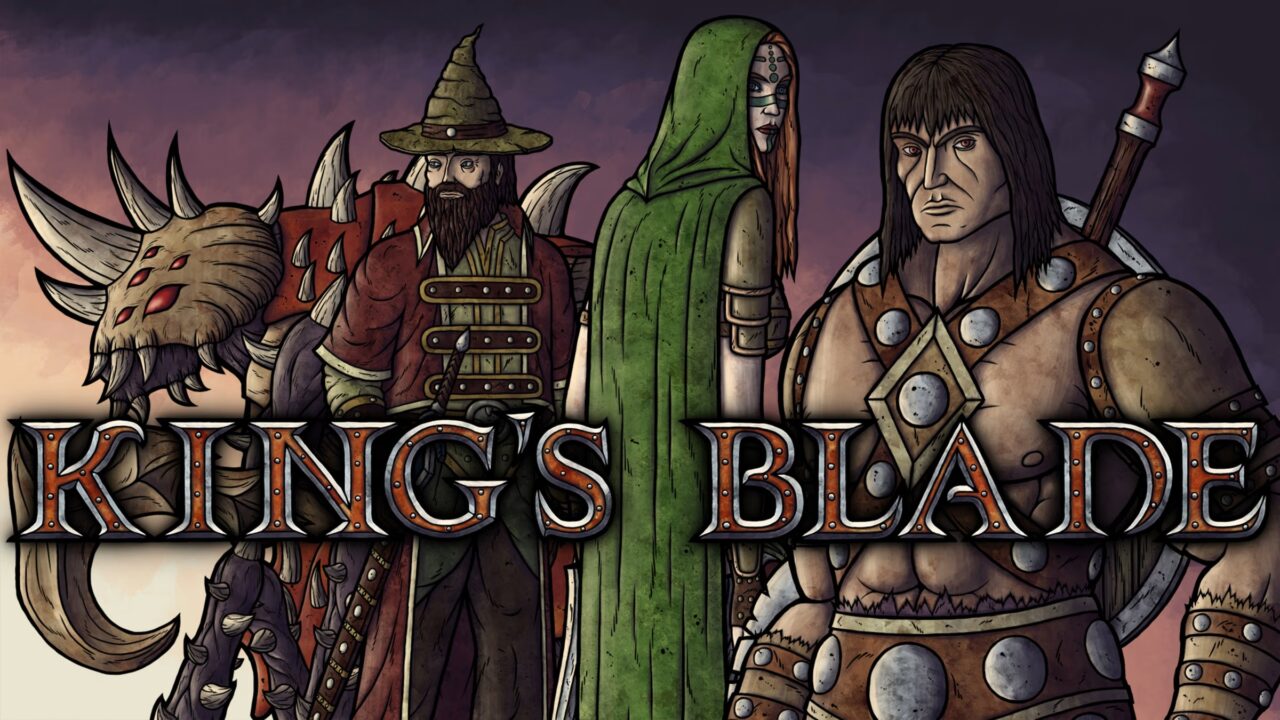
There is something inherently appealing about a good fantasy beat ’em up. The genre has never needed an especially complicated premise to work, with a handful of heroes, a dangerous kingdom and an endless stream of enemies usually being enough to justify another journey from one side of the screen to the other. King’s Blade understands that appeal. Developed by Alexey Suslin and published by Sometimes You, this side-scrolling brawler wears its Golden Axe and Streets of Rage influences openly, but it also tries to build something more mechanically involved around that familiar foundation. Rather than relying entirely on button mashing and increasingly large groups of enemies, King’s Blade places considerably more importance on positioning, timing, enemy placement and learning how its six playable heroes handle themselves in battle.
The result is an old-school fantasy brawler that can take some time to fully appreciate. King’s Blade does not have the immediate accessibility of some modern beat ’em ups, and its combat can initially feel somewhat unusual when coming from games that make positioning and attacks more forgiving. Once its mechanics begin to make sense, however, there is a greater degree of thought behind its encounters than the straightforward presentation might suggest. The game also manages to avoid relying on unnecessary progression systems to extend its campaign, instead putting much of its replay value into its characters, hidden content, difficulty levels and the simple process of becoming better at its combat.
The story keeps things appropriately simple. The warriors of the King’s Blade are tasked with fighting through enemy territory and reaching the capital to stop the invading Barganian Empire. There is additional lore and story development along the way, but the narrative never attempts to turn the game into something it isn’t. The fantasy setting provides enough context for the journey without constantly interrupting the action with lengthy exposition. That straightforward approach works well for the genre, allowing the focus to remain on progressing through each stage, discovering what is waiting around the next corner and gradually becoming more familiar with the game’s cast.

Those six playable heroes are an important part of what gives King’s Blade some of its replay value. They are not simply cosmetic variations of the same character, with each fighter offering different strengths, abilities and approaches to combat. Some are better suited to close-range attacks and absorbing punishment, while others make better use of speed, magic or ranged abilities. This makes character selection more meaningful than it might initially appear, particularly once the game starts demanding a greater understanding of spacing and enemy positioning. Additional characters can also be unlocked through hidden content, giving players another reason to revisit stages and search areas that may have been overlooked during an initial playthrough.
The campaign consists of 12 levels, including 10 main stages and two hidden ones, and there is enough environmental variety to prevent the adventure from feeling like one extended hallway. The journey moves through different fantasy locations, with changing scenery helping establish a sense of progression as the story moves towards its conclusion. Some sections can still feel fairly linear, but the environments provide more than just a different backdrop. Destructible objects such as boxes and boulders can contain food, weapons, scrolls and other useful items, while secret areas encourage players to pay attention to their surroundings rather than simply moving towards the next group of enemies.
That exploration works particularly well because King’s Blade does not rely on an elaborate progression system to create a reason to keep playing. There is no need for a sprawling RPG structure or roguelite mechanics to artificially extend the campaign. Instead, replay value comes from learning the different heroes, discovering hidden content, experimenting with weapons and abilities and gradually taking on higher difficulty levels. It is a more traditional approach, but one that suits a game so heavily inspired by arcade brawlers. The goal is less about endlessly improving a character through statistics and more about improving the player through familiarity with the mechanics.
Combat is where King’s Blade separates itself most clearly from a straightforward Golden Axe homage. The basic structure is familiar, with standard attacks, stronger attacks, special abilities and evasive moves forming the foundation of each encounter. What makes the system more demanding is the importance it places on positioning. In particular, the vertical axis of the battlefield matters considerably more than it does in some modern beat ’em ups. Attacking does not simply pull the character towards an enemy, meaning that being slightly out of position can result in an attack connecting with nothing at all.

This makes King’s Blade considerably less forgiving than some of its contemporaries. Coming from a game such as Streets of Rage 4, where attacks can often feel more immediately responsive and accommodating, the difference can be noticeable during the opening stages. The temptation to simply stand in front of an opponent and repeatedly attack does not always work here. Enemies need to be approached from the correct angle, attacks need to be timed properly and incoming attacks have to be anticipated rather than simply absorbed.
Once those mechanics begin to click, there is a satisfying amount of skill involved. Managing distance, recognising enemy behaviour, controlling knockback and deciding when to use special abilities can have a noticeable effect on the outcome of an encounter. King’s Blade does not have the elaborate combo systems associated with traditional fighting games, but it does not need them to make its combat meaningful. Its depth comes from understanding the battlefield and making better decisions within it.
There are some inconsistencies that prevent the combat from being as polished as it could be. Hit detection can occasionally feel unpredictable, with some attacks connecting from distances that are difficult to judge while others can miss despite appearing as though they should have landed. These issues are not constant enough to undermine the entire system, but they become more apparent at higher difficulty levels, where a single missed attack or poorly judged position can have considerably greater consequences.
Enemy design helps compensate for some of those rough edges. King’s Blade does not simply increase the number of enemies on screen as the campaign progresses. Different enemy types are combined in ways that force players to think about which threats need to be dealt with first. Melee enemies can create a defensive line around ranged attackers, faster creatures can disrupt an otherwise comfortable rhythm, airborne opponents can attack from less predictable positions and support units can make an otherwise manageable group considerably more dangerous if they are ignored.
As a result, encounters often become exercises in prioritisation. One group may be best handled by eliminating the enemies at the front before working towards the more dangerous opponents behind them, while another may encourage players to move through the crowd to reach a support enemy. Familiar opponents can also feel different when placed alongside other enemy types, and this combination of enemies does a good job of keeping the combat from becoming completely predictable.
Weapons and magical abilities add another layer to that decision-making. Powerful items can appear shortly before difficult encounters, creating a choice between using them immediately or saving them for a situation where they may be even more useful. Learning when to spend those resources becomes part of mastering the stages, particularly when replaying a level reveals a more effective way to approach a section that previously caused problems.
The stages themselves are also fairly substantial for a beat ’em up, with individual levels taking around 10 minutes to complete. Checkpoints are useful during these longer stretches, particularly when a difficult encounter appears towards the latter half of a stage. Reaching a checkpoint after surviving a particularly challenging sequence provides a welcome sense of progression, although the longer stages can also make repetition more noticeable when a difficult section has to be attempted again.
Boss encounters provide a natural change of pace. Rather than simply throwing another large group of enemies at the player, these battles focus attention on patterns, positioning and learning how an individual opponent behaves. Some bosses can create noticeable difficulty spikes, but they also provide the kind of memorable encounters that help give each stage a stronger sense of conclusion.
Difficulty is handled with a similar understanding of the genre’s arcade roots. The lower settings provide a more approachable way to experience the campaign, while higher settings place considerably greater demands on positioning, enemy management and timing. The flexibility is welcome because King’s Blade can feel very different depending on how aggressively the player approaches its combat. Those looking for a more demanding experience will find that the mechanics become more rewarding when the game removes some of the room for error.

Local multiplayer is another area where the game’s arcade influences are particularly obvious. King’s Blade supports up to four players in local co-op, allowing the entire campaign to be tackled with a group of friends or family. Having several different heroes fighting together can create considerably more chaotic encounters, while the differences between the characters allow their abilities to complement one another.
Solo players are not left entirely on their own, either, as AI-controlled companions can be added to the party. It is a useful option for anyone who wants the spectacle of several heroes on screen without needing additional players, although the AI has some limitations. Companions can compete with the player for health pickups and other resources, while their priorities do not always feel particularly helpful. It is more of an irritation than a major flaw, but better AI behaviour would make the feature considerably more useful.
Visually, King’s Blade takes a different approach to its retro influences. Rather than attempting to reproduce the pixel-art aesthetic of the arcade games that inspired it, the game uses clean, hand-drawn-looking artwork and a darker fantasy presentation. The environments have an earthy quality, while the character and enemy designs are distinct enough to remain readable when the screen becomes crowded.
The animation is relatively simple, and some environments lack the detail found in more visually ambitious modern beat ’em ups. Even so, the overall art direction gives King’s Blade its own identity. It feels inspired by older fantasy brawlers without simply trying to reproduce them, and the changing environments help maintain some visual variety throughout the campaign.
The soundtrack takes a similarly restrained approach. The music moves between dramatic, melancholy and sombre pieces, creating an appropriately dark fantasy atmosphere without attempting to overwhelm the action. Combat effects provide enough impact for weapons and magical attacks, while quieter moments offer some welcome contrast to the constant fighting. It is not an especially elaborate soundscape, but it fits the game’s tone and presentation well.
On Nintendo Switch, King’s Blade provides a dependable way to experience the game. The action remains smooth during larger encounters featuring several enemies, effects and bosses on screen at once, with no noticeable slowdown during testing. Loading times are brief, and the Switch version did not encounter crashes or save problems. That stability is particularly important for a game whose combat depends so heavily on timing and positioning. When an attack misses or an enemy catches the player off guard, there is little reason to blame the hardware for the outcome.
The Switch version also benefits from the game’s straightforward arcade structure. The stages are substantial enough to provide a meaningful play session without turning the campaign into an enormous commitment, while the ability to revisit levels with different characters gives the game some additional longevity. Whether played alone, with AI companions or through local multiplayer, King’s Blade is structured in a way that makes it relatively easy to pick up for another stage without requiring a major time investment.
King’s Blade ultimately benefits from having a clear understanding of what it wants to be. It does not attempt to reinvent the beat ’em up genre, nor does it cover its arcade foundation with unnecessary progression systems. Instead, it takes the familiar fantasy brawler formula and adds a greater emphasis on spacing, timing, enemy combinations and character variety.

That approach will not necessarily appeal to players looking for the immediate responsiveness of something like Streets of Rage 4. The combat takes some adjustment, and the inconsistent hit detection can occasionally work against the otherwise thoughtful mechanics. Some stages can also feel overly linear, while the AI companions are not always as helpful as they could be. These shortcomings prevent King’s Blade from reaching the level of polish found in the genre’s strongest modern examples.
There is nevertheless more depth here than the game’s straightforward presentation initially suggests. Learning how each hero functions, understanding enemy combinations, managing weapons and magical abilities and becoming more comfortable with the game’s particular approach to positioning all give the campaign a stronger mechanical foundation than a simple button-mashing brawler. The hidden stages and unlockable characters also provide legitimate reasons to return rather than merely padding out the experience.
King’s Blade sits somewhere between a traditional arcade fantasy brawler and a more mechanically demanding modern interpretation of the genre. Its influences are immediately apparent, but its focus on positioning and enemy management gives it enough of an identity to stand on its own. The rough edges are noticeable, particularly in its hit detection and AI, but they do not erase what works. For players willing to adjust to its particular rhythm, King’s Blade offers a thoughtful take on the classic fantasy beat ’em up formula, with enough character variety, exploration and multiplayer content to make the journey worthwhile. The Nintendo Switch version complements that experience with stable performance and the portability that suits this kind of arcade-inspired adventure particularly well.
Disclaimer: A review key was provided.