

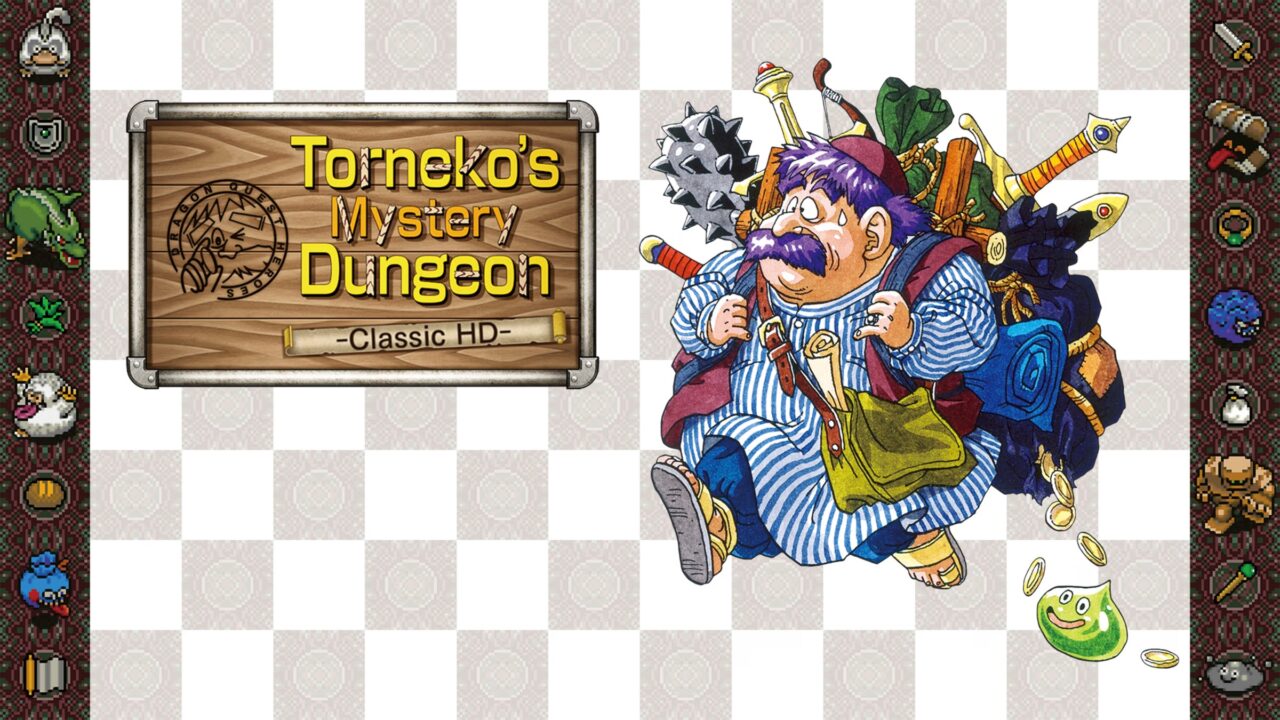
There is something fascinating about going back to the beginning of a series after experiencing what it eventually became. Dragon Quest Heroes: Torneko’s Mystery Dungeon Classic HD is the first game in the long running Mystery Dungeon series, originally released for the Super Famicom in 1993, and it is immediately apparent just how much of the formula was already established. After spending time with later entries such as Shiren the Wanderer, it would be easy to look at Torneko and see everything that is missing, but that would overlook what makes the game so compelling. Despite its age, its simplicity, and a number of flaws that are difficult to ignore in a modern release, Torneko’s Mystery Dungeon has somehow become a game I keep coming back to. There is always the thought that one more trip into the dungeon might be the run where everything finally comes together.
For those unfamiliar with the original, Torneko is the merchant from Dragon Quest IV, now trying to establish himself and his family in a new town while pursuing the dream of becoming the greatest weapons merchant. That premise gives the game a slightly different flavour from many roguelikes, because Torneko’s adventures are directly tied to his business. The dungeon is where he finds weapons, armour, food, gold and other items, while what he brings back can help develop his shop and provide additional options for future expeditions. The story itself is fairly simple, but it does an effective job of giving your repeated dungeon runs a purpose. You are not simply entering another randomly generated area because the game needs somewhere to put its combat encounters. You are going back because there is always the possibility of coming out with something that will make the next attempt easier.

The Mystery Dungeon formula itself is remarkably intact here. Dungeons are randomly generated, enemies and items change from run to run, and Torneko begins each new expedition at level one. As he explores, he earns experience and levels up, while equipment and other items can further increase his effectiveness and stats. Dying means losing what he was carrying and returning to level one, so the progress made during a successful run is always balanced against the risk of pushing too far. That creates an important distinction between Torneko becoming stronger during an individual expedition and the player becoming more knowledgeable over time. You are learning which enemies to avoid, how to manage your resources, when to take a risk and, perhaps most importantly, when it is time to turn around and return safely.
A failed run is therefore not necessarily wasted time. You may have learned something about an enemy, discovered how an item works, realized that you pushed too far into a dungeon or simply become better at managing Torneko’s resources. There are also ways to build up your long-term situation through the town and shop, giving successful expeditions consequences beyond simply reaching the next floor. The result is a progression system that combines temporary character growth with persistent preparation and player knowledge, rather than relying on one form of progression to carry the entire experience.

Every action also matters because this is a strictly turn-based roguelike. Moving one space, attacking an enemy, using an item or performing another action gives the enemies an opportunity to respond. What initially looks like a straightforward action RPG can therefore become surprisingly tactical. You cannot simply rush through a room and expect to overpower everything in your path. Positioning, enemy behaviour and knowing when to retreat can be just as important as the equipment Torneko is carrying. It is the same fundamental idea that would become such an important part of later Mystery Dungeon games, and it is impressive to see how effective the concept already was in 1993.
The hunger system adds another layer to that decision-making. Torneko’s hunger decreases as he moves through a dungeon, meaning food is not simply another item to collect but an essential resource that can determine how long a run can continue. Running out of food can turn a promising expedition into a desperate attempt to find something to eat before your health begins to disappear with every step. It creates another reason to think before moving and makes seemingly insignificant decisions more important. Do you explore another room in search of treasure, or do you conserve your resources and try to make it back safely? Do you use an item now, or save it for a situation that might never come?

This is where the game demonstrates why the Mystery Dungeon formula has endured for so long. Randomness does not simply mean that the rooms look different every time. It changes the circumstances surrounding each run. You might find useful equipment early and suddenly have the confidence to push farther than usual, only to encounter a situation that leaves you scrambling for a way out. Another run might provide almost nothing useful but teach you how to deal with a particular enemy or remind you that you have been wasting too many resources. The game constantly asks you to make decisions with incomplete information, and when those decisions work, the satisfaction is considerable.
Later Mystery Dungeon games would add far more systems, characters, equipment types, abilities and other ways to influence a run. Shiren the Wanderer in particular demonstrates how much the formula could eventually evolve, but Torneko is interesting precisely because it does not have all of that. Its relatively straightforward design makes the fundamentals easier to see. You enter a dungeon, manage what you have, adapt to what the game gives you, try to get as far as possible and hopefully return with something useful. There is a purity to that structure that makes it remarkably easy to lose track of time.

That simplicity can also work against the game. Torneko’s Mystery Dungeon is unmistakably an older game, and there are moments when its age becomes difficult to overlook. Its interface and overall presentation are more basic than what later entries would offer, and there are fewer systems designed to give individual runs the kind of variety found in more modern roguelikes. The story is also fairly light, so anyone expecting the character-driven structure of later Dragon Quest or Mystery Dungeon games may find it underdeveloped. This is a game much more interested in the dungeon itself than in constantly providing narrative reasons to keep going.
The shop and town progression help compensate for some of that simplicity. What you accomplish inside the dungeon can have consequences outside of it, giving you a reason to think beyond a single run. Storing items, managing your resources and gradually improving your situation creates a sense of long-term progress even though Torneko himself repeatedly returns to level one. It is a different kind of progression from what many modern roguelikes use. The character is not necessarily becoming stronger forever. Instead, your knowledge, preparation and understanding of the game are what carry over.
Classic HD does make some concessions to modern players. Various parameters can be adjusted, including elements such as enemy density, experience, gold, item frequency and food availability. These options are particularly useful because the original design can be unforgiving while you are still learning its rules. They do not fundamentally change the game, but they can make the early experience less punishing for players who are not accustomed to this particular style of roguelike.

The HD presentation is similarly conservative. The original sprites remain a major part of the game’s identity, while the environments receive a cleaner, more dimensional presentation. It is an attractive enough update, although it does not completely disguise the game’s age. Some of the visual changes can even make the original’s more deliberately pixelated look preferable depending on your tastes. The music, meanwhile, retains the unmistakable Dragon Quest sound and does a good job of giving the otherwise simple adventure plenty of personality, although the soundtrack can become repetitive over longer sessions.
There are also some issues that are harder to overlook. The lack of additional modernization is noticeable when compared with later Mystery Dungeon releases, and the absence of French localization is disappointing for a release with a substantial amount of text. The $24.99 price also makes the conservative nature of the remake more difficult to ignore. This is not a comprehensive remake that attempts to bring Torneko’s Mystery Dungeon entirely in line with modern roguelikes. It is much closer to a polished presentation of an important piece of genre history.
Yet somehow, those issues have not stopped me from becoming slightly addicted to it. There is something about the way Torneko’s Mystery Dungeon constantly offers the possibility of a better run that makes it difficult to put down. Even when a run ends because of a mistake, an unlucky encounter or poor resource management, there is always another attempt waiting. Maybe the next dungeon layout will be more favourable. Maybe the right equipment will appear. Maybe a previous mistake will be avoided. Maybe this time Torneko will finally make it farther.

That feeling is ultimately what makes Dragon Quest Heroes: Torneko’s Mystery Dungeon Classic HD work. It is not the most sophisticated Mystery Dungeon game, and it certainly does not have the breadth of many modern roguelikes. But it does not need to. The fundamental ideas that made the genre so enduring are already here, and they remain surprisingly effective more than three decades later. Seeing those ideas in such an early form also makes it easier to appreciate how much later games built upon this foundation.
Dragon Quest Heroes: Torneko’s Mystery Dungeon Classic HD is therefore an unusual kind of remake. Its greatest strength is not necessarily what it adds, but what it preserves. There are certainly areas where it could have gone further, and some of its limitations are impossible to ignore, but the underlying gameplay remains strong enough to keep pulling me back into the dungeon. For anyone interested in the history of roguelikes or the origins of Mystery Dungeon, there is a lot to appreciate here. More importantly, even with its flaws, Torneko proves that sometimes a simple formula can remain remarkably difficult to put down.
Disclaimer: A review key was provided