

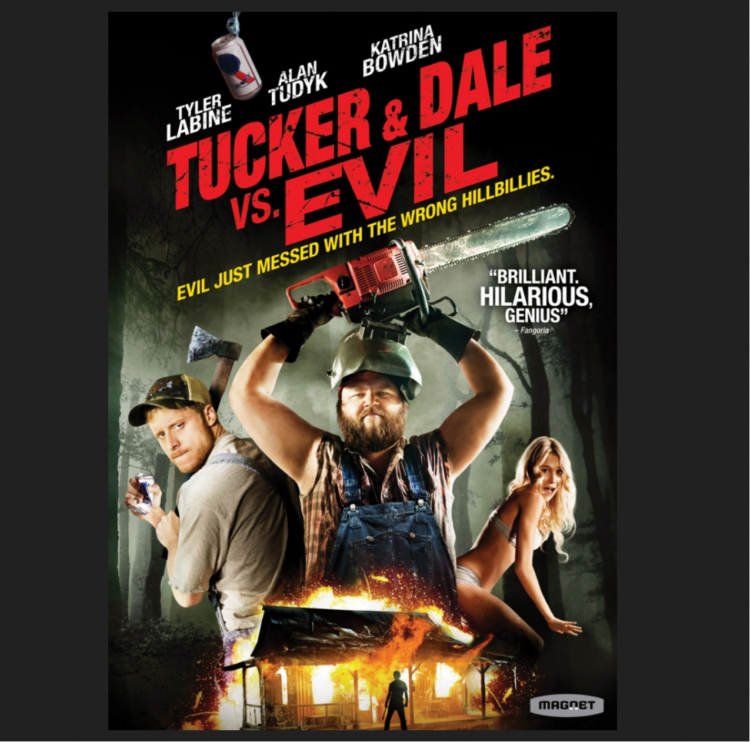
I might be in the minority here, but I think Tucker & Dale vs. Evil understands what makes Evil Dead work better than the franchise’s modern films. That might sound strange coming from someone who enjoys Evil Dead (2013), Evil Dead Rise, and Evil Dead Burn, but I think there is a difference between making an Evil Dead movie and capturing the spirit of one. The newer films have the Necronomicon, the deadites, and enough gruesome violence to satisfy even the most demanding horror fan. What they have largely left behind, however, is the strange combination of horror, comedy, and irreverence that helped make the original films so memorable. For that, I would look to a 2010 horror comedy about two hillbillies whose biggest mistake is trying to have a relaxing weekend at their vacation cabin.
At first glance, Tucker & Dale vs. Evil has little in common with Evil Dead beyond its rural setting, chainsaws, and increasingly ridiculous body count. There is no Necronomicon, no demonic possession, and no connection to the franchise’s mythology. Instead, the film takes the familiar cabin-in-the-woods setup and turns it inside out. A group of college students encounters Tucker and Dale, two working-class friends who look like the sort of people who would normally feature in a horror movie as the threatening locals. The students immediately assume they are dangerous, while Tucker and Dale are simply trying to fix up a rundown cabin and enjoy their time away.
The joke is that neither side understands what is happening. Every attempt by Tucker and Dale to help the students is interpreted as a threat, while the students’ increasingly panicked attempts to escape lead to a string of gruesome accidents. A wood chipper, a chainsaw, and some spectacularly unfortunate misunderstandings turn what should have been an ordinary weekend into a bloodbath. Tucker and Dale are not secretly murderous villains, and the students are not necessarily foolish for recognizing the warning signs associated with countless horror movies. They are simply trapped in a situation where their assumptions become a self-fulfilling prophecy.
That reversal is what makes the film more than a collection of horror movie references. It understands the conventions of the genre well enough to play with them, finding comedy in the gap between what the audience knows and what the characters believe. Evil Dead has always benefited from a similar willingness to push familiar ideas into absurd territory. The original film established the cabin as a place where ordinary people could encounter unimaginable horrors, while Evil Dead 2 took that foundation and turned it into something much more mischievous. Tucker & Dale vs. Evil approaches the same tradition from an entirely different angle, making the people who would ordinarily be the source of the horror its unlikely heroes.
There is even a precedent for this sort of rural character within Evil Dead itself. Evil Dead 2 introduced Jake and Bobby Joe, whose presence helped expand the world around Ash and the cabin. Tucker and Dale feel like they could belong in that world, albeit in a movie where they would probably be the only people who have not read the horror movie rulebook. The difference is that Tucker & Dale vs. Evil gives them the opportunity to carry the story, rather than treating them as supporting characters in somebody else’s nightmare.
More importantly, it understands something that has always made Evil Dead special: horror and comedy do not have to work against each other. Evil Dead 2 remains one of the clearest examples of how effective that combination can be, particularly when Ash Williams finds himself fighting against his own possessed hand. The sequence is horrifying in concept, but Bruce Campbell’s physical performance turns it into an increasingly ridiculous battle that neither the character nor the audience can quite believe. Army of Darkness took the same sensibility further, embracing fantasy, slapstick, and Ash’s talent for making an already terrible situation even worse.
That balance is a major part of what separates those films from more conventional horror. The violence can be shocking, but it can also be funny. The characters can be in genuine danger without the film insisting that every moment must be played with absolute seriousness. Tucker & Dale vs. Evil understands this just as well. Its practical effects are gruesome, its deaths are often outrageous, and its comedy comes from watching events spiral completely out of control. Alan Tudyk and Tyler Labine play Tucker and Dale with complete sincerity, which makes the increasingly absurd circumstances around them even funnier. Neither actor needs to wink at the audience or remind us that we are watching a comedy. The situation does the work for them.
This is the balance I want to see more often in Evil Dead. I have no problem with the brutality of the 2013 film, Evil Dead Rise, or Evil Dead Burn, and I do not think every entry needs to imitate Sam Raimi’s direction. Each filmmaker should be able to bring something different to the franchise. My issue is that the recent films have generally leaned much further toward sustained horror than the anarchic horror comedy that helped distinguish the original trilogy. The modern entries have their own strengths, but there is room for the franchise to revisit the broader, more physical comedy of its earlier films without sacrificing what makes it frightening.
None of this means that Tucker & Dale vs. Evil is a better film in every respect, nor does it mean that the newer Evil Dead movies have failed to understand their own franchise. The comparison is about what each film emphasizes. The modern entries have pushed the series toward a more visceral form of horror, and there is certainly an audience for that direction. However, the original films were never defined solely by their capacity to shock. They also had an irreverent personality, a willingness to embrace absurdity, and a sense of fun that could turn a nightmare into something entertainingly chaotic.
Tucker & Dale vs. Evil captures those qualities without borrowing the franchise’s mythology or relying on nostalgia for Ash Williams. It has the cabin, the chainsaws, the practical gore, and the sense that events can go from bad to catastrophically worse in the space of a few seconds. Its modest production and inventive approach also recall the resourcefulness of the original Evil Dead, which made effective use of practical effects and creative filmmaking rather than relying on spectacle.
I would love to see Evil Dead Wrath make room for more of that spirit, although the film should be allowed to find its own balance rather than being expected to recreate Evil Dead 2 or Army of Darkness. The franchise does not need to abandon its darker direction, and it certainly does not need to make every installment a comedy. What it could use is a little more variety in tone, with room for humour that emerges naturally from the horror rather than feeling like an afterthought.
Ultimately, Tucker & Dale vs. Evil is a reminder that a horror franchise can be frightening without taking itself too seriously. Its appeal comes from the combination of inventive gore, genre-savvy humour, and two protagonists whose good intentions make their increasingly disastrous circumstances all the more entertaining. It does not need a supernatural mythology or an established legacy to achieve what it sets out to do, and that is precisely why the comparison works.
That is why Tucker & Dale vs. Evil feels more faithful to the spirit of Evil Dead than its modern counterparts. It understands that a cabin, a chainsaw, and a mountain of gore are only part of the equation. The rest comes from the comedy, the characters, and the willingness to embrace the absurdity of it all. The Necronomicon may be missing, but the spirit is there all the same.