

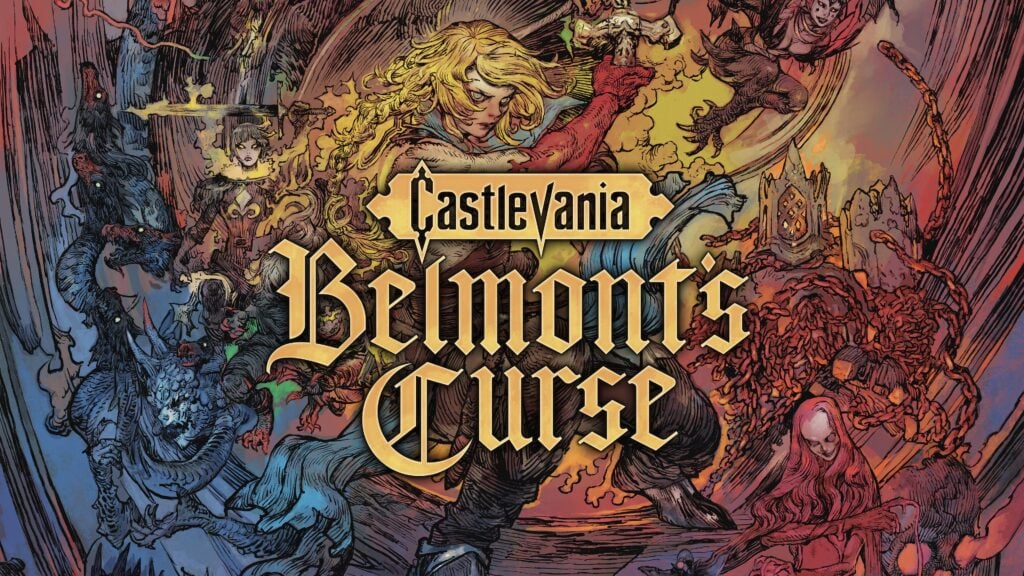
Castlevania has never completely disappeared since 2014, but it has certainly felt that way at times. Collections, collaborations, mobile games and a remake of one of the series’ more infamous arcade entries have kept the name alive, yet it has been nearly twenty years since the last proper 2D adventure in the franchise. With the series celebrating its 40th anniversary, Konami has finally entrusted a new entry to Evil Empire, the studio behind Dead Cells, which previously demonstrated its understanding of the franchise with the Return to Castlevania DLC in 2023. On paper, this seems like an excellent pairing, and after spending time with Castlevania: Belmont’s Curse, I can say that the result is a very good action platformer with some of the best combat the series has seen in years. However, while Evil Empire clearly understands what makes Castlevania special, there is a difference between paying tribute to a beloved franchise and giving it a meaningful new direction. Belmont’s Curse is an enjoyable adventure, but its desire to celebrate the series often comes at the expense of establishing an identity of its own.
Set in 1499, twenty-three years after Trevor Belmont defeated Dracula in Castlevania III: Dracula’s Curse, the story follows Rose, Trevor’s daughter, as she joins her father in fighting a demonic invasion of Paris. Rose is the first member of the Belmont family to combine both the Belmont and Belnades bloodlines, and she carries a curse that visibly spreads across her arm. She is also trying to establish herself as a worthy successor to her father, with the monsters she encounters often surprised to discover that their opponent is a young woman rather than the seasoned warrior they expected. Her late mother’s tarot deck serves as the central storytelling device, with major enemies connected to individual cards. Defeating these enemies captures their souls, grants Rose new arcana abilities and provides clues about where her next target can be found.

There are some interesting ideas here, particularly in how the game incorporates French history and locations into established Castlevania lore. The connection to the Netflix animated series is also apparent, with several voice actors from the show returning for the game. Unfortunately, the story is considerably more dialogue-heavy than what I have come to expect from Castlevania, and the captured souls that accompany Rose throughout her journey are a mixed bag. Their conversations can be amusing, particularly when they bicker among themselves or comment on the situations Rose finds herself in, but their constant chatter eventually becomes distracting. Rather than allowing the gothic atmosphere to speak for itself, the game frequently fills the silence with dialogue, and the overall tone occasionally feels closer to an anime adventure than the darker, more restrained atmosphere I prefer from this series.
This is not to say that the story is poorly written or that its characters are uninteresting. There is enough here to keep the adventure moving, and Rose herself is a perfectly serviceable protagonist. The problem is that Belmont’s Curse feels more concerned with explaining its characters and connecting its various plot points than building the sort of mysterious atmosphere that made the older games so memorable. The Igarashi-era entries, in particular, often allowed players to piece together their mythology through exploration and environmental storytelling. Belmont’s Curse takes a more conventional approach, and while that is not necessarily a bad thing, it does make the experience feel different from the Castlevania I have come to love.
Thankfully, the gameplay is where Evil Empire really demonstrates its strengths. Those familiar with Dead Cells will recognize some similarities in the movement and combat, but Belmont’s Curse is not a roguelike. Instead, it is a more deliberate action platformer that borrows some modern sensibilities while retaining the fundamentals of Castlevania. Rose has access to a slide, a back hop, a dodge, a defensive holy light ability and even a duck, which proves more useful than it might initially sound. Her backdash feels particularly satisfying, and the quality of the animation helps make every movement feel deliberate. Enemies are also more responsive than in previous entries, with some retreating from attacks, kicking Rose away or using unexpected moves to punish players who become too aggressive.

There are seven weapon classes to choose from, including the sword, lance, rapier, dual blades, greatsword, cestus and, naturally, the Vampire Killer-style whip. Each weapon has its own attack combinations and characteristics, encouraging experimentation to find what works best for different encounters. You can switch between weapons through the pause menu without any penalty, making it easy to adapt your approach as needed. The cestus, for example, rewards aggressive play by increasing its damage as you continue landing attacks, while the lance offers a different approach thanks to its throwing ability. The greatsword, unfortunately, never quite found a place in my arsenal, as its slower attacks made it difficult to justify using over the more responsive alternatives.
The developers have also included some amusing fighting game references through Rose’s victory poses and combat animations. The cestus combos feature stances that will look familiar to fans of classic fighting games, with references to characters such as Ryu, Chun-Li, Sagat, Mai Shiranui and Akuma, alongside a pose reminiscent of Spider-Man from Marvel vs. Capcom 2. It is a fun detail that demonstrates the developers’ appreciation for gaming history, even if it is another example of how frequently Belmont’s Curse looks backward for inspiration.
Combat is further expanded through relics, which provide passive bonuses, and the arcana acquired from defeated bosses. These abilities function much like enhanced sub-weapons, allowing Rose to unleash attacks such as a wall of fire, a giant fist, a petrifying glare and the familiar Holy Cross. Additional upgrades can be unlocked by completing specific challenges, giving players more reasons to experiment with their available abilities.
The boss encounters are among the strongest parts of the experience. Drawing inspiration from different cultures and legends, these battles demand that players learn attack patterns and recognize opportunities to strike. They can be challenging, but most feel fair once you understand what each boss is capable of doing. Some encounters introduce unusual mechanics, including a trap-filled gauntlet leading up to a boss and a fight in which a number displayed above Rose determines how many hits she can withstand. Defeating these major enemies also grants abilities that open up new areas, tying combat progression into exploration.
However, the regular encounters are not always as well balanced. Certain rooms lock Rose inside and overwhelm her with enemies and projectiles, leaving little room to recover if things go wrong. Healing potions are limited and generally replenish when you die or reach a save room, which can make these encounters particularly frustrating if you run out of supplies. Save rooms are also relatively sparse, meaning that a failed boss attempt or an especially difficult combat encounter can force you to repeat lengthy stretches of the game. I often found myself running past enemies on the way back simply to avoid wasting time, which is hardly the most satisfying way to approach a game built around combat.]]

There are difficulty modifiers that allow you to adjust experience gains, damage dealt and received, potion availability and even the placement of respawn points before boss encounters. I appreciate having these options, especially since they allow players to tailor the challenge to their preferences. At the same time, their inclusion feels like a response to some uneven balancing rather than a fully integrated part of the design. The experience system itself is also rather underwhelming, primarily offering incremental increases to health and attack power without adding much depth to progression. It is easy to forget about it entirely until a level-up notification appears in the middle of a fight, and the resulting stat increases can make later encounters considerably easier. Weapon upgrades are similarly inconsistent, with some of the best equipment hidden behind frustrating platforming challenges while other powerful options are simply lying around.
Exploration is where Belmont’s Curse becomes more complicated. The whip is easily the highlight of Rose’s movement abilities, doubling as a grappling tool that can be used to swing between anchor points, launch across gaps and latch onto enemies for timed attacks. It adds a great deal to both traversal and combat, and some of the platforming sequences built around it are genuinely enjoyable. The game also deserves credit for making its spike traps less punishing, as they generally reset your progress through a platforming sequence rather than killing you outright.
Beyond the whip, however, Rose’s movement abilities are fairly conventional. A wall jump, double jump and air dash eventually become available, but they do little to change how you approach the world. One of the pleasures of a good Metroidvania is discovering an ability that completely changes how you navigate familiar locations, and Belmont’s Curse rarely delivers that feeling. Symphony of the Night and the later handheld entries understood how important movement progression was to exploration, whereas Rose’s abilities feel more like necessities for reaching the next section than tools that fundamentally transform the experience.
The map itself is reasonably well designed, with secrets scattered throughout the environment and occasional sub-areas that are not immediately visible. These hidden locations help make the world feel larger than it first appears, and the tarot deck provides clues that encourage players to investigate suspicious areas. There were moments when I found myself wandering around trying to work out where to go next, only to realize that a clue or environmental detail had pointed me in the right direction. That sense of discovery is welcome, even if most of the solutions rely on familiar tricks such as false walls, background details and dialogue hints.

Unfortunately, the game does not always encourage players to explore as freely as it should. Fast travel arrives later than I would have liked, and its locations are spread far enough apart that revisiting earlier areas can become a chore. Save rooms do not provide their own teleportation options, either, which makes the prospect of searching for optional upgrades less appealing when it involves trekking back through several previously explored locations. There are also barriers that prevent you from venturing into certain areas before the game considers you ready, which can make the world feel more restrictive than it initially appears.
This is the central problem with Belmont’s Curse as a Metroidvania. It borrows the interconnected environments, hidden secrets and ability-gated progression associated with the genre, but its strongest elements are clearly its combat and action platforming. The exploration often feels secondary, and the game does not do enough to make discovering new paths as rewarding as defeating enemies. There is nothing inherently wrong with prioritizing action, but the result is an adventure that seems caught between two different design philosophies without fully committing to either.
Visually, Belmont’s Curse is a treat. The painterly 2.5D presentation gives the environments a convincing sense of depth, with layered backgrounds and detailed scenery that help bring its gothic locations to life. From imposing castles and clock towers to graveyards and mirror-lined halls, the game understands the visual language of Castlevania. The animation is particularly impressive, with Rose’s movements and attacks possessing a fluidity that makes combat feel as good as it looks. The soundtrack, composed by Danny Asadi, takes a different approach from some previous entries, relying heavily on original compositions built around driving percussion, organs, harpsichords and strings. There are some excellent tracks here, although not every piece leaves the same lasting impression as the series’ most memorable music. Familiar musical themes are also held back until later, which is an interesting decision but another reminder of how much the game relies on its connections to the past.
The Nintendo Switch version is more problematic. On Switch 2, the game mostly runs at a stable 60fps, although I noticed occasional dips while navigating the map, along with some minor graphical oddities, including a thrown axe that remained suspended in mid-air. The resolution could also be sharper, but the overall experience remains enjoyable, and the improved performance is particularly welcome in a game that relies on precise timing and responsive controls. The original Switch version makes considerably greater sacrifices in both resolution and frame rate, which is more noticeable during combat and demanding platforming sections. If you have access to Switch 2, that is the version I would recommend. A Day 1 Patch has resolved many issues, and somewhat improved performance but those playing on the original hardware may want to see whether further patches improve the experience.

Castlevania: Belmont’s Curse is ultimately a difficult game to judge because so much of what it does well is undermined by its reluctance to move beyond its influences. Evil Empire has created an excellent combat system, a satisfying whip mechanic and some memorable boss encounters, all wrapped in a beautiful presentation that captures the gothic atmosphere of the series. There is plenty to enjoy here, and the game provides a solid introduction for newcomers who want to experience a modern take on Castlevania.
Yet for all its strengths, Belmont’s Curse feels more like a celebration of the franchise than a genuine new chapter. Its story is too chatty for its own good, its exploration never quite matches the quality of its combat, and its many references sometimes feel like substitutes for more original ideas. The technical shortcomings of the original Switch version also make it harder to recommend without reservation.
I would love to see Evil Empire return to Castlevania, because the foundations are here for something special. With a more confident approach to storytelling, a greater emphasis on meaningful exploration and less reliance on nostalgia, the studio could deliver something that stands alongside the series’ best entries. For now, Castlevania: Belmont’s Curse is a very good action platformer that falls short of being the revival the franchise deserves.
Disclaimer: A review key was provided.
Images were taken from Nintendo.com and are Pre-Day One Patch