

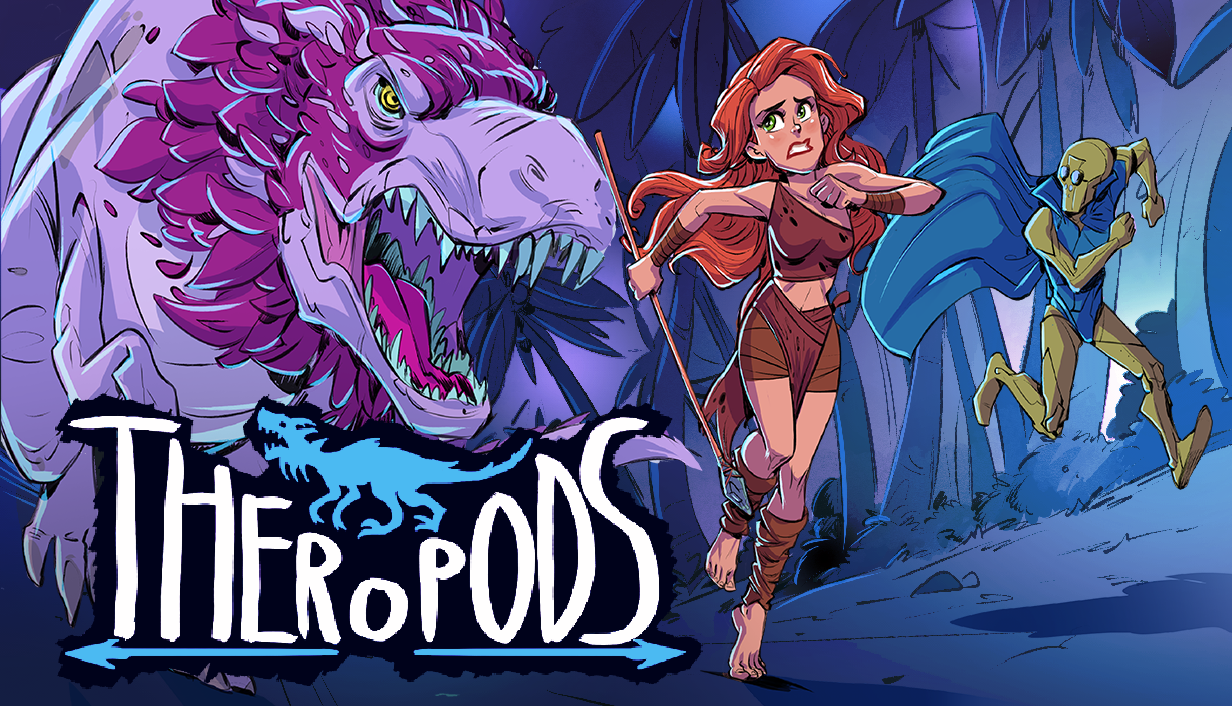
There is something genuinely admirable about a developer who looks at the point and click formula and decides to strip out one of its most fundamental pillars, and that is exactly what Theropods does by removing written dialogue entirely. Set in a prehistoric world where early humans live alongside dinosaurs, the game mixes low fantasy prehistory with the pulpy science fiction aesthetic of 1950s and 60s B-movies, a fun combination on paper. The result is a short adventure, but one that manages to tell its entire story through visuals alone, and it mostly pulls this off.
The plot follows a young huntress whose tribe gets attacked by a rival faction not long after a mysterious object crashes down nearby. That object turns out to belong to a stranded alien traveller, and the two end up teaming up despite sharing no common language whatsoever, working together to rescue her captured people, avenge her family and recover the energy source the alien needs to get home. A small droid companion tags along too, rounding out a fun little trio once it all comes together.

The most striking element is that there is no written dialogue anywhere in this game. No text boxes, no item descriptions, no lengthy explanations of what is happening on screen. Everything gets communicated through animation, facial expression, environmental cues and a series of grunts and vocalizations that sound like a prehistoric take on on garbled languages you may hear in games like the Sims, or even Banjo-Kazooie and others of the sort. Even the interface skips text entirely in favour of simple, recognizable icons.
This is a big swing for a genre that usually leans heavily on text, and it works surprisingly well. The language barrier between the two leads is not just a gimmick to justify skipping a localization budget. It is baked directly into the story and becomes central to how the relationship develops, as the two characters slowly learn to trust each other through gesture and action alone rather than conversation. Some of the best moments in Theropods come from these small interactions, particularly a handful of scenes where the animation communicates something that would have taken paragraphs of dialogue in a lesser game.
Visually, Theropods goes with detailed pixel art, and it does a surprisingly good job of making its world feel much bigger and more dangerous than the compact environments actually are. The dinosaurs are properly intimidating, and the two leads carry enough personality through animation alone that the wordless approach never feels like a gimmick. At times, Theropods is able to use just facial emotions to communicate better than any words can, though I will not give spoilers here for context.

The presentation is not perfectly consistent throughout. Some of the pixel art looks a bit smudged in places, there is occasional sprite flickering, and the handful of pre-rendered cutscenes feel oddly disconnected from the rest of the game’s traditional pixel art look. None of this is a dealbreaker, and the atmosphere remains one of the game’s biggest strengths regardless.
Credit also has to go to the sound design here, because with no dialogue to lean on, the music and sound effects are doing the majority of the emotional heavy lifting. Theropods delivers on that front, with a soundscape that sells everything from quiet moments of discovery to scenes of real loss and danger. It says a lot about the strength of the audio direction that a nearly silent game can still hit this hard emotionally.
On the gameplay side, Theropods sticks fairly close to the classic point and click formula, which suits everything else it is trying to do differently. Players explore small, dense environments, collect objects and use them to solve environmental puzzles. Later on, players gain the ability to switch between the huntress and the alien, and their different abilities open the door to some genuinely fun cooperative puzzle solving.
One addition worth highlighting is the option to highlight interactive objects. Given how much visual detail gets packed into some of these environments, this is close to essential, since important items can vanish into the background otherwise. The highlight switches between white and red depending on context, though the red version can be tricky to spot against certain backgrounds.

The puzzles themselves are a bit of a mixed bag. Because there is no text describing what anything actually is, Theropods avoids the classic adventure game trap of handing players a massive inventory full of objects with no obvious purpose. Most solutions feel intuitive enough, and the environment usually points toward what needs to be done. That said, without any kind of examination system, there are moments where an item’s purpose is genuinely unclear, leading to trial and error, particularly when the environmental hints are not doing much to help.
There are also a handful of timed sequences and puzzles that span multiple screens, along with some backtracking, since previously cleared areas can gain new interactive objects further into the story. None of this derails the experience on its own, but it does keep Theropods from feeling quite as tight and streamlined as it could have been.

At roughly two to three hours, Theropods is a very short game, and that brevity cuts both ways. On one hand, the brief runtime means its unconventional approach never wears out its welcome. On the other hand, there is just not enough room here for the puzzle design to develop into anything particularly sophisticated. A significant chunk of the runtime goes toward cinematic storytelling rather than puzzle solving, so at times Theropods feels closer to an interactive animated short than a traditional puzzle heavy adventure, and that appears to be by design rather than a shortcoming.
Even so, that is exactly what makes the game worth experiencing. Theropods is not particularly interested in reinventing point and click mechanics. What it wants to do is experiment with how a story gets told within that structure, and the decision to strip out virtually every piece of conventional language is what makes it stand out from the pack. Combine that with dinosaurs, prehistoric humans and a vintage sci-fi flavour, and the result feels genuinely different from most of what is out there right now.

Adventure game veterans looking for elaborate puzzles or a lengthy story may come away wanting more, and that is a completely fair criticism to have. But as a compact, imaginative experiment, Theropods succeeds. The visual storytelling is surprisingly effective, the atmosphere is excellent, and the relationship between its two unlikely leads gives the whole adventure real emotional weight. For anyone willing to meet it on its own terms, Theropods manages to say quite a lot without ever really saying anything at all.
Disclaimer: A review key was provided