

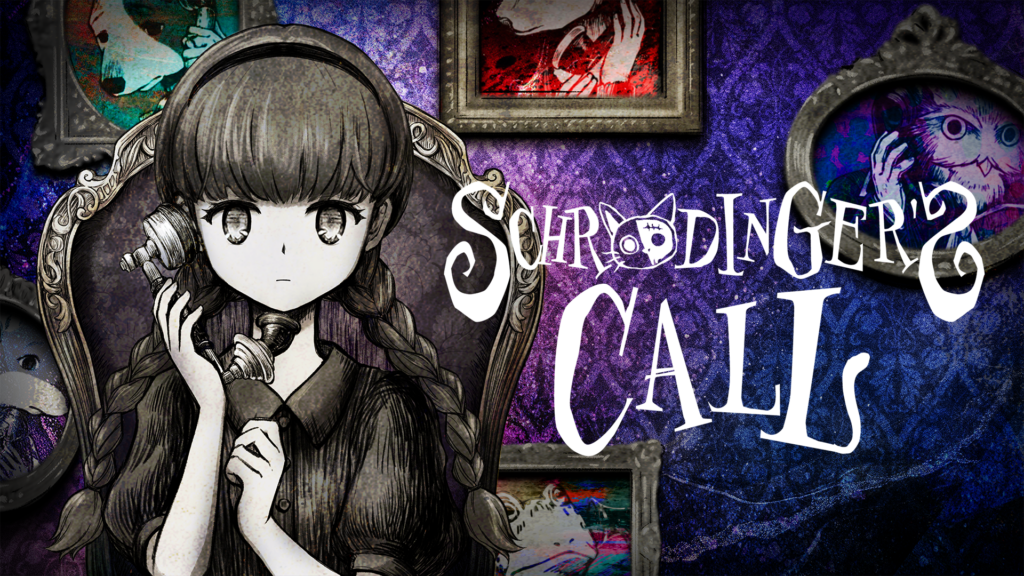
Death has become something of a recurring subject in video games lately, and it is not hard to see why, since few themes carry that kind of built-in emotional stakes. Schrödinger’s Call throws its hat into that ring, but rather than going big, it goes small, choosing hushed conversations over anything resembling a spectacle. Can a story built almost entirely around quiet dialogue actually carry the weight of something this heavy? As it turns out, yes, and rather beautifully at that.
Mary is our lead here, an unassuming young girl who discovers she has become humanity’s very last Confidant, whether she wanted the job or not. She is not alone in this, though, as Hamlet, an oddly enigmatic cat, offers cryptic scraps of guidance along the way that slowly bring the full weight of her role into focus. A Confidant typically exists to ease one soul at a time into whatever comes after death, but there is no precedent for what Mary is asked to do here. The Moon slams into Earth without so much as a warning, and in a single instant, humanity is gone, leaving her to walk an entire civilization through its last living seconds.
On paper, that is already a massive hook, yet the game finds its true heartbeat somewhere after the impact rather than in the collision itself. Everything that follows takes place across the final twenty-one nanoseconds of humanity’s collective consciousness, an almost unthinkably brief window that the game somehow manages to stretch into a slow, meditative journey through dozens of lives. Within that fraction of a second, Mary crosses paths with people from every background imaginable, helping them surface buried memories, settle old regrets, and land on some kind of peace before the light goes out for good. Woven through all of this, Mary’s own past starts to come into view too, giving the whole experience a second thread worth following closely.

Rather than dwelling on the destruction itself, the writing keeps its focus squarely on the people caught up in it. Each new encounter functions like a small window into an unfinished life, touching on quiet victories, buried heartbreak, and relationships that never got the chance to heal. Some of these moments lean toward hope, others toward genuine sorrow, and yet almost all of them work, mostly because the script never once reaches for cheap melodrama to get there. It trusts plain honesty to do the heavy lifting instead, and that trust pays off far more often than not.
The standout of the whole cast, without question, is the pairing of Lucy and her son William. Their relationship reads as a fairly ordinary case of estrangement early on, the sort of setup you may feel like you have already seen a dozen times, but Schrödinger’s Call is not content to leave it there. Layer by layer, the writing complicates things until it lands on something far messier and more human than the opening scenes suggest. Neither character comes away looking like the clear villain or the clear victim, and that refusal to pick a side is exactly what makes their resolution hit so hard. This is easily the game’s finest piece of writing, and proof that the team behind it understands family dysfunction better than most.
Do not go into this expecting choice-driven branching or any kind of investigative gameplay, because Schrödinger’s Call is a straightforward visual novel through and through. The bulk of your time is spent reading, flipping through Mary’s journal, revisiting memories, and occasionally choosing a line of dialogue. Those choices can nudge the tone of a scene here or there, but nothing you pick is going to send the plot off in a wildly different direction.

That said, the lack of branching actually benefits the game rather than holding it back. This is a story that knows precisely what it wants to say, and keeping such a tight hold on the structure lets the writers control pacing down to the smallest beat, giving quieter scenes room to breathe before the bigger emotional swings arrive. Rather than diluting player involvement, that linear backbone keeps everything anchored to the same handful of ideas, namely acceptance, forgiveness, and the slow process of letting go.
Visually, the game backs up its themes beautifully. The art direction leans hard into a dreamlike, almost surreal quality, constantly blurring the boundary between solid reality and fading recollection. Backgrounds mix melancholic scenery with more ethereal touches, building a world that feels caught somewhere between the living and whatever lies beyond it. Character portraits shift and fade with a subtlety that only adds to that unreal quality, and when emotions run especially high, the screen leans into distortion effects that sell just how fragile Mary’s surroundings have become.
The cast itself deserves a mention too. Mary is a genuinely likeable protagonist, and her warmth carries a lot of the story’s heavier stretches without ever feeling forced. The people around her hold their own as well, each bringing something distinct enough to keep every vignette from blending together. A few of the supporting characters land on the anthropomorphic side of things, which might sound like an odd fit for a story this serious, though in practice it never once undercuts the tone, since it is the writing, not the design, doing the real work here.

The soundtrack complements all of this nicely, staying quiet and a touch haunting for most of the runtime rather than fighting for attention against the dialogue. Gentler pieces underscore the more reflective scenes, while the score swells only when a moment genuinely calls for it, never once feeling like it is overselling the emotion on screen.
One of the more unexpected choices is how the game approaches voice work. Instead of full voice acting, Schrödinger’s Call opts for stylized gibberish not unlike what you would hear from characters in The Sims or Animal Crossing. It sounds like a strange fit for something this heavy on paper, yet it lands surprisingly well in execution. That unintelligible chatter puts just enough distance between the physical and the spiritual to reinforce the dreamlike tone, while still leaving room for players to fill in the emotional blanks themselves.
What stands out most is how tightly every element of Schrödinger’s Call points toward the same idea. The writing handles mortality with genuine compassion, the art builds a world suspended between life and death, and the music backs up that emotional tone without ever stealing focus from the characters carrying it. Nothing here feels bolted on just to look impressive, every single decision is in service of the same story.
Though it is built on the extinction of an entire species, this is not really a story about endings at all. It is a story about connection, and about how even the smallest moment shared with another person can leave a mark that outlasts them both. Closure, as the game frames it, rarely comes from some grand gesture, usually just an honest conversation will do, and that idea gets explored with a level of sincerity that never once feels manufactured.

Schrödinger’s Call is not interested in branching paths or player-driven freedom, and honestly, it does not need either. By committing fully to one carefully told story, it delivers a visual novel where the characters, not the mechanics, are doing all of the heavy lifting.
Overall, this is a game that knows exactly what kind of story it wants to tell and refuses to compromise on that vision from start to finish. If narrative-driven experiences built around genuine emotion are your thing, Schrödinger’s Call comes highly recommended. And if not, this may be the game to get you hooked.
Disclaimer: A review key was provided