

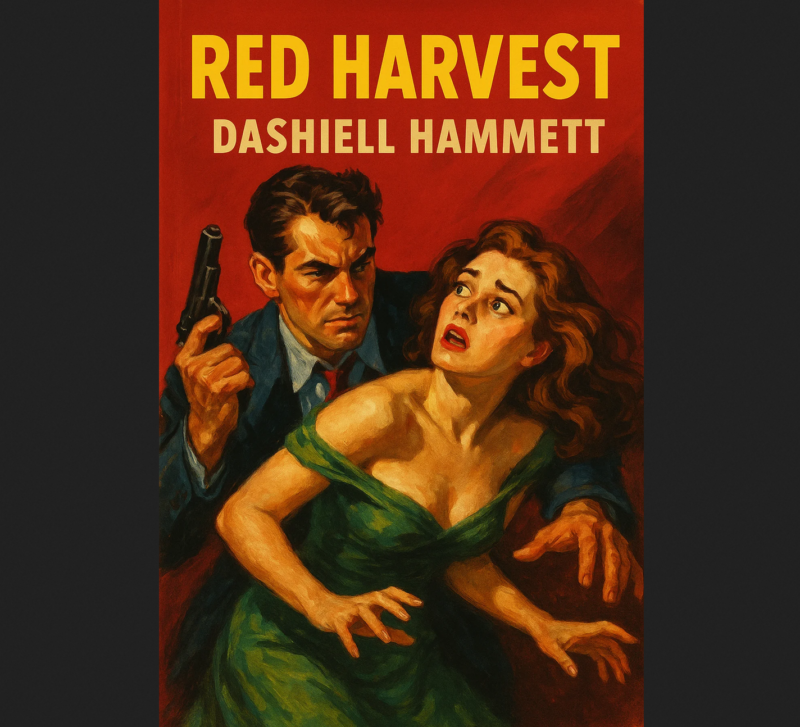
Dashiell Hammett’s Red Harvest (1929) begins with a deceptively simple observation about a town whose name has become synonymous with everything wrong with it. Personville is what appears on the map, but those who know the community have given it another name: Poisonville. It is an appropriate description for a place where criminal organizations, corrupt officials, and powerful business interests have become so thoroughly intertwined that distinguishing between legitimate authority and organized crime is practically impossible. Yet Hammett’s novel is not simply concerned with exposing corruption. It is interested in what happens when someone attempts to eliminate it using methods that are hardly distinguishable from those employed by the people responsible for it.
The novel follows the Continental Op, Hammett’s unnamed private investigator, who travels to Personville after being summoned by newspaper publisher Donald Willsson. Unfortunately, the Op never gets the chance to meet his prospective employer because Willsson is murdered before they can talk. His death brings the Op into contact with Willsson’s father, Elihu, a wealthy industrialist who wants the town rid of the criminal organizations that have effectively taken control of it. However, Elihu’s own involvement in creating the situation makes his request considerably more complicated than it initially appears. The gangs did not simply arrive and seize control of Personville. They were brought in to help break a labour strike, and once their usefulness had expired, they proved considerably more difficult to remove.
The novel’s backstory has real-world roots. Personville draws heavily on the industrial conflicts and labour unrest of Butte, Montana, where Hammett worked as a Pinkerton operative in 1920. The town’s history of labour disputes, corporate influence, and anti-union repression provides an important historical backdrop for the novel, although its fictional events should not be treated as a direct retelling of any single incident. These circumstances are essential to understanding what makes Red Harvest such an effective crime novel. Personville’s corruption is not an unfortunate consequence of a few criminals finding opportunities to exploit. It is the product of powerful individuals who were willing to use criminal violence when it suited their interests, only to discover that the people they employed had developed ambitions of their own. The town’s respectable leadership is therefore just as responsible for its deterioration as the gangsters who now dominate its streets. Hammett does not offer an especially comforting distinction between the people who supposedly maintain order and those who openly disregard it.
The Continental Op initially approaches the situation as a professional assignment, but his investigation quickly becomes something much more destructive. Rather than attempting to dismantle the criminal organizations individually through conventional detective work, he recognizes that their competing interests can be turned against one another. By manipulating information, exploiting rivalries, and encouraging distrust between the various factions, he sets in motion a conflict that threatens to consume the entire town. His strategy shows little concern for minimizing casualties. If the criminal organizations are willing to destroy one another, he is more than happy to provide the necessary encouragement.
This is where Red Harvest begins to distinguish itself from more traditional detective fiction. The Continental Op is not simply following clues, identifying suspects, and presenting evidence that allows justice to take its course. He is actively engineering the circumstances surrounding the crimes, manipulating people into making decisions that further his objectives. His investigation becomes an elaborate exercise in destabilization, with the detective effectively turning the criminal underworld into a weapon against itself.
What makes this strategy unsettling is how difficult the Op’s methods become to defend. Although he maintains that his actions are necessary to accomplish the job, the growing number of deaths suggests that the distinction between fighting criminals and participating in their violence is becoming increasingly meaningless. The Op notices it himself. Near the midpoint, he tells Dinah Brand that the town is getting to him and that if he doesn’t leave soon he’ll be “going blood-simple like the natives,” a phrase that would later provide the title for the Coen brothers’ Blood Simple. Later, he observes that playing with murder gets a person one of two ways: it makes you sick, or you get to like it. Noonan succumbs to the first outcome, but the Op’s own admission that he has “got the fever” leaves open a more troubling possibility: that he is becoming accustomed to the violence, perhaps even finding something unsettlingly satisfying about his ability to manipulate it. It is an unusually revealing admission for a protagonist who otherwise approaches dangerous situations with considerable professional detachment.
The novel’s treatment of Dinah Brand adds another dimension to this moral uncertainty. A woman with connections to several of Personville’s criminal figures, Brand becomes an important source of information for the Op, although their relationship is never quite as straightforward as a conventional detective and informant arrangement. Their interactions provide some of the novel’s most memorable exchanges, with Brand frequently demonstrating that she understands the dangerous environment around her just as well as the men attempting to control it. She is neither an innocent bystander nor simply an obstacle for the protagonist to overcome. Brand’s position also complicates the novel’s treatment of the femme fatale. Although she possesses many of the characteristics associated with the archetype, she is not simply a manipulative woman leading an otherwise innocent detective astray. The Op is already willing to deceive, manipulate, and provoke violence before their relationship develops. In many respects, they are both participants in the same dangerous environment, even if they approach it from different positions.
Her murder becomes one of the novel’s most disturbing developments. After a night of drinking with Brand and a dose of laudanum, the Op passes out and experiences a series of disorienting dreams before awakening to find her dead, an ice pick buried in her chest and his hand on it. He cannot immediately account for what happened, and the possibility that he might have committed the murder himself introduces an uncomfortable degree of uncertainty into the investigation. The mystery eventually leads back to Reno Starkey, whose confession establishes that the Op was not Brand’s killer, although the experience leaves him with little reason to feel entirely removed from the violence surrounding him. More importantly, the sequence challenges the reader’s confidence in the protagonist. The detective who has spent the novel manipulating murderers and orchestrating violence is suddenly confronted with the possibility that he has become indistinguishable from them.
Hammett’s prose is particularly effective in supporting this atmosphere. His writing is economical, his dialogue frequently sharp, and his descriptions rarely linger longer than necessary. Characters reveal themselves through their behaviour, their conversations, and the ways they react when confronted with danger. There is little interest in romanticizing the criminal underworld or making violence seem particularly glamorous. Instead, Personville feels like a place where everyone has something to hide, everyone is looking for an advantage, and practically any disagreement can become an excuse for another murder.
The novel’s serialized origins also contribute to its distinctive structure. Originally published in four instalments of Black Mask magazine between November 1927 and February 1928, Red Harvest retains something of the momentum and episodic construction associated with pulp fiction. Individual investigations and confrontations feed into a much larger conflict, creating a story that frequently seems to move from one crisis to another without allowing its protagonist much opportunity to catch his breath. Rather than weakening the experience, this accumulation of violence reinforces the impression that Personville has become an environment in which disorder is practically impossible to contain. Hammett subsequently revised the serialized material for book publication, incorporating changes suggested during the editorial process before Alfred A. Knopf released the novel in February 1929.
Despite its hardboiled foundations, Red Harvest also has much in common with the Western tradition. Although it is generally remembered as a foundational hardboiled detective novel, its central premise resembles the familiar story of an outsider entering a lawless community and attempting to restore order. The difference is that the Continental Op is not a conventional Western hero arriving with a clearly defined moral code and a willingness to uphold the law. His methods involve deception, manipulation, and deliberately provoking violence between people who are already accustomed to killing one another. The result is a curious combination of detective fiction, gangster storytelling, and the kind of frontier conflict that would become familiar in Western cinema.
Hammett’s experience as a Pinkerton operative also helped distinguish his fiction from the more genteel mysteries that preceded it. His understanding of professional investigation and the criminal world gave his detective stories an unromantic realism that went beyond simply presenting a more convincing kind of detective. Red Harvest takes that realism further by questioning whether restoring order is even possible when the institutions responsible for maintaining it have already been compromised. This approach would also find an important critical champion in Raymond Chandler, whose 1944 essay The Simple Art of Murder famously examined Hammett’s contribution to the development of modern detective fiction and the movement away from more artificial mystery storytelling.
Its influence can also be seen beyond literature, though the lines of descent are debated. Critics such as Manny Farber and Kurosawa scholar David Desser have argued that Akira Kurosawa’s Yojimbo (1961) was influenced by Red Harvest, particularly its premise of an outsider manipulating rival criminal factions into destroying one another. Kurosawa himself pointed instead to Hammett’s The Glass Key, and another Kurosawa authority, Donald Richie, considered the similarities coincidental. Sergio Leone’s A Fistful of Dollars (1964) is an unauthorized remake of Yojimbo, one that drew a lawsuit from Kurosawa’s side, so any Hammett connection there runs through Kurosawa’s film. Whatever the exact lineage, the underlying concept demonstrates how effectively Hammett understood the possibilities of placing an unconventional protagonist in the middle of competing criminal interests.
What makes Red Harvest particularly remarkable, however, is that its conclusion does not offer the reassuring sense of justice that readers might expect from a detective story. By the end, Noonan and the gang leaders are all dead, but the Op gets there by blackmailing his own client. Having obtained love letters Elihu once wrote to Dinah Brand, he forces the old man to call in the governor, who sends in the National Guard, declares martial law, and suspends the entire police force. Elihu gets his town back, just not in the way he anticipated. The detective has helped eliminate a collection of immediate threats, but the circumstances that allowed them to flourish have not necessarily disappeared. They have simply been overridden by force, and the deeper problem is considerably more difficult to solve.
That is ultimately what gives Red Harvest its enduring place in crime fiction and makes it such a compelling addition to Noirvember. Hammett presents a world where corruption is not confined to shadowy criminals operating outside respectable society, but is embedded within the very institutions that claim to protect it. His detective may be capable of manipulating that environment, but he cannot entirely escape its influence. By the time the violence subsides, the question is no longer simply whether the Continental Op has succeeded in cleaning up Poisonville. It is whether anyone can emerge from such an undertaking without becoming a little more like the people they set out to destroy.
Red Harvest remains a fascinating examination of the hardboiled detective, not because it presents an idealized figure capable of restoring justice through intelligence and determination, but because it understands how easily that ideal can become corrupted. Personville may be rid of its gangs, but its poisonous foundations remain. In Hammett’s world, defeating the criminals is one thing. Finding a way to escape the kind of society that created them is another entirely.
Works referenced:
-
Jack Crowley, Red Harvest and Dashiell Hammett’s Butte.
-
J. A. Zumoff, Politics and the 1920s Writings of Dashiell Hammett.
-
Dashiell Hammett, Red Harvest (1929).
-
Art Taylor, The Curious Case of the Novel in Stories.
-
Martin Holtz, The ‘Corkscrew’ Journey of an Adaptation.
-
Catherine Ross Nickerson (ed.), The Cambridge Companion to American Crime Fiction.