

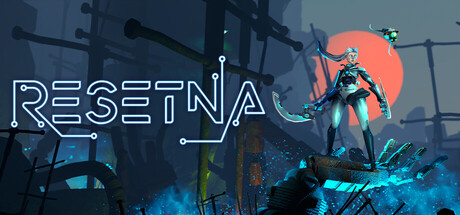
The narrative of ReSetna is a somber, high concept sci-fi tale that respects the player’s intelligence by favoring environmental storytelling over long winded and unavoidable cutscenes. You are a “warrior forged” unit awakened by the APEX AI in the ruined district of Polis, tasked with traversing seven distinct biomes to save the “last human remnants”. These last human remnants, as they are called, now exist solely as consciousness trapped in circuitry.
The plot unfolds primarily through cryptic codex entries and the eerie visual cues of the world, such as the toxic, Entropium scarred wasteland of Acidia or the reality warping Darkness Zone. While the primary objective of destroying the rogue Signal is straightforward, the deeper lore involving the downfall of humanity and the ethical dilemmas of digital immortality provides a compelling backdrop. However, it is a “read to lead” experience; those who ignore the scattered data logs may find the broader strokes of the plot and the secondary characters a bit thin, as the game prioritizes mystery over direct exposition.

In terms of mechanics, ReSetna is a “Robosoulsvania” that rewards precision and tactical flexibility. Combat is built around three distinct weapons that you can hot swap mid combo, allowing for a mix of close quarters aggression and ranged support from your drone companion, IXA. The standout feature is undoubtedly the Tetris Chip System, where you slot geometric upgrade chips into a limited grid.
This adds a layer of spatial puzzle solving to your character build. While this forces you to choose between raw power and utility, it feels right at home in this harsh futuristic world. Traversal feels exceptionally fluid especially once you unlock the air dash and the “Self-Echo” ability, which allows you to record your movements and rewind time to create a clone for platforming puzzles. While the difficulty can spike and some mid game bosses are notorious “HP sponges” that require perfect parry timing, the lack of a “corpse run” (you don’t lose materials upon death) encourages experimentation rather than frustration.

Visually, the game is a masterclass in sci-fi art direction, utilizing 3D assets in a side-scrolling plane to create immense depth. On the Xbox Series X, ReSetna runs at a razor sharp resolution with a target of 60 FPS, which is critical for the game’s late game “bullet-hell” boss phases. The aesthetic is “rusted futurism” with glowing glyphs, flickering neon, and organic decay that all coexist in a way that feels tangible. The lighting engine is particularly impressive, with the neon greens of Acidia reflecting off ReSetna’s metallic frame with high-fidelity clarity. The visual feedback for time-manipulation of after-images and shimmering “temporal bridges” is handled with a polish that makes the complex mechanics easy to read during high speed action.

The soundscape of ReSetna, composed by Nikola Jeremić, is arguably its most immersive element. The soundtrack is a “dirty” fusion of retro synthwave and ambient industrial noise; achieved by processing real instruments like wood and metal to sound distorted and mechanical. This “decayed” audio perfectly mirrors the state of the world; the music transitions from melancholic, hollow drones during exploration to aggressive, high BPM synth during boss encounters.
The clatter of ReSetna’s footsteps changes based on the surface, and the hum of IXA’s hacking beams provides satisfying acoustic feedback. This attention to audio fidelity results in a balanced, atmospheric experience that breathes life into the cold, silicon world.

ReSetna is a confident, atmospheric entry that offers roughly 15 to 20 hours of high quality Metroidvania action. It doesn’t radically reinvent the genre, but it executes the “explore,upgrade and fight” loop with a level of polish and artistic vision that is rare for a debut indie title. The combination of its unique Tetris inspired progression, fluid movement, and hauntingly beautiful world makes it a must play for fans of sci-fi and challenging platformers alike.
While the story might be a bit too “hands off” for some and certain boss battles can feel like tests of endurance, the overall package is a stellar addition to any gamers digital library. It is a game that rewards curiosity and rewards it well, proving that even in a world of circuits and data, there is plenty of soul to be found.
Disclaimer: A review key was provided

In addition to writing articles, Ryan Byers also creates content for his YouTube channel called "Obscure Games and Consoles", collects video games, and dabbles in video game development.